H&M sees growth in online sales lifting earnings this year

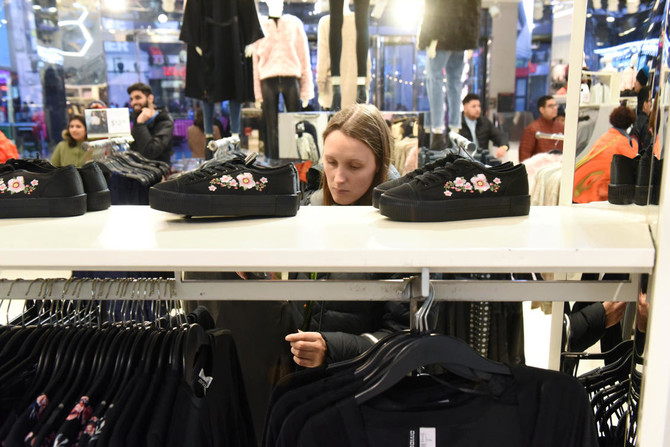
A woman shops at an H&M store in New York City. The retailer is seeing a pickup in online sales. (Reuters)
Updated 14 February 2018
Follow

H&M sees growth in online sales lifting earnings this year

STOCKHOLM: Sweden's H&M expects earnings to grow this year as rising online sales offset weakness in its physical stores, it said on Wednesday at its first ever day of investor briefings held to assuage concerns over future strategy.
Shares in the world's second-biggest fashion retailer reacted positively and were up 2.5 percent at 145.22 Swedish crowns by 0727 GMT, compared with a 0.7 percent firmer European retail sector.
The company, a rival globally to Zara-owner Inditex , forecast growth of at least 25 percent in online sales and in its new brands such as COS and H&M Home in 2018, but said sales from its existing stores would continue to fall, noting high stock levels.
H&M has in recent years seen sales growth stall as it struggles to keep up with shoppers moving online, and fend off competition in its core budget segment. Inditex has consistently outperformed its Swedish rival in that time, helped by having a faster and more flexible supply chain and by moving faster into e-commerce.
In a statement ahead of its capital markets day for analysts and investors, H&M said it expected a "somewhat better" result for the 2017/18 financial year.
Analyst John Hernander at Nordea, a top-ten H&M shareholder, said: "The market expects lower earnings for 2018, so if H&M instead delivers on its target of a somewhat higher profit and turns the negative estimate revision trend, the stock will also turn."
Shares in H&M, which is controlled by the Persson family, have slid for three straight years, shedding more than half their value from a record high in March 2015 amid mounting scepticism the company has a viable turnaround plan.
H&M said it expects online sales to reach 75 billion crowns ($9.4 billion) in 2022, up from 29 billion in 2016/17, and new brands to achieve sales of 50 billion in 2022, up from 17 billion in 2016/17.
"Overall, this is expected to lead to good increases in profit," CEO Karl-Johan Persson said.
The group said its online channel accounted for 12.5 percent of total sales in 2016/17, but 22 percent of operating profit.
H&M, which has said it will close some stores in mature markets in regions such as Europe, said it expected newly opened stores to increase sales for the group by between 1 and 3 percent in the 2019 to 2022 period.
It also held out the prospect of additional growth from two "completely new business models" it is working on, without elaborating.
Earlier this week the retailer dropped plans to ask shareholders to reinvest their dividend payout in new H&M shares, saying this would have been too difficult to carry out.
The original proposal, supported by the Persson family, took markets by surprise and played a part in sending the battered stock down to its lowest level since 2008 when announced late last month.


Saudi Arabia’s venture scene goes global 

Updated 04 January 2026
Follow

Saudi Arabia’s venture scene goes global 

  • 2026 to see more exits, more AI, and a bigger push to tell Saudi’s story abroad  

RIYADH: Saudi Arabia’s business landscape is set to see a “record year of liquidity events” in 2026,  Philip Bahoshy, CEO of venture data platform MAGNiTT, has told Arab News.

Setting out his expectations for the upcoming 12 months, Bahoshy said he expects a shift from the domination by funding momentum seen in 2025 to one defined by exits.
The CEO thinks Saudi Arabia is “likely to see one, if not two, IPOs happening within the Kingdom,” and alongside public listings he forecast “a record year of merger and acquisition transactions,” positioning M&A as another major route to liquidity for founders 
and investors. 
Being cautious about using hype-driven labels like unicorns, Bahoshy still expects that 2026 will see the emergence of multiple billion-dollar companies. 
All this comes after a year in which Saudi Arabia’s venture capital market increasingly attracted international investors alongside a growing base of local institutional capital, with marquee events helping pull global players into the Kingdom and the wider Gulf Cooperation Council region. 

Maturity, focus, appeal 
Bahoshy summed up Saudi Arabia’s venture capital market in 2025 in three words — “attractiveness, focus and maturity.” 
In his view, the ecosystem is “maturing” after “about five years or six years now of investment,” with capital increasingly reaching “every stage of the funnel.” 
Bahoshy said he has long argued the market needs investment “across each stage, early stage, medium stage, late stage,” and he framed 2025 as a year when that breadth became more visible. 
He contrasted the current cycle with recent years, noting that “two years back, it was mega deals,” while “last year we saw the underlying ecosystem.” 
In 2025, he said, the market showed “a balance of early stage, middle stage and late stage investment,” which he described as “a positive sign of a continually evolving ecosystem.” 
Bahoshy also pointed to “focus by the government on problem-solution” as another marker of maturity. 
On the international front, he said global players are arriving “not just because it makes sense for political reasons,” but because of “the companies and the scale that they’ve achieved.” 

Heading for records 
Bahoshy said Saudi Arabia’s venture market closed 2025 with strong momentum, with leading indicators suggesting an unusually active finish to the year. 
His remarks point to a market where deal flow remained steady through the back half of the year rather than tapering off, supporting a narrative of sustained fundraising appetite among investors and continued capital formation among startups.  
Balancing the funnel 
Bahoshy said the spread of activity across mega rounds, later-stage deals, and earlier funding in 2025 was not accidental, but the result of a deliberate effort to “make sure that each step of the stage, the funding stage, has been taken care of.” 
In his account, government-backed infrastructure has been built to support the full pipeline, “whether it’s through incubators and accelerators at early stage … accelerator programs that are both private and public,” and “seed funds that continue to get capital from some of the fund to fund structures to support at the seed and series A stages.” 

A bigger push to tell Saudi’s story abroad
Beyond deal outcomes, Bahoshy framed 2026 as a year to refine Saudi Arabia’s investor strategy. 
He said “a lot of work has been done to bring people to the Kingdom,” and described that as “a credit to the Kingdom.” 
In his view, the next phase is expanding outbound engagement — “the type of delegation trips that they do” — citing recent visits to London, Silicon Valley, Korea, and Hong Kong. 
He argued the Kingdom has already achieved “the 70 percent, 80 percent attractiveness of bringing people to the Kingdom,” and now needs to “share the story outwards.”
He also expects artificial intelligence to take a much larger share of venture deployment.
“I anticipate that AI will contribute close to 20 to 30 percent or 25 percent plus of all venture capital deployed in the Kingdom,” Bahoshy said.