

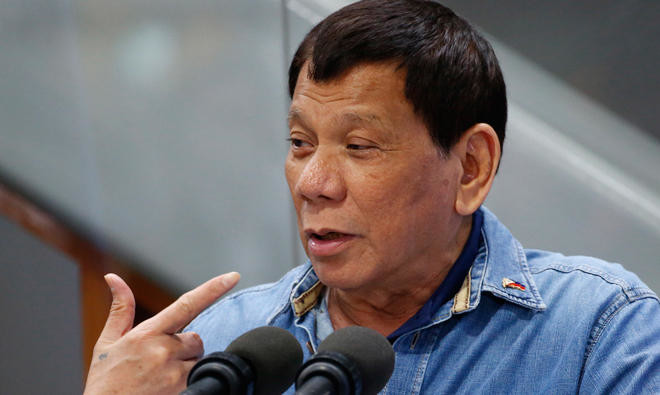
Duterte meets second batch of repatriated Filipino workers from Kuwait

Philippine President Rodrigo Duterte gestures while addressing Filipino Overseas Workers who were repatriated from Kuwait, on Feb. 13, 2018 at the Ninoy Aquino International Airport in suburban Pasay city southeast of Manila, Philippines. (AP)
Updated 13 February 2018
Follow

Duterte meets second batch of repatriated Filipino workers from Kuwait

MANILA: Philippine President Rodrigo Roa Duterte personally welcomed 116 overseas Filipino workers (OFWs) who have been repatriated from Kuwait.

In his speech at Ninoy Aquino International Airport, Duterte told his audience not to lose hope and that his administration would assist them and provide them with employment opportunities.

“We are here to see to it that every Filipino is treated decently,” he said.

On Monday, the Philippines banned its citizens from traveling to work in Kuwait and began to repatriate the thousands of Filipinos already employed there. The first batch of more than 300 repatriated OFWs arrived in Manila on Monday.

The ban was sparked by Duterte’s anger over the treatment of Joanna Demafelis, a domestic worker whose body was found last week inside a freezer in an apartment in Kuwait that had been abandoned by her Lebanese employer in 2016.

Duterte said the government is willing to give land to those interested in farming it, adding that the Department of Labor and Employment (DOLE) also runs a livelihood program for returning OFWs.

The president said he could assure Filipino workers that the government has the necessary resources to look after them on their return home, and underscored that the decision and the urgency with which it was implemented were for the protection of OFWs.

Duterte also said the government would examine other markets for OFWs — citing China and Japan as examples of markets that are opening up to Filipino workers — but that his administration is already increasing efforts to attract foreign business to the Philippines in a bid to create more jobs locally.

UK police to arrest those chanting ‘globalize the intifada’

Updated 8 sec ago
Follow

UK police to arrest those chanting ‘globalize the intifada’

  • Pro-Palestinian groups say the move will infringe on the right to protest and misunderstands the meaning of the word
  • UK police say the context surrounding the chants has changed after the Bondi Beach attack
LONDON: People publicly chanting pro-Palestinian calls to “globalize the intifada” will be arrested, UK police warned Wednesday, saying the “context had changed” in the wake of Australia’s Bondi Beach attack.
The announcement by the police forces of London and the northwest English city of Manchester swiftly prompted accusations of political repression by some campaigners.
The move follows father-and-son gunmen killing 15 people Sunday at a Hanukkah festival on the Sydney beach and an October attack on a Manchester synagogue on Yom Kippur, the holiest day of the Jewish calendar.
“We know communities are concerned about placards and chants such as ‘globalize the intifada’,” the UK capital’s Metropolitan Police and Greater Manchester Police said in a joint statement vowing to “be more assertive.”
“Violent acts have taken place, the context has changed — words have meaning and consequence. We will act decisively and make arrests.”
Jewish groups welcomed the announcement, with the UK’s Chief Rabbi Ephraim Mirvis calling it “an important step toward challenging the hateful rhetoric we have seen on our streets, which has inspired acts of violence and terror.”
But Ben Jamal, from the Palestine Solidarity Campaign, said in a statement that it infringes on the right to protest.
“The statement by the Met and GMP marks another low in the political repression of protest for Palestinian rights,” he said, ahead of a planned central London pro-Palestinian protest Wednesday evening.
He criticized the lack of consultation over the move, adding “the Arabic word intifada means shaking off or uprising against injustice.”

‘Sickening’

“It came to prominence during the first intifada which was overwhelmingly marked by peaceful protest that was brutally repressed by the Israeli state,” Jamal said.
The intifada refers to Palestinian uprisings against Israel. The first raged from 1987 to 1993, while the second flared between 2000 and 2005.
UK police have already stepped up security around the country’s synagogues, Jewish schools and community hubs in the wake of this year’s violent incidents.
Israeli Foreign Minister Gideon Saar urged Australia to act against a “surge” of antisemitism after Sunday’s atrocity, echoing similar previous demands aimed at Britain.
In a social media post, Saar branded slogans heard at pro-Palestinian protests such as “Globalize the Intifada” “Death to the IDF,” the Israeli military, as antisemitic and violent incitement.
UK Prime Minister Keir Starmer, whose wife is Jewish, denounced the weekend gun rampage in Australia as “sickening,” saying it was “an antisemitic terrorist attack against Jewish families.”
Chief prosecutor Lionel Idan said Britain’s Crown Prosecution Service (CPS) was “already working closely with police and communities to identify, charge and prosecute antisemitic hate crimes.”
“We will always look at ways we can do more,” he added.
Hate crime referrals and completed prosecutions rose by 17 percent to 15,561 in the year to June 2025, according to the CPS.