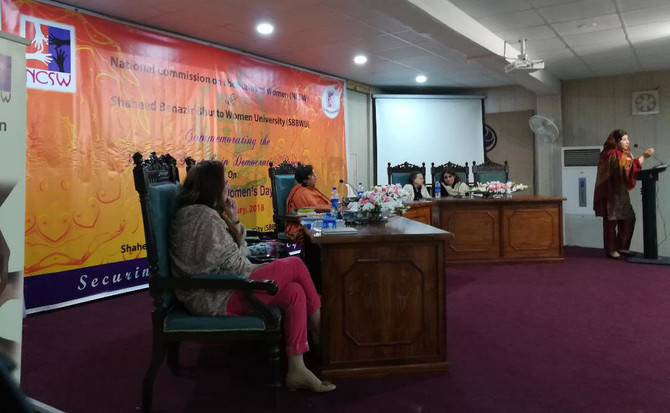
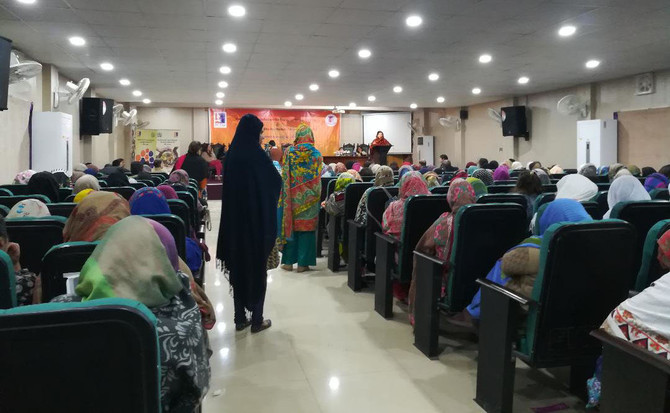
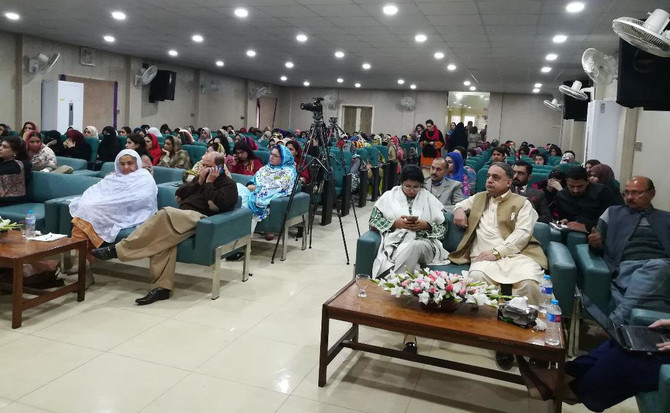
PESHAWAR: Speakers at a seminar on “Women’s Role in Democracy” in Peshawar said on Monday that education and hard work can produce good female leaders, although it requires a great deal of effort and time for them to emerge in a male-dominated society.
The seminar was jointly organized by the National Commission on the Status of Women (NCSW) and Shaheed Benazir Bhutto Women University (SBBWU) in connection with Tuesday’s National Women’s Day.
Talking to Arab News, Neelum Toru, chairperson of NCSW’s Khyber Pakhtunkhwa (KP) chapter, explained that while International Women’s Day is observed on March 8 each year, Pakistan’s National Women’s Day is observed on Feb. 12 because on that day in 1983, the Punjab Women Lawyers Association staged a rally in Lahore against the late Gen. Ziaul Haq’s Law of Evidence — which stated that, in certain civil matters, a woman’s testimony was worth just half that of a man’s.
“The protesters were beaten, tear-gassed and arrested,” Toru said.
The speakers at the seminar included Toru; Anoosh Khan, chairperson of the Center for Gender Studies at the University of Peshawar; Gulalai, programs director of NGO Khwendo Kor; Zubaida Khatoon, human rights activist; Samina Afridi, professor at Peshawar University; Mossarat Qadeem, CEO of Paiman Trust; Maryam Bibi, CEO of Khwendo Kor; and Dr. Huma Qureshi of NCSW.
The speakers lauded prominent Pakistani women who have excelled in their respective fields and presented them as role models for young women. They urged female university students to register to vote and to take informed decisions during the next election, later this year.
The participants also paid tribute to the recently deceased human rights activist Asma Jahangir and her struggle for women’s rights in Pakistan.
Dr. Razia Sultana, vice-chancellor of SBBWU, said in her opening address that awareness of the need to educate girls and allow young women to join the workforce is increasing.
“One should not give up in the face of challenges and threats,” she said. “Challenges can also be opportunities, and threats can make one strong.”
Speaking to Arab News after the event, Dr. Sultana said: “Women are largely restricted to the role of mother in our society and such stereotypes are the main hindrances faced by women here. However, change is taking place and women are also assuming leadership roles now.”
She said universities play an important role in creating an educated culture that can produce good female leaders, adding that she hopes women will be given more opportunities to take up roles in politics and other areas of power.
Asked if modern society can produce leaders like Benazir Bhutto and Asma Jehangir, she said: “BB was a product of her era. And in this modern era, the education rate of women is increasing, which means women have a more conducive environment to play their role.”
The seminar was intended to raise awareness about women’s rights, and to pay tribute to women who were tortured and arrested during Gen. Zia’s era, Toru told Arab News.
“I think a woman could also become a political leader like Benazir Bhutto today, with hard work and dedication,” she said, acknowledging Bhutto’s political struggle for democracy.
Discussing female leadership at the seminar, Zakia Shah, a student of Law at SBBWU, said Asma Jehangir was her role model among female leaders in Pakistan.
“Women leaders are not promoted in Pakistan,” she added.
Syeda Maleeha Zainab Hashmi, an English student, lauded the contribution of her university’s vice-chancellor and other women who advocated the right to education. She said Bhutto was a role model for her and an exemplary Pakistani leader, adding that persistence and hard work were the only way forward for women.


![]()
![]()
![]()
![]()
Rights activists urge greater role for women on Pakistan’s National Women’s Day

Rights activists urge greater role for women on Pakistan’s National Women’s Day
Latest updates



Recommended


© 2026 SAUDI RESEARCH & PUBLISHING COMPANY, All Rights Reserved And subject to Terms of Use Agreement.