NEW YORK: With Gigi Hadid as his opener and her royally dressed sister, Bella, at the end, Prabal Gurung celebrated the strength, grace and resilience of women in a collection full of vibrant purples, reds and blues, inspired in part by the women-led Mosuo tribe of China.
Gurung, raised by a single mother in Nepal, said in a backstage interview he’s had matriarchies on his mind for a collection over the last four or five years, deciding to go ahead with this one now amid the recent movements bringing women together to fight back against sexual misconduct and oppression around the world.
His bright pinks, some in lush cashmere and wool knits hand done in Nepal, and his sari and sarong-inspired draping, he said, were references to the Gulabi Gang of women activists in northern India. They “adorn themselves in pink saris symbolic of their self-proclaimed power and fearlessness,” Gurung said, as they come to the defense of women, vigilante style.
There were other elements, feather and sequin detailing, the use of velvet and pearls, that generally symbolized ceremonial wardrobes.
Bella Hadid took a slow walk around the bright sand art Gurung displayed on the floor wearing a strapless, royal-red cape gown with a gold cord belt. Gigi Hadid opened the show in a porcelain-white cashmere turtleneck with fox trim on the sleeves, an orchid-colored skirt and a draped sarong overlay that wound around her neck and fell below the waist.
He also embraced the practical, in shearling and quilted puffer jackets inspired by the need to trek.
Gurung said he grew up in a culture where color is celebrated in the clothes. After seeing the wear-black protest at the Golden Globes, he said he wanted to show women “in their full feminine glory.” Back home, he said, “color and texture was kind of unnerving for men.”
Usually, Victoria Beckham takes a quick little bow and a wave at the end of her runway show. On Sunday, she changed it up a little, rushing over to the front row to embrace husband David Beckham and their three younger children, Romeo, Cruz and Harper.
Beckham may have been emotional because she was beginning what she called her label’s 10th anniversary year. In her show notes, the British designer noted that she wanted Sunday’s show to be “a quiet celebration of where we have come since those very first appointments here in New York.” In September, she plans to show at London Fashion Week to fete her anniversary.
Beckham was also showing in a new space on the Upper East Side of Manhattan — the James A. Burden House, an Italian Renaissance-style mansion completed in 1905. Guests climbed a grand spiral staircase to arrive at the show.
It was a collection heavy on workplace looks, with belted coats and jackets with defined shoulders and drawn-in waists. Her favorite item, Beckham said afterward, was a striking belted leopard-print coat, made from a chenille jacquard fabric that was based on Venetian upholstery. She also featured clingy leggings, ankle cuffs in leather, and a print on silk that resembled fur — “my take on fake fur,” she explained afterward.
At DVF, the label’s creator, Diane von Furstenberg, introduced a new (and returning) designer — Nathan Jenden — and a new muse for the brand: her 18-year-old granddaughter, Talita von Furstenberg, who modeled an outfit from the new collection and pronounced it “really cool” to embark on her new role.
Jenden, who returned to the label in January after working there for a decade until 2011, said he’d chosen the young von Furstenberg as his muse after watching her grow up. “I’ve known her since she was 2,” he noted.
The new collection included a lot of riffs on the iconic DVF wrap dress — some obvious and some more subtle.
“To me it was obvious what we needed to do,” Jenden said in an interview. “Richness, layer on layer of fabrics. There’s a lot of wrap. If you look carefully, everything is constructed so it feels like a little light jersey dress.”
Von Furstenberg, 71, made a pointed reference to the #MeToo movement in remarks to the crowd at her downtown showroom.
“I just wanted to say that with everything that’s happening with women right now ... I personally am more committed than ever to the empowerment of women,” she said. “And this is really important and the DVF woman through the generations has always been about being a woman in charge — in charge of her life, in charge of who she sleeps with, in charge of what she does. She’s in the driver’s seat.”
Jenden addressed the crowd as well, saying his designs were “all about being brave, about being unapologetically a woman, about celebrating femininity ... this is an homage to Diane, it’s an homage to Talita, it’s an homage to all women.”


![]()
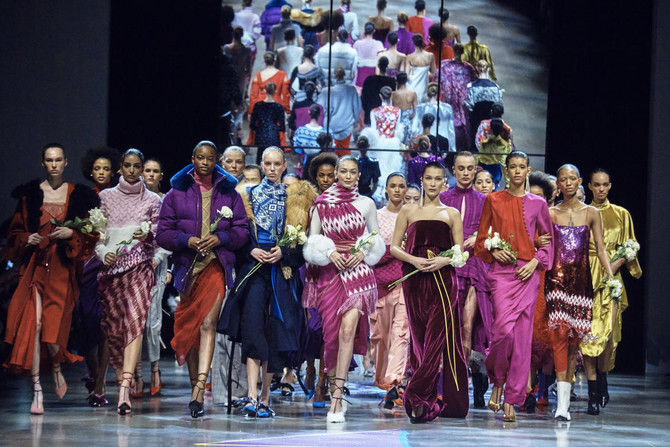
Gigi and Bella Hadid celebrate women at Prabal Gurung NYFW show
Gigi and Bella Hadid celebrate women at Prabal Gurung NYFW show


Latest updates


© 2026 SAUDI RESEARCH & PUBLISHING COMPANY, All Rights Reserved And subject to Terms of Use Agreement.