Tonga braces as powerful Cyclone Gita bears down

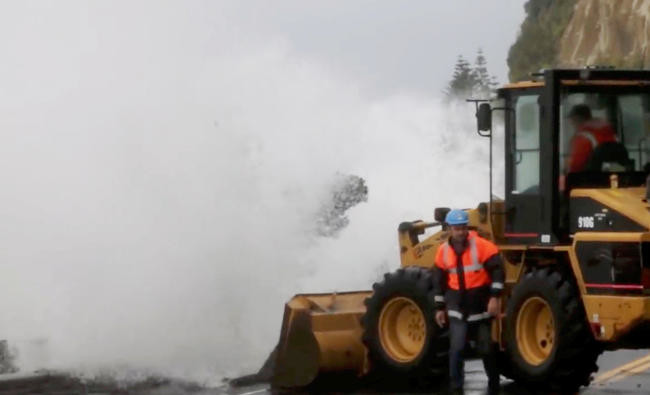
A wave hits heavy machinery as emergency personnel work on a flooded road in Nelson, after the downgraded Tropical Cyclone Fehi brought heavy rain in New Zealand, in this still image taken from a February 1, 2018 social media video. (REUTERS)
Updated 12 February 2018
Follow

Tonga braces as powerful Cyclone Gita bears down

WELLINGTON/SYDNEY: The Pacific nation of Tonga braced for destructive winds and potential flash flooding from Tropical Cyclone Gita on Monday after the powerful storm pummelled Samoa over the weekend.
The Category 4 storm was moving south across the Pacific and was expected to hit Tonga’s capital, Nuku’alofa, by 7 p.m. on Monday (0600 GMT), prompting the island nation to declare a state of emergency.
“Very destructive hurricane force winds are expected from this evening,” the Tongan Metservice said in a hurricane warning.
The Metservice said it expects Cyclone Gita to peak at a Category 4 event, but other regional meteorological agencies said the storm would reach Category 5, the most destructive wind-speed ranking.
Aid agencies warned of potential damage from heavy rain and winds, which the Metservice said could reach up to to 185 km per hour (115 mph).
Schools and workplaces in Tonga, which has a population of over just over 100,000, were closed ahead of the storm.
The Red Cross said residents were racing to identify strong buildings to be used for evacuations and to clean up debris such as loose wood or metal that could turn into dangerous missiles in powerful winds.
“That’s an incredibly strong cyclone ... people are getting prepared ... it really does save lives,” said Hanna Butler, Red Cross Pacific spokeswoman based in Fiji.
The Metservice also warned of huge coastal swells and flooding of low-lying areas.
Cyclone Gita pummelled Samoa and American Samoa, about 900 km (560 miles) to the northeast, over the weekend, flooding the Samoan capital, Apia. About 300 people had evacuated but were now returning to their homes, Butler said. Many people remained without clean, running water.
US President Donald Trump declared emergency status for American Samoa, authorizing the Department of Homeland Security and Federal Emergency Management Agency to coordinate disaster relief efforts.


Three Afghan migrants die of cold while trying to cross into Iran

Updated 58 min 36 sec ago
Follow

Three Afghan migrants die of cold while trying to cross into Iran

  • More than 1.8 million Afghans were forced to return to Afghanistan by the Iranian authorities between January and the end of November 2025

AFGHANISTAN: Three Afghans died from exposure in freezing temperatures in the western province of Herat while trying to illegally enter Iran, a local army official said on Saturday.
“Three people who wanted to illegally cross the Iran-Afghanistan border have died because of the cold weather,” the Afghan army official told AFP on condition of anonymity.
He added that a shepherd was also found dead in the mountainous area of Kohsan from the cold.
The migrants were part of a group that attempted to cross into Iran on Wednesday and was stopped by Afghan border forces.
“Searches took place on Wednesday night, but the bodies were only found on Thursday,” the army official said.
More than 1.8 million Afghans were forced to return to Afghanistan by the Iranian authorities between January and the end of November 2025, according to the latest figures from the United Nations refugee agency (UNHCR), which said that the majority were “forced and coerced returns.”
“These mass returns in adverse circumstances have strained Afghanistan’s already overstretched resources and services” which leads to “risks of onward and new displacement, including return movements back into Pakistan and Iran and onward,” UNHCR posted on its site dedicated to Afghanistan’s situation.
This week, Amnesty International called on countries to stop forcibly returning people to Afghanistan, citing a “real risk of serious harm for returnees.”
Hit by two major earthquakes in recent months and highly vulnerable to climate change, Afghanistan faces multiple challenges.
It is subject to international sanctions particularly due to the exclusion of women from many jobs and public places, described by the UN as “gender apartheid.”
More than 17 million people in the country are facing acute food insecurity, the UN World Food Programme said Tuesday.