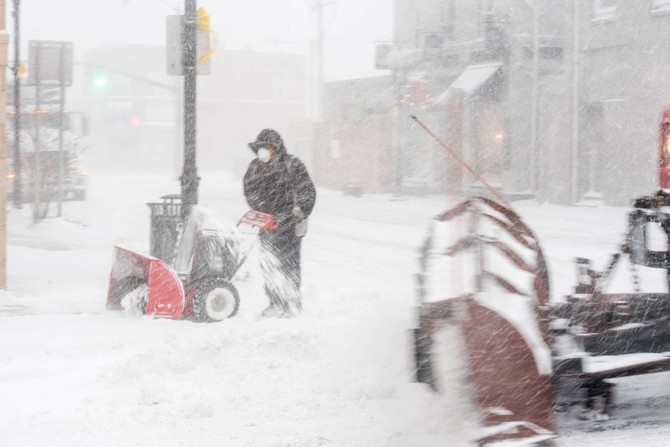
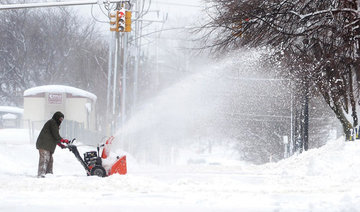
NEW YORK/LONDON: An intense winter storm froze pipes and disrupted services at refineries on the US Atlantic coast on Thursday, sending fuel prices higher as heavy snowfall and high winds caused electricity outages for tens of thousands of Americans.
Some 65,000 homes and businesses along the US East Coast are without power, and that number is expected to swell on Thursday as the storm punishes the densely populated US Northeast.
The storm is the product of a rapid and rare sharp drop in barometric pressure known as bombogenesis, or bomb cyclone. Heavy snow pounded the East Coast along a front stretching from Maine as far south as North Carolina early on Thursday, taking out power lines, icing over roadways and closing hundreds of schools.
Prices for heating oil and natural gas in the US Northeast hit their highest levels in years on the back of near-record heating demand. Benchmark US heating oil futures are near their highest in almost three years.
US natural gas demand was expected to remain near record highs this week. Natural gas is the major fuel for residential and commercial heating in the US Northeast and is also widely used by power plants.
On Wednesday, natural gas futures fell 1.6 percent to $3.008 per million British thermal units, but cash prices in New York and New England remain elevated.
“NYMEX Henry Hub prices should rise further to the mid-$3 range, as cash Henry Hub prices already traded above $6. But the market, due to the supposed record-breaking production growth in 2018, still seems to be under-appreciating the potential for cold weather persisting,” Citi analysts said in a note.
New England’s cash prices
“We expect to have sufficient capacity and fuel available and expect to be able to weather the storm without running up against significant emissions limits, but concerns remain the same regarding fuel availability and emissions limits throughout this protracted cold spell and the rest of the winter,” the company said in a statement.
There are fears that a significant disruption could lead to a heating oil shortage, as distillate inventories, including heating oil, in the New England and Mid-Atlantic regions are currently at their lowest levels for this time of year since 2015.
This has spurred tankers carrying diesel and heating oil to set out from Europe bound for the United States to address supply worries, reversing a traditional trade route.
Icebreakers have been used in key ports of Boston, New York and Philadelphia to keep shipping lanes clear, though delays are expected, and the Coast Guard said late Wednesday that those ships will remain at shore until the storm passes.
Reliance on heating oil is highest in the Northeast region, with about 21 percent of households using oil for space heating.
So far, most northern US refiners are not reporting problems. Phillips 66 shut a crude and coking unit at its Wood River, Illinois, refinery after a line froze followed by a brief fire, a source told Reuters on Wednesday. It did not currently have a timeline for restarting the units at the Illinois plant, the source said.
Philadelphia Energy Solutions postponed planned work at its 335,000 refinery complex in Philadelphia until after the storm.
Valero’s 125,000 bpd refinery in Meraux, Louisiana, restarted most operations after sub-freezing conditions froze instruments earlier this week, according to a report by Energy News Today (ENT).
Valero was forced to cut rates at its Port Arthur, Texas, refinery due to the cold weather, ENT reported, and operations are expected to return to normal by the end of the week.

‘Bomb cyclone’ hits US East Coast energy, power supply
Terror at Friday prayers: Witnesses describe blast rocking Islamabad mosque
- The Daesh group has claimed responsibility for the attack, according to the SITE Intelligence Group, which monitors jihadist communications
ISLAMABAD: A worshipper at the Shiite mosque in Islamabad where dozens of people were killed in a suicide blast on Friday described an “extremely powerful” explosion ripping through the building just after prayers started.
Muhammad Kazim, 52, told AFP he arrived at the Imam Bargah Qasr-e-Khadijatul Kubra mosque shortly after 1:00 p.m. (0800 GMT) on Friday and took up a place around seven or eight rows from the Imam.
“During the first bow of the Namaz (prayer ritual), we heard gunfire,” he told AFP outside the Pakistan Institute of Medical Sciences (PIMS) hospital, where many of the wounded were brought for treatment.
“And while we were still in the bowing position, an explosion occurred,” he said.
Kazim, who is from Gilgit-Baltistan in northern Pakistan and lives in Islamabad, escaped unharmed, but accompanied his wounded friend to the PIMS hospital for treatment.
“It was unclear whether it was a suicide bombing, but the explosion was extremely powerful and caused numerous casualties,” Kazim said.
“Debris fell from the roof, and windows were shattered,” he added. “When I got outside, many bodies were scattered... Many people lost their lives.”
The Daesh group has claimed responsibility for the attack, according to the SITE Intelligence Group, which monitors jihadist communications.
Another worshipper, Imran Mahmood, described a gunfight between the suicide bomber, a possible accomplice and volunteer security personnel at the mosque.
“The suicide attacker was trying to move forward, but one of our injured volunteers fired at him from behind, hitting him in the thigh,” Mahmood, in his fifties, told AFP.
“He fell but got up again. Another man accompanying him opened fire on our volunteers,” he said, adding the attacker “then jumped onto the gate and detonated the explosives.”
As of Saturday morning, the death toll stood at 31, with at least 169 wounded.
The attack was the deadliest in the Pakistani capital since September 2008, when 60 people were killed in a suicide truck bomb blast that destroyed part of the five-star Marriott hotel.
Lax security
Describing the aftermath of the attack, Kazim said unhurt worshippers went to the aid of those wounded.
“People tried to help on their own, carrying two or three bodies in the trunks of their vehicles, while ambulances arrived about 20 to 25 minutes later,” he told AFP.
“No one was allowed near the mosque afterwards.”
Kazim, who has performed Friday prayers at the mosque “for the past three to four weeks,” said security had been lax.
“I have never seen proper security in place,” he told AFP.
“Volunteers manage security on their own, but they lack the necessary equipment to do it effectively,” he said.
“Shiite mosques are always under threat, and the government should take this seriously and provide adequate security,” he added.
Muhammad Kazim, 52, told AFP he arrived at the Imam Bargah Qasr-e-Khadijatul Kubra mosque shortly after 1:00 p.m. (0800 GMT) on Friday and took up a place around seven or eight rows from the Imam.
“During the first bow of the Namaz (prayer ritual), we heard gunfire,” he told AFP outside the Pakistan Institute of Medical Sciences (PIMS) hospital, where many of the wounded were brought for treatment.
“And while we were still in the bowing position, an explosion occurred,” he said.
Kazim, who is from Gilgit-Baltistan in northern Pakistan and lives in Islamabad, escaped unharmed, but accompanied his wounded friend to the PIMS hospital for treatment.
“It was unclear whether it was a suicide bombing, but the explosion was extremely powerful and caused numerous casualties,” Kazim said.
“Debris fell from the roof, and windows were shattered,” he added. “When I got outside, many bodies were scattered... Many people lost their lives.”
The Daesh group has claimed responsibility for the attack, according to the SITE Intelligence Group, which monitors jihadist communications.
Another worshipper, Imran Mahmood, described a gunfight between the suicide bomber, a possible accomplice and volunteer security personnel at the mosque.
“The suicide attacker was trying to move forward, but one of our injured volunteers fired at him from behind, hitting him in the thigh,” Mahmood, in his fifties, told AFP.
“He fell but got up again. Another man accompanying him opened fire on our volunteers,” he said, adding the attacker “then jumped onto the gate and detonated the explosives.”
As of Saturday morning, the death toll stood at 31, with at least 169 wounded.
The attack was the deadliest in the Pakistani capital since September 2008, when 60 people were killed in a suicide truck bomb blast that destroyed part of the five-star Marriott hotel.
Lax security
Describing the aftermath of the attack, Kazim said unhurt worshippers went to the aid of those wounded.
“People tried to help on their own, carrying two or three bodies in the trunks of their vehicles, while ambulances arrived about 20 to 25 minutes later,” he told AFP.
“No one was allowed near the mosque afterwards.”
Kazim, who has performed Friday prayers at the mosque “for the past three to four weeks,” said security had been lax.
“I have never seen proper security in place,” he told AFP.
“Volunteers manage security on their own, but they lack the necessary equipment to do it effectively,” he said.
“Shiite mosques are always under threat, and the government should take this seriously and provide adequate security,” he added.
© 2026 SAUDI RESEARCH & PUBLISHING COMPANY, All Rights Reserved And subject to Terms of Use Agreement.