BAGHDAD: Iraq has asked British energy giant BP to help bolster production at oilfields recaptured from the Kurds in northern Kirkuk province, Oil Minister Jabbar Al-Luaybi said Sunday.
Luaybi told AFP he wanted to discuss a request for BP to draft a study on increasing output when the company’s boss visits Kirkuk in the coming days.
“I suggested they study my proposal and I am waiting for their reply,” Luaybi said.
BP is the biggest foreign player in Iraq’s oil sector, running the Rumaila field in the south of the country which produces 1.5 million barrels per day (bpd) — almost a third of Iraq’s output.
In 2014, the oil ministry and BP signed a consultancy deal under which the energy titan would study reserves in the Baba Gurgur and Havana fields and ways of developing them.
But Baghdad lost the Kirkuk fields to Kurdish forces that year during a sweeping offensive by Daesh, and the deal was never implemented.
“Because of Daesh, it was frozen,” Luaybi said.
But he said Iraq had signed a new memorandum with BP in January after the federal government seized back control of the area following a September Kurdish independence referendum bitterly opposed by Baghdad.
Baba Gurgur, discovered in 1927, is Iraq’s oldest oilfield.
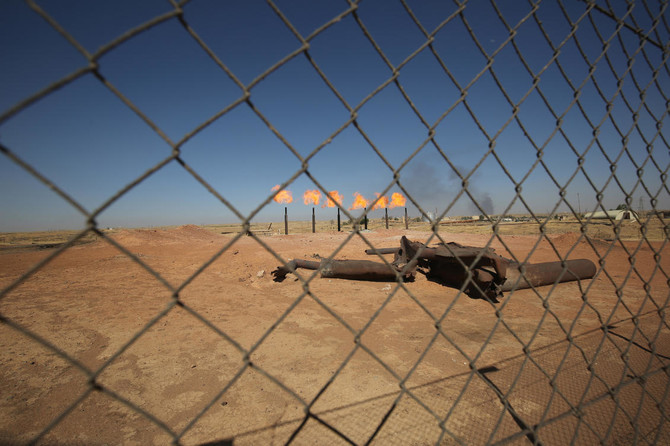
Central government forces recaptured it from the Kurds in October along with the fields of Havana, Bai Hassan, Jambu and Khabbaz.
The five fields have a total output of around 470,000 barrels of oil per day (bpd) but production and export have been slow as the main pipeline linking Kirkuk to the Ceyhan oil terminal in Turkey was damaged and needs repairs.
Luaybi said a new 350-kilometer (220-mile) oil pipeline able to pump over one million bpd from the Kirkuk fields to Turkey may be completed within as little as a year.
In the meantime, Iraq will export up to 60,000 bpd by road to refineries around Iran’s Kermanshah, where oil firms face major challenges transferring oil from wells in southern Iran, he said.
“We will supply those refineries and (receive) the equivalent quantities in our southern port” of Basra, he said.
Luaybi also said talks were underway with the Kurdish authorities with a view to pumping Kirkuk oil via a pipeline through the autonomous Kurdish region.
“We hope to succeed. We have reached a sort of understanding so far,” he said.
A sixth oilfield, Khurmala, remains under Kurdish control, but Luaybi insisted it belongs to Iraq’s state-owned North Oil Company.
“Khurmala belongs to NOC and was discovered more than 30 years ago,” he said. “We started developing it in 1995. NOC and the oil ministry have finished drilling 36 wells there.”
Luaybi said the Iraqi oil ministry had launched a $37 million program in 2004 to develop Khurmala.
The ministry of resources in the autonomous Kurdish region of northern Iraq seized Khurmala in 2008-2009, Luaybi said.
“But it’s a field that belongs to the oil ministry of the federal government,” Luaybi said.
Iraq is the second largest producer in the OPEC cartel after Saudi Arabia.
It reported its oil exports at 109.6 million barrels in December last year, the same month that the government announced victory over Daesh.
Iraq in December 2017 earned around $6.5 billion (5.3 billion euros) from crude sales, at $59.3 per barrel.


![]()
Iraq asks BP to study developing Kirkuk oilfields
Iraq asks BP to study developing Kirkuk oilfields

Latest updates



© 2026 SAUDI RESEARCH & PUBLISHING COMPANY, All Rights Reserved And subject to Terms of Use Agreement.