India’s Modi puts his country’s faith in technology for ‘inclusive growth’

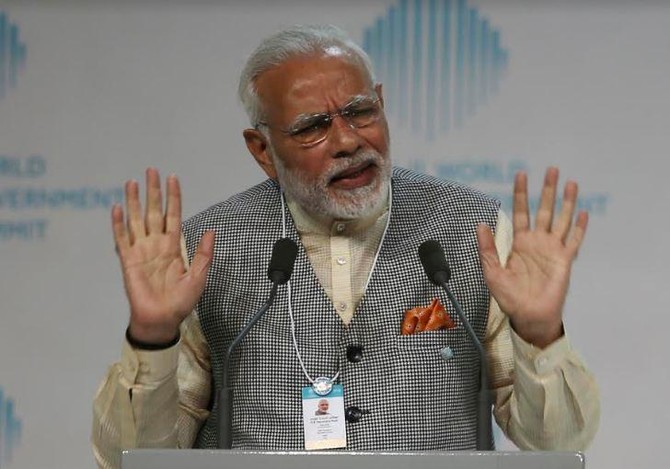
Indian Prime Minister Narendra Modi gives a speech at the World Government Summit in Dubai on Sunday. (AP)
Updated 12 February 2018
Follow

India’s Modi puts his country’s faith in technology for ‘inclusive growth’

DUBAI: Indian Prime Minister Narendra Modi launched an eloquent advocacy of the power of technology to reduce poverty and bring about “inclusive growth for everyone” at the World Government Summit in Dubai.

Modi, who had previously addressed thousands of his compatriots at the Dubai Opera, told the summit that 21st century technology was essential for his country to face its big challenges: Poverty, unemployment, housing, education and natural disasters.

“Technology, from the Stone Age to the industrial revolution to the digital revolution, has fundamentally altered the condition of man for the better. It is a source of disruptive change, empowering men and women, minimizing government and maximizing governance,” he said.

But he warned that governments have a responsibility to see that technology is not used for negative ends.

“It is the job of governments to ensure that the power of technology is used for the good of the common man. Technology has got to be a constructive, positive force. Man sometimes fashions technology into destructive and violent areas, like when cyberspace is used for the spread of extremism.”

In a speech preceded by traditional Indian dancing and studded with references in Sanskrit, the ancient Indian language, Modi said: “Sometimes it seems like man is making the cardinal mistake of using technology to come into conflict with nature. Man has to coexist with nature, as India has done with yoga.”

It was his second visit to the UAE since he became prime minister in 2014. He said the UAE was a “home from home” for 3.3 million Indian workers.

“The vision of Dubai is backed by technology, innovation and enterprise, but it is not confined to the laboratories. It is applied in the real world, in Masdar (Abu Dhabi’s sustainable city) and the Future Accelerator in Dubai.”

He added: “In establishing ministries of happiness and the future, the UAE has recognized the idea of maximizing human happiness.”

Modi highlighted India’s achievements in biometric profiling, linking identities to financial details and mobile phone numbers, which he said was leading to the creation of a “cashless society” in his country, and also the commitment to solar energy use and Internet-based “long distance” education.


Global trade isn’t deglobalizing — it’s reshuffling, Harvard economist says

Updated 16 min 52 sec ago
Follow

Global trade isn’t deglobalizing — it’s reshuffling, Harvard economist says

ALULA: Global trade is not retreating into deglobalization despite geopolitical shocks, but is instead undergoing a structural reshuffling led by US-China tensions, according to Harvard University economist Pol Antras. 

Presenting research at the AlUla Emerging Market Economies Conference, Antras said there is no evidence that countries are systematically turning inward. Instead, trade flows are being redirected across markets, creating winners and losers depending on export structure and exposure to Chinese competition. 

This comes as debate intensifies over whether supply-chain disruptions, industrial policy and rising trade barriers signal the end of globalization after decades of expansion. 

Speaking to Arab News on the sidelines of the event, Antras said: “I think the right way to view it is more a reorganization, where things are moving from some countries to others rather than a general trend where countries are becoming more inward looking, in a sense of producers selling more of their stuff domestically than internationally, or consumers buying more domestic products than foreign products.”  

He said a change of that scale has not yet happened, which is important to recognize when navigating the reshuffling — a shift his research shows is driven by Chinese producers redirecting sales away from the US toward other economies. 

He added that countries are affected differently, but highlighted that the Kingdom’s position is relatively positive, stating: “In the case of Saudi Arabia, for instance, its export structure, what it exports, is very different than what China exports, so in that sense it’s better positioned so suffer less negative consequences of recent events.” 

He went on to say that economies likely to be more negatively impacted than the Kingdom would be those with more producers in sectors exposed to Chinese competition. He added that while many countries may feel inclined to follow the United States’ footsteps by implementing their own tariffs, he would advise against such a move.  

Instead, he pointed to supporting producers facing the shock as a better way to protect and prepare economies, describing it as a key step toward building resilience — a view Professor Antras underscored as fundamental. 

Elaborating on the Kingdom’s position amid rising tensions and structural reorganization, he said Saudi Arabia holds a relative advantage in its economic framework. 

“Saudi Arabia should not be too worried about facing increased competitive pressures in selling its exports to other markets, by its nature. On the other hand, there is a benefit of the current situation, which is when Chinese producers find it hard to sell in US market, they naturally pivot to other markets.” 

He said that pivot could benefit importing economies, including Saudi Arabia, by lowering Chinese export prices. The shift could increase the Kingdom’s import volumes from China while easing cost pressures for domestic producers.