In Oman desert, European venture sets sights on Mars

1 / 4
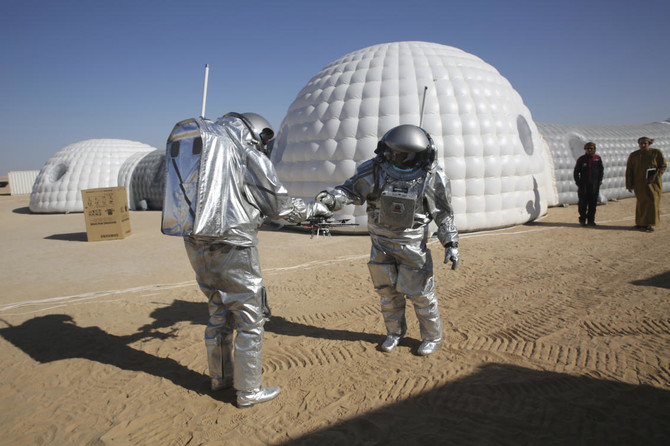
Analog astronaut Joao Lousada (C) hands his colleague Kartik Kumar a drone while two Omani men watching in front of the Mars simulation base camp in the Dhofar desert of Oman. The desolate desert in southern Oman resembles Mars so much that more than 200 scientists from 25 nations organized by the Austrian Space Forum are using it for the next four weeks to field-test technology for a manned mission to Mars. (AP)
2 / 4
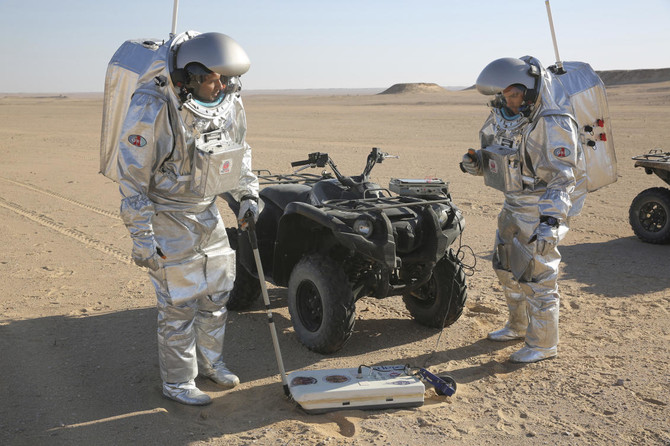
Members of the AMADEE-18 Mars simulation mission ride all-terrain vehicles while wearing spacesuits during an analog field simulation in Oman’s Dhofar desert, in a collaboration between the Austrian Space Forum and the Oman National Steering Comittee preparing for future human Mars missions. (AFP)
3 / 4
Two scientists test space suits and a geo-radar for use in a future Mars mission in the Dhofar desert of southern Oman. (AP)
4 / 4
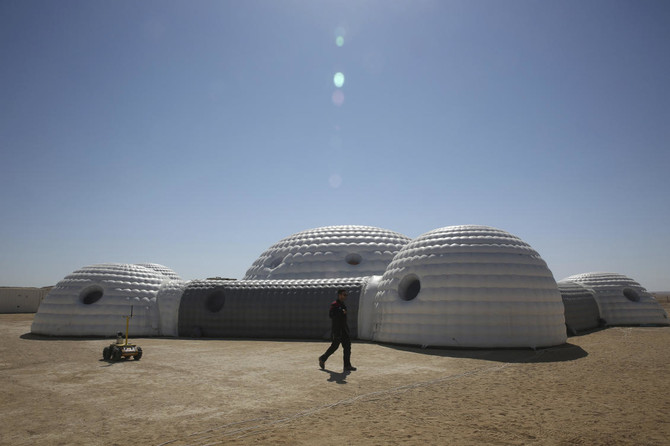
A 2.4-ton inflated habitat used by the AMADEE-18 Mars simulation in the Dhofar desert of southern Oman. (AP)
Updated 08 February 2018
Follow

In Oman desert, European venture sets sights on Mars

DHOFAR, Oman: Would-be astronauts in aluminum-coated suits venture out in rovers from a sprawling camp in Oman’s barren desert: a simulation by a European venture aiming to one day help humans survive on Mars.
Behind a barbed wire fence protected by soldiers from the Gulf sultanate, researchers in prefab facilities work away on experiments that include trying to grow vegetables in inhospitable terrain chosen for its resemblance to the red planet.
Run by the Austrian Space Forum, a mainly volunteer collective, with the backing of the Omani government, the AMADEE-18 Mars Analog Mission has brought together researchers, inventors, space professionals and enthusiasts.
For decades the realm of science fiction, sending a manned mission to Mars is now the stated — albeit still distant — goal of the US government and entrepreneurs.
On Tuesday US billionaire Elon Musk launched the world’s most powerful rocket — the SpaceX Falcon Heavy — toward an orbit near Mars.
In this remote corner of the Arabian Peninsula’s Dhofar desert, the European-led project may be far less flashy — but it is still looking to answer major questions.
“Once we go to Mars, and stay on Mars, we will have to use the resources we find on Mars because we cannot bring everything from Earth,” forum president Alexander Soucek said.
“So we have to use the things we find there: first of all to sustain life there, to sustain missions there, and then in the longer run maybe also for other things.”
The Austrian Space Forum does not have a rocket like Musk, but its members — many with day jobs at traditional space agencies or private companies — share the entrepreneur’s drive to be innovative.
In the increasingly crowded field of space exploration, Soucek says the project is carving out a special niche with its Mars simulations.
“We get sponsors from private industry. We collect money, partnerships, invite people to join forces,” he said.
Volunteer researcher Joao Lousada was struggling into a pressure-simulating exoskeleton suit with the help of three technicians.
Weighing more than 50 kilograms (110 pounds), it is custom-built to simulate the constricted movement astronauts would feel on Mars — and takes a gruelling hours-long process just to put on.
Like the other volunteers he watched the Falcon Heavy launch with awe, but he said there were serious issues about the commercialization of space.
“You can’t claim the moon, you can’t claim asteroids so mining comes into a bit of a legal loophole,” Lousada said.
“But... I think it’s a very interesting idea. I think definitely we should look into using resources from asteroids that are not available on Earth or are less frequent on Earth.”
Once suited up, Lousada and fellow researcher Kartik Kumar mounted rovers and rode off under the blazing sun to complete their set of experiments in the desert.
Returning before dusk, Kumar — an expert on space debris — reflected on the role and responsibility of space voyagers.
“We should never forget that as we explore our own planet and the solar system we have to do it responsibly and ethically,” said Kumar.
Since 2015, the United States and Luxembourg have moved to the forefront of what has been dubbed the new space race, creating legal frameworks that could eventually allow mining in space.
The European Union has yet to take a position, as its members are on vastly different pages over the controversial topic.
“Can you just go there and take resources or not?” Soucek said.
“There are a few things you have to sort out from technical and economic and also political point of view. But as always in space, today it’s science fiction. Tomorrow, perhaps reality.”


India crushes Pakistan by 61 runs in marquee game in T20 World Cup. No handshakes again

Updated 6 sec ago
Follow

India crushes Pakistan by 61 runs in marquee game in T20 World Cup. No handshakes again

  • India made a competitive 175-7 on Sunday on a sticky pitch at R. Premadasa Stadium. In reply Pakistan was bowled out for 114 in 18 overs

COLOMBO, Sri Lanka: Archrivals India and Pakistan declined to shake hands before and after the most-anticipated game of cricket’s Twenty20 World Cup, with India easily winning by 61 runs on Sunday to secure its Super 8 spot.
India opener Ishan Kishan scored 77 off 40 deliveries in a match which almost didn’t take place after Pakistan had threatened a boycott earlier this month before reversing its decision.
Pakistan captain Salman Ali Agha and India captain Suryakumar Yadav didn’t shake hands at the toss, which Pakistan won and chose to field. India and Pakistan players had refused to shake hands at last year’s acrimonious Asia Cup tournament in the United Arab Emirates that took place amid diplomatic and military tensions between the two neighbors.
India made a competitive 175-7 on Sunday on a sticky pitch at R. Premadasa Stadium. In reply Pakistan was bowled out for 114 in 18 overs. Despite the heavy defeat, Pakistan can still advance from Group A. It plays Namibia in its last group game.
Sunday’s game was the first time the teams have met since the Asia Cup, won by India.
Early setback for India
India’s batting suffered an early setback when its most aggressive batter Abhishek Sharma was dismissed without scoring. Agha bowled the first over with four consecutive dot balls and had Sharma caught by Shaheen Shah Afridi.
Kishan pulled India back with a six and two fours in the following over and he dominated an 87-run stand for the second wicket off 46 deliveries with Tilak Varma.
Kishan’s innings included three sixes and 10 boundaries before being bowled by off spinner Saim Ayub.
Ayub took two consecutive wickets in his last over to finish with his career-best T20 bowling of 3-25.
India captain Yadav (32 off 29) and Shivam Dube (27 off 17) made useful contributions for India.
Poor start for Pakistan’s chase
Seam bowler Hardik Pandya gave India an ideal start with a wicket-maiden over, dismissing Sahibzada Farhan in the fourth delivery.
Jasprit Bumrah took two wickets in the next over — Ayub (lbw for 6) and Agha (caught by Pandya for 4).
Spinner Axar Patel bowled Babar Azam (5), leaving Pakistan 34-4.
Usman Khan resisted with a 34-ball 44 but was stumped when he stepped out to hit Patel.
Pandya, Bumrah, Patel and Varun Chakravarthy took two wickets each.
All eyes on Colombo
In the lead-up to the match in Colombo, Agha said he believed it was up to the Indian players to decide whether they would shake hands with his team before and after Sunday’s game.
Yadav, for his part, had been non-committal.
“Why are you highlighting that?” Suryakumar asked reporters on the eve of the game. “We are here to play cricket. We will play good cricket. We will take all those calls tomorrow. We will see tomorrow.”
Pakistan’s government considered not playing Sunday’s match after the International Cricket Council kicked Bangladesh out of the World Cup for refusing to play matches in India, citing security concerns.
Pakistan only agreed to play after intense discussions with the ICC. The fixture is a major revenue earner for the ICC.
Political and military tensions have meant the two teams have not played a bilateral series for years.
India has not traveled to Pakistan since 2008 and Pakistan visited India for the 50-over World Cup in 2023 but has since played ICC tournaments at neutral venues.
India has defeated Pakistan 13 times in the 17 T20 games they have played. It now also has an impressive 8-1 record in the nine T20 World Cup matches since the first edition in 2007.
West Indies makes it 3 in 3, US keeps slim hopes alive
At Mumbai, West Indies notched its third successive win in Group C when it thumped Nepal by nine wickets and qualified for the Super 8 stage of the tournament.
West Indies had already beat Scotland and England to take command of Group C.
Nepal showed plenty of promise in its first game when it lost narrowly to England, but then two heavy defeats against first-timer Italy and Sunday against West Indies saw it eliminated.
Fast bowler Jason Holder grabbed 4-27 and restricted Nepal to 133-8. ShaiHope then smashed an unbeaten 61 off 44 balls and Shimron Hetmyer scored 46 off 32 balls as West Indies cruised to 134-1 in 15.2 overs.
Sanjay Krishnamurthi kept the United States’ hopes of Super 8 qualification alive with a maiden T20 half-century – 68 not out off 33 balls – against Namibia in their Group A clash.
Skipper Monank Patel also scored 52 off 30 balls as the US notched up its tournament highest score – 199-4 in 20 overs.
In reply, Namibia was restricted to 168-6, losing its third game and is now eliminated from the competition.
The US won its final game by 31 runs.