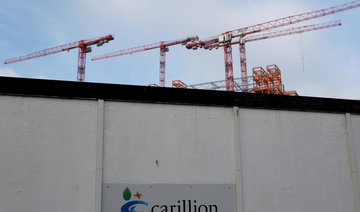
LONDON: A Qatari company’s refusal to settle a £200 million bill for work linked to the 2022 World Cup is at the heart of controversy surrounding UK construction company Carillion’s collapse.
During a select committee hearing on Tuesday, MPs grilled Carillion bosses on the company’s decision to enter such a “complex commercial environment,” and questioned their fitness to be “let loose” on other companies in the future.
The firm behind the delayed £5.5 billion downtown development, Msheireb Properties, is backed by the government-supported Qatar Foundation.
Carillion’s ex-chairman Philip Green, said the board had been trying to mitigate the “geographic risk” in the run-up to the company’s collapse on Jan. 15 and pulled back on plans to expand in the region.
The Qatar contract was cited as one of three major projects, alongside hospitals in Liverpool and Birmingham, that capsized the UK company, which employed around 43,000 people worldwide, including 20,000 in Britain.
During the hearing, Carillion executives said the company is owed £200 million for work on the Doha development, which was originally due for completion in May 2017.
Former chief executive Richard Howson said the completion date, now set for December this year, was continually pushed back. He told MPs that it has been “a very difficult project,” with the client changing architect three times and issuing 40,000 drawings in eight months.
Howson described shuttling back and forth to Qatar ten times a year in an attempt to settle the bill but ultimately failed to obtain payment for the project. “I felt like a bailiff,” he said.
Keith Cochrane, who took over as chief executive in July, said he also tried to “achieve a settlement” on the bill, which remains unpaid. He claimed Howsen confirmed the Qataris would pay up in board meeting last April but said: “Six weeks later the world had changed and it wasn’t paid.”
Carillion bosses also pointed the finger at Brexit and a snap election in 2017 as they fielded fierce questions from MPs, who branded them “delusional characters.”
A statement released by MPs after the hearing said:
“We heard variously that this was the fault of the Bank of England, the foreign exchange markets, advisers, Brexit, the snap election, investors, suppliers, the construction industry, the business culture of the Middle East and professional designers of concrete beams.
“Everything we have seen points the fingers in another direction — to the people who built a giant company on sand in a desperate dash for cash.”
Carillion, one of the largest contractors operating in the Middle East, was involved in a number of high-profile projects across the region, including the Dubai Canal and the Royal Opera house in Oman.


![]()

Doha debt behind controversy over Carillion demise
Doha debt behind controversy over Carillion demise

Latest updates



© 2026 SAUDI RESEARCH & PUBLISHING COMPANY, All Rights Reserved And subject to Terms of Use Agreement.