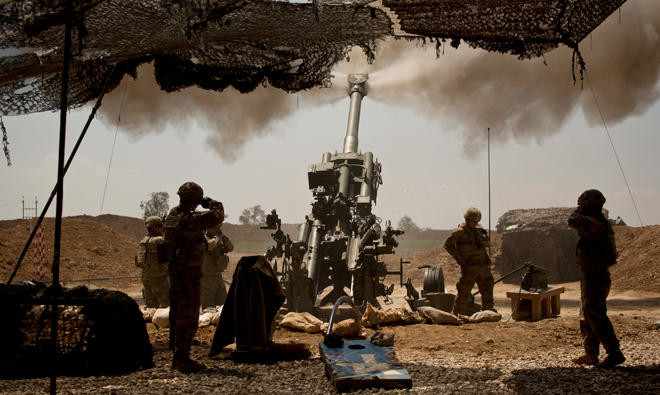
BAGHDAD: Two major Iraqi Shiite groups backed by Iran are demanding all US forces leave Iraq, opposing plans by Baghdad and Washington to keep some there for training and advisory purposes.
An Iraqi government spokesman said on Monday US forces — who number more than 5,000 — had begun reducing their numbers but some would remain.
The Badr Organization, a Shiite group that has a minister in Prime Minister Haider Al-Abadi’s government, in charge of the interior, said any remaining US, troops would be cause for instability.
“The two governments should coordinate to ensure a full withdrawal. US presence will be cause for internal polarization and a magnet for terrorists,” Badr spokesman Kareem Nuri said.
Kataib Hezbollah, a more militant, secretive and anti-American group, repeated threats to attack US forces.
“We are serious about getting the Americans out, using the force of arms because the Americans don’t understand any other language,” its spokesman, Jaafar Al-Husseini, told Beirut-based Al-Mayadeen TV on Monday evening.
Kataib Hezbollah has strong links to Iran’s Revolutionary Guards Corps and has threatened to attack US forces several times in the past, describing their presence as an occupation.
A US official in Baghdad said: “We take anything that sounds like a threat from anyone against Americans seriously.”
“There’s not that many of us here and we are all operating within Iraqi military bases. A lot of this is frankly just political posturing and trying to take advantage of stories in the press to make broader political points,” he added.
The US-led international military coalition helped Iraqi forces recapture territory taken by Daesh in 2014 and 2015, providing air and artillery support in the battle to for Mosul, and trained tens of thousands of elite Iraqi soldiers.
“The coalition will tailor our forces in consultation with our Iraqi partners in order to ensure the lasting defeat of Daesh,” the coalition’s director of operations, Brig. Gen. Jonathan Braga, said in a statement on Monday.
Braga said that even if the composition of the force changes, the coalition would maintain the capabilities and presence to continue to train, advise and equip Iraqi forces to ensure that Daesh does not re-emerge.
US officials said that while Daesh has lost most of the territory it once controlled in Iraq and Syria, there is concern about surviving fighters returning to insurgency tactics.

Iran-backed groups urge full US withdrawal from Iraq
Can Syria’s recovery outpace the hidden dangers left by years of war?
- Fighting in Aleppo compounds problem of landmine and UXO contamination following 14 years of war
- Aid groups warn explosive remnants continue to threaten civilians across Syria — especially children
LONDON: Recent clashes in Syria’s Aleppo Governorate between interim government forces and the Kurdish-led Syrian Democratic Forces have added to the deadly legacy of unexploded ordnance (UXO) left over by 14 years of civil war.
The fighting erupted on Jan. 6, after months of stalled talks over implementing an agreement to merge the SDF, which controls much of northeastern Syria, into the national army.
As hostilities intensified, about 148,000 people were displaced from the predominantly Kurdish neighborhoods of Achrafieh, Sheikh Maqsoud and Bani Zeid, according to UN figures.
Although a ceasefire was declared on Jan. 11 — a day after the interim government captured the three neighborhoods — the aftermath of the violence continues to hamper returns.
The UN Office for the Coordination of Humanitarian Affairs (OCHA) said on Jan. 12 that about 106,000 people displaced to Afrin from Sheikh Maqsoud were still unable to go home as they awaited the completion of UXO clearance.
Meanwhile, Achrafieh saw limited returns, OCHA said.
A day later, Mohammed Abdul Ghani, head of internal security in Aleppo, said specialized units were conducting extensive sweep operations in the two neighborhoods and had cleared “a large number of landmines,” according to state media.
But landmines and other explosive remnants continue to pose a grave threat to civilians, especially children, across Syria, humanitarians and demining organizations have warned.
These silent killers that lurk beneath people’s feet remain a major obstacle to the safe return of people displaced since the conflict began in 2011.
The UK-based HALO Trust has been conducting clearance operations in Aleppo for several months.
“We’re working in the Old City with teams working on rubble removals,” spokesperson Paul McCann told Arab News. “We are there to do explosive hazard assessments as they work, in case they come across dangerous items in the rubble.”
While access for humanitarian groups has improved since the removal of President Bashar Assad in December 2024, the scale of the challenge has grown alongside the pace of returns.
“The return of civilians means the workload doesn’t just double — it triples or even quadruples,” David Francis, technical field manager for Syria at France-based Humanity and Inclusion, formally Handicap International, told Arab News in a phone call from eastern Syria.
“It really does feel like we’re fighting fires. We’re racing against time to save lives.”
As families return to reclaim homes and livelihoods, they are often moving back into areas still littered with explosives.
“People move back because they want their homes back,” Francis said. “They want to start rebuilding.
“I’ve seen it firsthand, families living in damaged houses, sometimes even among rubble, repairing walls and roofs while, just outside in the garden, there are still mines, mortars, or other unexploded munitions.”
With displaced people eager to rebuild their lives, aid groups have rapidly expanded operations.
McCann said that since the toppling of Assad, the HALO Trust’s presence had grown from about 40 staff members based in Idlib to roughly 300 working across Idlib, Aleppo, Damascus, Daraa and Deir ez-Zor.
But the pace of returns also means higher casualties, even as clearance accelerates.
“While we are clearing explosives — about 6,000 items in the last year — the numbers of accidents involving civilians has remained pretty steady at several every week,” McCann said.
He attributed that in part to the sheer scale of displacement and return, adding: “Several million people have returned to what were former battlefields, so more people are coming into contact with mines and old bombs, shells and other (explosive remnants).”
Indeed, UXO incidents have surged over the past year as farming families return to long-abandoned land now riddled with explosives. The threat continues to undermine rural recovery and restrict access to basic services such as education, healthcare and food supplies.
Poverty and desperation to restore a sense of normalcy have pushed many to ignore safety warnings in search of work. Some even attempt rudimentary demining themselves, often with fatal consequences.
In the first nine months of 2025, Syria saw about 650 UXO incidents that caused more than 570 deaths and 850 injuries, according to data collected by Syria Weekly and analyzed by Syria in Figures. The true toll is thought to be higher owing to underreporting, particularly in rural areas.
In contrast, from 2011-24, an average of 267 people were killed by explosive remnants per year, according to the Syrian Network for Human Rights.
“We see the survivors (of explosive ordnance) every day up very close,” Francis said. With more families returning to rebuild homes and farm their land, “this year alone there have been countless incidents — almost daily.”
Children are particularly vulnerable, he said, and added: “Parents may know not to touch certain things, but children often don’t.”
INNUMBERS
- 650 UXO incidents recorded in the first nine months of 2025.
- 6k explosives cleared by the HALO Trust in the past year.
(Sources: Syria Weekly/HALO)
Within a year of Assad’s downfall, about 1.2 million Syrians returned from neighboring countries and another 1.9 million internally displaced people went back to their areas of origin, the UN refugee agency said in December.
Fourteen years of civil war displaced more than 12 million Syrians, including about 5 million hosted in neighboring countries. A year on from the rebel victory, about 7 million people remain displaced, according to OCHA.
Although aid groups run risk-education sessions, locals’ eagerness to farm their lands means explosive ordnance incidents might still happen.
“A child might see their father out in the field, find a UXO, pick it up, and move it so he can continue farming,” Francis said. “The child sees that and thinks, ‘Well, if my father can do it, it must be OK’.”
Francis recalled one incident that has stayed with his team. A young boy, playing with his two brothers, picked up what he thought was a rock.
“In reality, it was a submunition, about the size of a golf ball or tennis ball,” he said. “It exploded. He lost his leg below the knee and one arm at the elbow.”
When Francis learned of the blast, he immediately deployed the teams to the area. “We met the two brothers, who showed us the blood still on the wall from the day before,” he said. “They were about 8 and 9 years old.”
The children pointed out additional unexploded items nearby. Francis accompanied one deminer to inspect the locations while the rest of the team secured the surrounding houses.
“I told them to put on their protective suits and start systematically searching the area, trying to prevent another tragedy,” he said. “That day alone, we recovered another four or five items.”
Francis added: “It often feels like we’re just fighting fires. We do as much as we can, but there’s never enough capacity.”
Nevertheless, progress is visible. “We were there for about five or six weeks, and in those first weeks, people were literally chasing us on motorbikes, trying to get us to come and clear their houses,” Francis said.
“By the end of those six weeks, that started to ease off. And the fact that it eased off told us something important: that we were making an impact. We could see that our work was helping, that conditions were improving.”
In a single area, Francis’ team removed about 600 explosive items. “After we finished, the family came out and walked across the land themselves,” he said. “They couldn’t believe it had all been cleared. They let their children come outside and play again.
“We gave them a football, and they played together. It was incredible to see.
“You start to notice these small roots of hope. That family, in particular, rebuilt a wall, improved their garden — and it’s because they want to come back. They want to live again.”
Alongside demining operations in Raqqa and Deir ez-Zor, Humanity and Inclusion is also providing rehabilitation and inclusion services, Abdulkarim Mohammed, the organization’s community liaison manager in northeast Syria, told Arab News.
These efforts include “physiotherapy, prosthetics and orthotics, psychosocial support, and the provision of assistive devices to beneficiaries in need, in addition to broader inclusion activities.”
Rehabilitation centers currently operate in Raqqa and Deir ez-Zor, though the Deir ez-Zor center is “scheduled to close by the end of January 2026 due to funding constraints,” Mohammed said.
So far this year, Humanity and Inclusion teams have conducted four bulk demolitions — two in Raqqa and two in Deir ez-Zor — destroying about five tonnes of explosive material.
“Organizing these takes a significant amount of work,” Francis said. “You can imagine the level of coordination involved.
“But if you invest the time and build strong relationships with all the actors involved, it can be done. And we have. Those four bulk demolitions were all highly successful, rendering the items completely safe and permanently beyond use.
“When you see the photos, the explosions can look almost like nuclear blasts, but in reality, it’s just a large volume of material going up at once. And at the end of the day, this is where some frustration sets in for those of us working on the ground.
“You see a lot of NGOs going around, teaching people, saying, ‘Don’t touch this, don’t touch that.’ And that education is important. But at some point, you have to get your hands dirty. You have to go in, recover the items, and destroy them; or remove them safely and then destroy them.
“That’s the only way the risk truly goes away.”
Despite steady progress, the scale of contamination and chronic funding shortages mean it could take decades to make Syria safe again.
One global UXO organization privately told Syria in Figures it would take 25 to 40 years of full-time work at current capacity.
The UK-based Mines Advisory Group has described Syria as “the greatest humanitarian impact of landmines and unexploded ordnance anywhere in the world.”
According to 2025 Syria Weekly data, the hardest-hit areas include the northwest, Daraa, rural Homs, and Deir ez-Zor’s Euphrates River corridor.
After months of intensive clearance, Defense Ministry teams estimate that about 350,000 landmines remain around Palmyra, with 25,000 cleared by late August, and another 316,000 in Deir ez-Zor, where 32,000 had been removed by early September.
But as violence resurfaces in several areas, each new round of fighting adds to Syria’s lethal legacy of explosive remnants, leaving civilians to pay the price long after the guns fall silent.