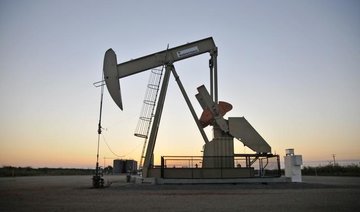
Oil prices slump amid global market rout

Oil prices slumped, extending falls from the previous session as global financial markets tumbled lower in the wake of one of the biggest intra-day falls ever registered on Wall Street. (Reuters)
Updated 07 February 2018
Follow

Oil prices slump amid global market rout

SINGAPORE: Oil prices slumped on Tuesday, extending falls from the previous session as global financial markets tumbled lower in the wake of one of the biggest intra-day falls ever registered on Wall Street.
Brent hit a session low of $66.82 a barrel early in the day, with US West Texas Intermediate (WTI) falling as low as $63.29 a barrel.
“The fall (in crude futures) is mainly attributable to a global sell-off in equities,” said Sukrit Vijayakar, director at consultancy Trifecta Energy.
“People ran to the US dollar as a safe-haven currency. Therefore the dollar strengthens. This makes commodities more expensive to buy, hence oil futures get sold off,” he added.
Financial markets went into a tailspin on Monday after a sharp rise in US bond yields that raised alarms over rising inflation and potentially higher interest rates.
The Dow Jones Industrial Average’s 4.6 percent loss on Monday was its largest in percentage terms since August 2011, and the day’s 1,175 point loss was its biggest ever in absolute terms. The index was briefly down more than 6 percent.
“Suddenly, inflation has become one of the most-talked about issues in markets,” US bank J.P. Morgan said in a note to clients.
The correction in oil is also being driven by fundamentals, traders said.
Despite OPEC and Russia cutting production in order to tighten the market, crude remains in ample supply.
That is largely due to soaring US shale oil production, which has jumped by almost 18 percent since mid-2016 to 10 million barrels per day (bpd), surpassing top exporter Saudi Arabia.
Only Russia produces more, averaging 10.98 million bpd in 2017
And US oil output will likely rise further.
The amount of rigs drilling for oil rose to 765 by late January, more than double the 316 that were in operation during 2016’s production lull.
There is also a seasonal downturn to demand, as many refineries shut for maintenance at the end to the peak-consumption winter season in the northern hemisphere.


Acwa signs key terms to develop 5GW of renewable energy capacity in Turkiye

Updated 23 February 2026
Follow

Acwa signs key terms to develop 5GW of renewable energy capacity in Turkiye

JEDDAH: Saudi utility giant Acwa has signed key investment agreements with Turkiye’s Ministry of Energy and Natural Resources to develop up to 5 gigawatts of renewable energy capacity, starting with 2GW of solar power across two plants in Sivas and Taseli.

Under the investment agreement, Acwa will develop, finance, and construct, as well as commission and operate both facilities, according to a press release.

The program builds on the company’s first investment in Turkiye, the 927-megawatt Kirikkale Independent Power Plant, valued at $930 million, which offsets approximately 1.8 million tonnes of carbon dioxide annually, the statement added.

A separate power purchase agreement has been concluded with Elektrik Uretim Anonim Sirketi for the sale of electricity generated by each facility.

Turkiye aims to boost solar and wind capacity to 120GW by 2035, supported by around $80 billion in investment, while recent projects have already helped prevent 12.5 million tonnes of CO2 emissions and reduced reliance on imported natural gas.

Turkiye’s energy sector has undergone a rapid transformation in recent years, with renewable power emerging as a central pillar of its strategy.

Raad Al-Saady, vice chairman and managing director of ACWA, said: “The signing of the IA (implementation agreement) and PPA key terms marks a pivotal moment in Acwa’s partnership with Turkiye, reflecting the country’s strong potential as a clean energy leader and manufacturing powerhouse.”

He added: “Building on our long-standing presence, including the 927MW Kirikkale Power Plant commissioned in 2017, this step elevates our partnership to a new level,” Al-Saady said.

In its statement, Acwa said the 5GW renewable energy program will deliver electricity at fixed prices, enhancing predictability for grid planning and supporting long-term industrial investment.

By replacing imported fossil fuels with domestically generated clean energy, the initiative is expected to reduce Turkiye’s exposure to global energy market volatility, strengthening energy security and lowering long-term power costs.

The company added that the economic impact will extend beyond the anticipated investment of up to $5 billion in foreign direct investment, with thousands of jobs expected during the construction phase and hundreds of high-skilled roles created during operations.

The energy firm concluded that its existing progress in Turkiye reflects a strong appreciation for Turkish engineering, construction, and manufacturing capacity, adding that localization has been a strategic priority, and it has already achieved 100 percent local employment at its developments in the country.