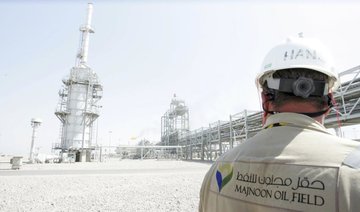
TOKYO: Oil rose for a third day on Friday after a survey showed strong compliance with output cuts by OPEC and others including Russia, offsetting concerns about surging US production.
Brent futures, the global benchmark, were up 24 cents, or 0.3 percent, at $69.89 a barrel by 0635 GMT.
US West Texas Intermediate (WTI) crude was up 33 cents, or 0.5 percent, at $66.13 a barrel.
Production by the Organization of the Petroleum Exporting Countries (OPEC) rose in January from an eight-month low as higher output from Nigeria and Saudi Arabia offset a further decline in Venezuela and strong compliance with a supply reduction pact, a Reuters survey showed.
OPEC pumped 32.4 million barrels per day (bpd) in January, the survey found, up 100,000 bpd from December. Last month’s total was revised down by 110,000 bpd to the lowest since April 2017.
Even so, adherence by producers included in the deal to curb supply rose to 138 percent from 137 percent in December, the survey found, suggesting commitment is not wavering even as oil prices hit their highest level since 2014.
“It underscores the commitment of the group, and their Russian partners, to keep a floor under the oil price,” said Greg McKenna, chief market strategist at futures brokerage AxiTrader.
That is drawing investors’ focus away from the rise in US production.
US crude output surpassed 10 million bpd in November for the first time since 1970, the Energy Information Administration said this week.

US oil prices extend gains on compliance with output cuts
IsDB announces $2.41bn in new financing for strategic development sectors
JEDDAH: The Islamic Development Bank has approved $2.41 billion in new financing for a series of transformative projects during its 364th Executive Board meeting, chaired by IsDB President Mohammed Al-Jasser.
The approvals underscore the bank’s ongoing commitment to regional cooperation, economic development, and climate- and environment-friendly investments that advance the UN Sustainable Development Goals across its member countries.
The new financing includes an additional $40 million for the Central Asia–South Asia Electricity Transmission and Trade Project (CASA-1000) in Tajikistan, aimed at boosting regional energy trade, improving electricity access and reliability, and mitigating climate change through the export of clean and renewable energy.
The bank also approved €116 million ($135 million) to upgrade Senegal’s Dakar Expressway Project.
The initiative is designed to improve health, education, and economic services for local populations, reduce traffic congestion and peak travel times, and enhance road safety measures to halve traffic-related deaths and injuries, with a particular focus on women and young pedestrians.
A $1.307 billion allocation was approved for Kazakhstan’s Economic and Industrial Zones Project to foster sustainable industrial development.
The initiative is expected to promote economic diversification, attract investment, create jobs, and boost global competitiveness through infrastructure upgrades and operational efficiency in special economic zones, industrial zones, and specialized industrial zones.
Bahrain will receive $330.07 million to expand its industrial capacity and strengthen economic competitiveness. The funding will support the development of modern industrial land with resilient infrastructure, advanced export-oriented manufacturing, effective internal connectivity, and reclaimed land facilities.
The project aims to stimulate private investment, generate employment, and reinforce Bahrain’s position as a regional industrial and logistics hub.
The IsDB approved $160 million to enhance utilities, water, and urban development sectors in Jordan.
The financing will secure future drinking water supply for Aqaba, Amman, and northern regions, support climate adaptation and mitigation, foster economic growth, and promote private sector participation in sustainable, long-term water solutions to alleviate severe water stress.
Azerbaijan was granted $436.67 million to improve agricultural productivity by reducing irrigation water losses and supporting sustainable rural development, in line with Azerbaijan’s 2030 vision.
The project will also promote green growth, strengthen climate resilience, and ensure long-term food security.
The approved projects reflect the IsDB’s strategic focus on fostering sustainable and inclusive growth across member countries by addressing critical infrastructure, energy, water, transport, and industrial development challenges.
These initiatives are expected to deliver lasting impact and contribute effectively to achieving the Sustainable Development Goals.