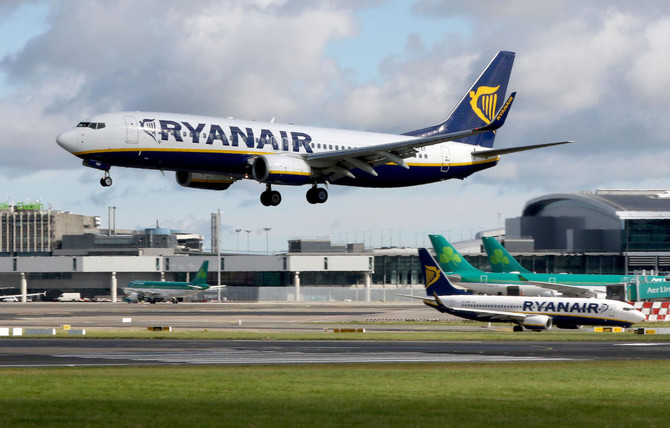
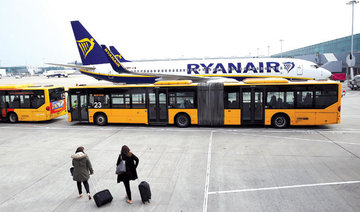
DUBLIN: Europe’s largest budget carrier Ryanair is to begin flying from Jordan for the first time next month as it expands its operations in the Middle East.
The Irish airline, which already flies to Israel and Morocco, will begin with a route from Amman to Paphos in Cyprus in March, it said in a statement. Next winter it will fly 14 routes from Amman and Aqaba.
The airline, which carried almost 130 million passengers last year, expects to fly 430,000 passengers per year to and from Jordan, it said.
The vast majority of Ryanair’s routes are in the European Union, but it also flies to a number of non-EU countries that, like Jordan, have “Open Skies” agreements with the EU that allow deregulated air travel.
“Enhancing air connectivity is one of the key areas Jordan is focusing on given its impact on unlocking economic growth through attracting business investment as well as spurring tourism,” Jordan’s Minister of Tourism Lina Annab said in a statement welcoming Ryanair’s announcement.
Jordan’s tourism market was damaged in 2016 when a dozen people, including a Canadian tourist, were killed in two attacks by militants in the southern city of Karak.

Ryanair expands in Middle East with first Jordan flights
Saudi POS spending opens 2026 with a 31% surge: SAMA
RIYADH: Saudi Arabia’s total point-of-sale transactions reached SR17 billion ($4.5 billion) in the week ending Jan. 3, with all sectors recording positive weekly growth.
According to the latest data from the Saudi Central Bank, the total POS value represented a 30.6 percent week-on-week increase, while the number of transactions rose 15.7 percent to 255.36 million.
Spending on freight transport, postal and courier services recorded the sharpest increase, surging 110.9 percent to SR74.22 million, followed by education, which rose 66.4 percent to SR235.51 million.

Expenditure on personal care increased by 31.7 percent, while spending on books and stationery rose 36 percent. Jewelry outlays climbed 48 percent to SR544.12 million.
Further gains were recorded across other categories. Spending at pharmacies on medical supplies rose 42.1 percent to SR284.81 million, while expenditure on medical services increased 20.8 percent to SR556.27 million.
The food and beverages sector saw outlays rise 41.4 percent to SR2.7 billion, accounting for the largest share of POS transactions.
Restaurants and cafes followed with a 20.9 percent increase to SR1.9 billion, while apparel and clothing spending rose 30 percent to SR1.6 billion, ranking third.
Together, the top three categories accounted for approximately 36.53 percent of total POS spending, or SR6.22 billion.

Saudi Arabia’s major urban centers mirrored the national surge.
Riyadh, which accounted for the largest share of POS spending, saw a 21 percent increase to SR5.61 billion, up from SR4.63 billion the previous week.
The number of transactions in the capital rose 12.2 percent to 79.6 million.
In Jeddah, transaction values increased 25.6 percent to SR2.24 billion, while Dammam posted a 26.1 percent rise to SR831.93 million.
POS data, tracked weekly by SAMA, provides an indicator of consumer spending trends and the ongoing growth of digital payments in Saudi Arabia.
The data also highlights the expanding reach of POS infrastructure, extending beyond major retail hubs to smaller cities and service sectors, supporting broader digital inclusion initiatives.
The growth of digital payment technologies aligns with Saudi Arabia’s Vision 2030 objectives, promoting electronic transactions and contributing to the Kingdom’s broader digital economy.