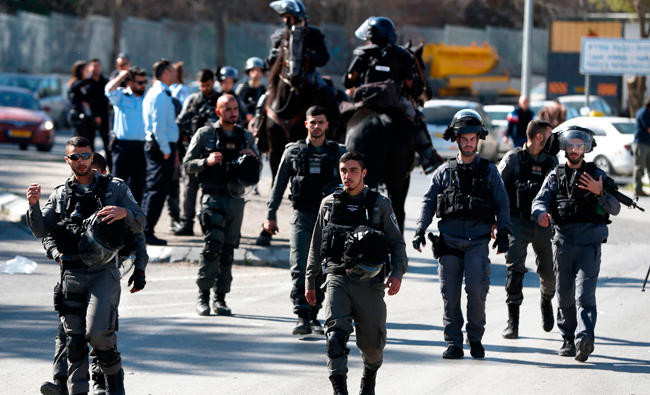
AMMAN: Church leaders and lawyers have reacted angrily to news of Israeli attempts to charge municipal taxes on church properties in Jerusalem.
According to a report from Agence France-Presse (AFP), Mayor of Jerusalem Nir Barkat has decided to change a policy applied to churches in Jerusalem since 1967.
The AFP report says the Jerusalem Municipality informed the Ministry of Finance and the Prime Minister’s Office that it is demanding that church and international institutions pay municipal taxes on properties owned by them.
It is estimated that the municipality is demanding 650 million shekels ($191 million) from the new policy from churches and international agencies that have previously been exempt from paying such taxes.
Rif’at Bader, director of the Catholic Center for Studies and Media in Amman, told Arab News that the issue is not new, but that the timing is curious and seems linked to political, rather than economic, reasoning.
“It comes after the churches in Jerusalem took a strong stand against the US president’s declaration of Jerusalem as the capital of Israel, and after they refused to meet with the visiting vice president Mike Pence,” he said.
Wadia Abu Nassar, adviser to the Assembly of Catholic Bishops in the Holy Land, told Arab News that the municipality had not discussed the issue with church leaders.
“No one has been contacted on it,” he said. “This is an idea from some of the Jerusalem municipality council members.”
Nassar said that the Vatican and Israel have been discussing various municipal issues since 1993, and claimed there is an agreement between the two parties that no changes would be made to the status quo until those talks were concluded.
The Eastern Orthodox Archbishop of Sebastia, Atallah Hanna, told reporters in Jerusalem that the tax initiative is part of a campaign to empty Jerusalem of its remaining Christians.
“At a time when Israel is targeting our endowments in various illegal and crooked ways, now they are using the lever of high taxes against our churches, convents and institutions in Jerusalem with the aim of emptying the old city of Jerusalem of its Christians and to marginalize the Christian presence in Jerusalem,” he said.
Atallah pointed out that churches existed in Jerusalem long before the creation of the state of Israel.
“Some of our churches go back to the fourth and fifth century AD,” he said. “The tradition has always been to exempt the churches and their properties from taxes. This was the case during the British mandate, during the Jordanian rule, and even as far back as the Ottoman period.”
Botrus Mansour, a Nazareth-based lawyer and general director of an evangelical school, told Arab News that Israel must treat all faiths equally if they wish to begin imposing taxes.
“The ultra-orthodox Jewish organizations enjoy a wide range of privileges and tax exemptions,” he said. “The minute they treat all religious institutions of all faiths equally then they are entitled to implement this law on Christians.”


![]()
Israeli attempts to tax churches opposed
Israeli attempts to tax churches opposed


Latest updates


© 2026 SAUDI RESEARCH & PUBLISHING COMPANY, All Rights Reserved And subject to Terms of Use Agreement.