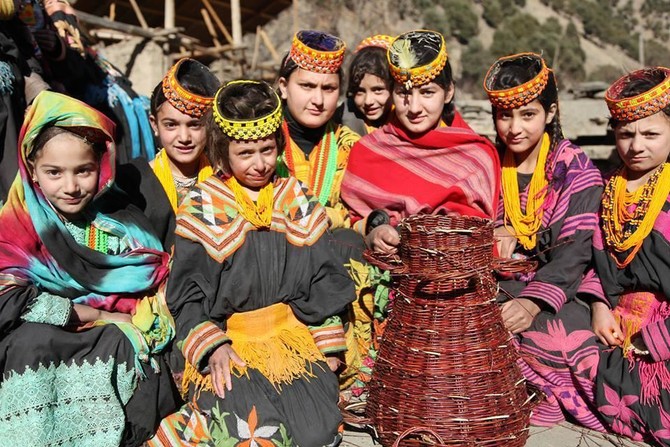
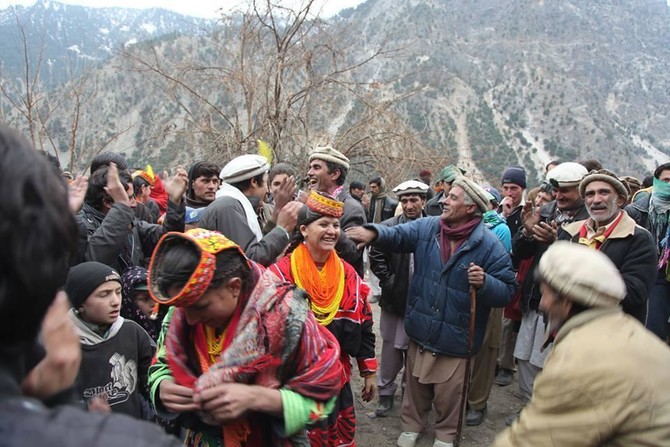
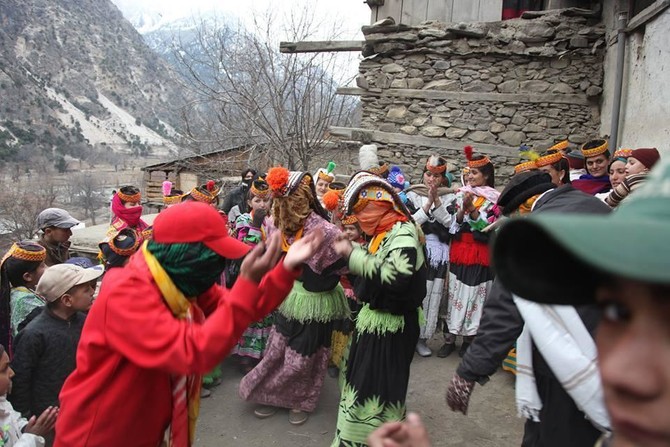
PESHAWAR:The Directorate of Archaeology and Museums in Pakistan’s Khyber Pakhtunkhwa (KP) province launched its “Presevation and Promotion of Kalash Valley” project over the weekend.
Nawazud Din, research officer at the directorate, said the Rs60 million ($543,000) project aims to promote and conserve the unique culture of the ancient Kalash community — an endangered minority in the Hindukush mountain belt of Chitral in northern Pakistan — as well as to attract tourism.
“Kalash has a great deal of tourism potential,” he told Arab News, saying both local and international travelers would find the area had much to offer.
Kalash architecture is a unique mixture of ancient woodcraft and the medieval traditions of figure art. Kalash buildings typically feature magnificently carved wooden pillars and beams decorated with human and animal figures and effigies — each one depicting a certain myth and superstition.
The area — divided into three main sub-valleys: Barir, Bamboret and Rumbor — is also known for its local handicrafts, including the spinning and weaving of rugs, carpets, belts and headgear. Sayed Gul Kalashi, manager of Chitral Museum, said the valley’s population is currently a little over 4,000. And Kalash activists have been raising concerns over the speed with which that number is shrinking.
The Kalash tribe has been settled in the valley for centuries. The people are widely believed to be descended from Alexander the Great’s soldiers. Indeed, Kalashi told Arab News that when a group of Greek nationals arrived in the valley a few decades ago, the locals were shocked at the resemblance between them and their guests.
The later Greek visitors, she said, “worked for the welfare of the locals” and earned their respect. They launched education and health projects “because the area is underdeveloped and lacks basic amenities,” and also set up a museum in Bamboret.
Chitral’s deputy commissioner, Irshad Sadhar, told Arab News that local authorities have banned the purchase or sale of land in Kalash valley in order to protect cultural heritage sites.
“We are preserving their places of worship, graveyards and where they usually dance during their festivals,” he explained, adding that they are also “creating places for tourists too.”


Kalash cultural preservation project launched in Pakistan
Kalash cultural preservation project launched in Pakistan



Director Kaouther Ben Hania rejects Berlin honor over Gaza
DUBAI: Kaouther Ben Hania, the Tunisian filmmaker behind “The Voice of Hind Rajab,” refused to accept an award at a Berlin ceremony this week after an Israeli general was recognized at the same event.
The director was due to receive the Most Valuable Film award at the Cinema for Peace gala, held alongside the Berlinale, but chose to leave the prize behind.
On stage, Ben Hania said the moment carried a sense of responsibility rather than celebration. She used her remarks to demand justice and accountability for Hind Rajab, a five-year-old Palestinian girl killed by Israeli soldiers in Gaza in 2024, along with two paramedics who were shot while trying to reach her.
“Justice means accountability. Without accountability, there is no peace,” Ben Hania said.
“The Israeli army killed Hind Rajab; killed her family; killed the two paramedics who came to save her, with the complicity of the world’s most powerful governments and institutions,” she said.
“I refuse to let their deaths become a backdrop for a polite speech about peace. Not while the structures that enabled them remain untouched.”
Ben Hania said she would accept the honor “with joy” only when peace is treated as a legal and moral duty, grounded in accountability for genocide.


