JEDDAH: US President Donald Trump has not ruled out military action to stop chemical weapons attacks in Syria, senior administration officials have said, signaling an intensified effort to press the Damascus regime and its Russian patrons.
In the wake of yet more suspected sarin and chlorine attacks blamed on the regime, Washington said it wants to send a message to Bashar Assad and Moscow that enough is enough.
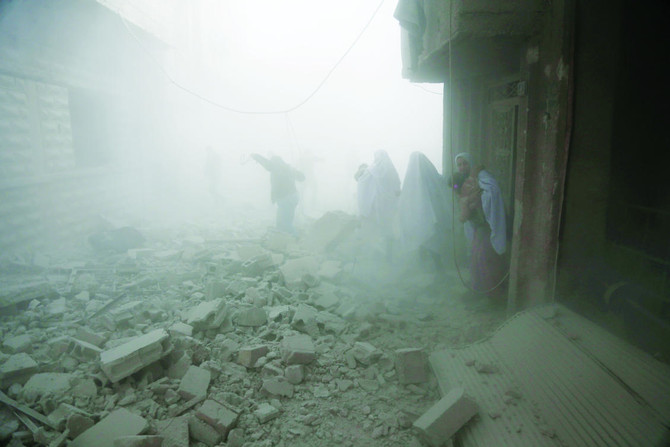
The latest unconfirmed attack came on Thursday, in the opposition-controlled town of Douma. The Syrian Observatory for Human Rights said that three people suffered respiratory problems after a rocket attack.
Yahya Al-Aridi, spokesman for the Syrian opposition, told Arab News that had it not been for Russia, “the regime wouldn’t have dared to continue its activities and brutal action.”
He said: “This, of course, is another war crime. Crimes perpetrated by the regime have become countless.”
There have been more than 260 reports of chemical attacks, some of which have been verified by UN-backed inspectors and attributed to the Assad regime.
A senior US official told AFP that military options against Damascus similar to those launched in April 2017 were always on the table and “always feasible.”
Trump “hasn’t excluded anything” in the bid to halt the program, the official said. “Using military force is something that is still considered.”
Al-Aridi said the only way to stop the regime’s crimes, in particular the use of chemical weapons, is for Russia, which is responsible for its survival, to behave in a responsible way as a member of the UN Security Council and pressure Assad.
He said the Security Council “should pass legislations or certain laws” that prevent the regime from killing its people with internationally prohibited weapons. “We hear talk, but we don’t see action.”
A second senior US official reported evidence that Assad’s regime has an “ongoing production capability” focused on sarin and chlorine and is developing new ways to deploy the chemicals banned for weapons use.
“It looks like they are trying to evolve for either military reasons or to escape accountability. It is incredibly important to stop that before it gets off the ground,” the official said.
“We are convinced that if the international community does not take action now,” the second official said, “we will see more chemical weapons use, not just by Syria but by non-state actors. That use will spread to US shores if we cannot stop it,” he said.
Al-Aridi said: “No one is doing anything to ease the pains of Syrian people, unfortunately.”
Syrians, he said, are still waiting for the world to act effectively, but there could come a time when the world acts “because these are crimes perpetrated against humanity on a daily basis.”
US Defense Secretary James Mattis said that chlorine gas has been weaponized and used repeatedly by the regime. He told reporters that the regime would be ill-advised to “go back to violating the chemical weapons convention.”
Mattis said that he had not seen the evidence of the use of sarin gas by the regime but was looking into reports about it.
The Assad regime appears to have altered course only slightly since the US fired 59 Tomahawk cruise missiles at a Syrian airfield in 2017 after a large chemical attack on opposition-held Khan Sheikhun.
Instead of dropping barrel bombs filled with chemical agents from helicopters, the officials said that mortars and other ground-based delivery systems were now being used.
“What they are trying to do as they tip-toe along is testing, and what we are trying to say is that we continue to care about this,” said the second official. The chemical of choice has most often been industrial chlorine, which is easy to produce and legal to possess, rather than sarin, which is banned by the Chemical Weapons Convention.


US not ruling out Syria strikes after new chemical attack
US not ruling out Syria strikes after new chemical attack



Internet blackout leaves anxious Iranians in the dark
PARIS: Iran’s internet is still “around 1 percent of ordinary levels,” monitor Netblocks said on Thursday, leaving most Iranians struggling to access independent news or communicate with the outside world.
Iranian authorities shut off internet access on Saturday after Israel and the US began air strikes, plunging the country into an information blackout.
“Iran’s internet blackout has now exceeded 120 hours with connectivity still flatlining around 1 percent of ordinary levels,” internet monitor Netblocks said in a message posted on social media platform X on Thursday.
Some Iranians are finding brief moments of the day when they are able to connect and send messages, while others have resorted to using illegal Starlink subscriptions. Calls to Iran from overseas to mobile phones or landlines are near-impossible.
“The internet speed is very slow,” a Tehran resident said by message, asking to remain anonymous for security reasons. “You can’t call and voice messages don’t get delivered. We can just text.”
Netblocks said that Iranian telecoms companies were now sending messages to “threaten users who try to connect to the global internet with legal action.”
“The internet situation here is abysmal,” a resident in Bukan in western Iran, said in a message. “It connects and disconnects. The connection is slow, so the VPNs don’t work.”
In normal circumstances, Iranians use VPNs to connect to Western internet services such as Instagram that are banned in Iran.
Others with working internet connections are helping out others.
Shima, a 33-year-old in Tehran, said that she was helping friends by sending news of life in the capital, which has been hit by waves of missile and bombing strikes since Saturday.
“I need to call a lot of people, even strangers, on behalf of their families,” she said.