UAE’s Al Jaber Group close to $1.6bn debt restructuring

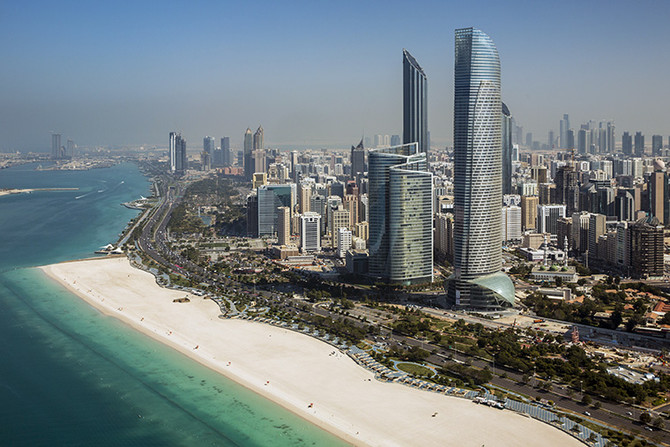
Al Jaber’s outlook has been boosted by expected awards of new construction projects in both Abu Dhabi, above, and Dubai. (Reuters)
Updated 01 February 2018
Follow

UAE’s Al Jaber Group close to $1.6bn debt restructuring

DUBAI: Abu Dhabi-based Al Jaber Group expects to seal a deal to restructure around 5.75 billion dirhams ($1.6 billion) in debt this month, a source at the company and other sources familiar with the matter said on Thursday.
Although the conglomerate, which was founded by the Al-Jaber family in 1970, has struggled since a downturn in construction hit the UAE after the global financial crisis, its outlook for 2018 onwards is positive, the company source told Reuters.
Al Jaber’s outlook has been boosted by expected wins of new construction projects in both Abu Dhabi and Dubai.
“We have concluded all commercial terms of the new deal and are about to sign with all the banks to receive 100 percent agreement imminently,” the company source said, adding that 97.5 percent of creditors had agreed so far.
Al Jaber’s debt is mostly held by local and international banks, although some hedge funds and other non-bank financial institutions also feature among the creditor group, sources familiar with the matter said.
Since completing a $4.5 billion debt restructuring in June 2014, Al Jaber, best known as a contractor but with interests in other sectors, has taken steps to sell non-core assets, including its 80 percent stake in construction joint venture ALEC to Investment Corporation of Dubai last year.
Such sales have helped to cut debt, with the reduction also boosted by increases in revenue, the sources said.
Under the new plan, the maturity of the debt will be extended by seven years to Sept. 30, 2024, with the company also required to continue to reduce it via quarterly repayments and further asset sales, the sources said.
It also includes a reduction in the interest rate on the debt and the removal of “payment in kind” accrued interest, while quarterly amortization payments will also be cut from March 2019, the company source said.
Al Jaber’s problems started in the mid-2000s when it borrowed to fund its drive to expand outside of its core business of construction.
The weight of the debt and a slowdown in the local market pushed it to begin talks with creditors in 2011. But the 2014 restructuring failed to ease Al Jaber’s troubles and in March 2016 it missed a repayment.



Saudi POS spending jumps 28% in final week of Jan: SAMA

Updated 8 sec ago
Follow

Saudi POS spending jumps 28% in final week of Jan: SAMA

RIYADH: Saudi Arabia’s point-of-sale spending climbed sharply in the final week of January, rising nearly 28 percent from the previous week as consumer outlays increased across almost all sectors. 

POS transactions reached SR16 billion ($4.27 billion) in the week ending Jan. 31, up 27.8 percent week on week, according to the Saudi Central Bank. Transaction volumes rose 16.5 percent to 248.8 million, reflecting stronger retail and service activity. 

Spending on jewelry saw the biggest uptick at 55.5 percent to SR613.69 million, followed by laundry services which saw a 44.4 percent increase to SR62.83 million. 

Expenditure on personal care rose 29.1 percent, while outlays on books and stationery increased 5.1 percent. Hotel spending climbed 7.4 percent to SR377.1 million. 

Further gains were recorded across other categories. Spending in pharmacies and medical supplies rose 33.4 percent to SR259.19 million, while medical services increased 13.7 percent to SR515.44 million. 

Food and beverage spending surged 38.6 percent to SR2.6 billion, accounting for the largest share of total POS value. Restaurants and cafes followed with a 20.4 percent increase to SR1.81 billion. Apparel and clothing spending rose 35.4 percent to SR1.33 billion, representing the third-largest share during the week. 

The Kingdom’s key urban centers mirrored the national surge. Riyadh, which accounted for the largest share of total POS spending, saw a 22 percent rise to SR5.44 billion from SR4.46 billion the previous week. The number of transactions in the capital reached 78.6 million, up 13.8 percent week on week. 

In Jeddah, transaction values increased 23.7 percent to SR2.16 billion, while Dammam reported a 22.2 percent rise to SR783.06 million. 

POS data, tracked weekly by SAMA, provides an indicator of consumer spending trends and the ongoing growth of digital payments in Saudi Arabia.  

The data also highlights the expanding reach of POS infrastructure, extending beyond major retail hubs to smaller cities and service sectors, supporting broader digital inclusion initiatives.  

The growth of digital payment technologies aligns with Saudi Arabia’s Vision 2030 objectives, promoting electronic transactions and contributing to the Kingdom’s broader digital economy.