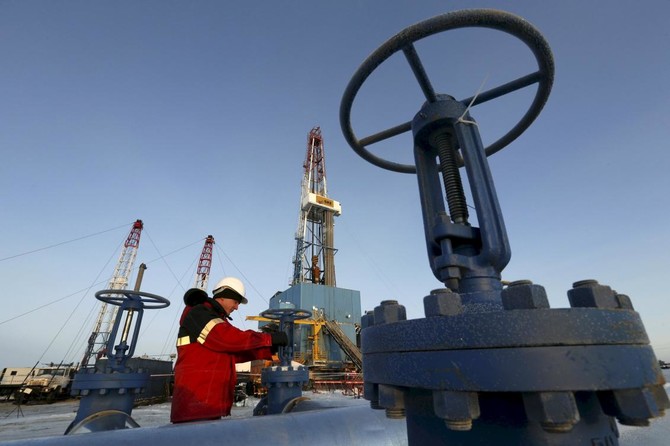
LONDON: An OPEC and non-OPEC agreement to limit crude production in 2018 at current levels will be difficult to maintain, Fahad Al-Turki, chief economist at Riyadh-based bank Jadwa Investment, has told a London conference.
The pact, which involves output cuts of 1.8 million barrels per day by the world’s biggest producers, is designed to buoy prices, and rebalance supply and demand. The deal was agreed at the end of 2016 and has been renewed several times, most recently in November, 2017, but is up for review in June, 2018.
Al-Turki told a Middle East and North Africa energy conference at Chatham House, London: “I doubt that the oil production cuts agreement will hold throughout 2018, partly because targets have already been met and because there will be some countries that will want to recoup their investment and increase production.”
He said for this reason and because of an expected increase in US shale production, Jadwa was forecasting the oil price in 2018 would average $60 per barrel.
Al-Turki said that after negative growth last year, the outlook for the Saudi economy was positive for 2018. “But how positive depends on the government implementing its reform policies sooner rather than later, especially the stimulus for the private sector,” he said.
The chief economist expected the oil sector to grow by about 1.5 percent and the non-oil sector by 1.4 percent this year.
Al-Turki said: “If, in 2015, you would tell me the government could generate non-oil revenue of more than SR250 billion ($66.6 billion), I would have said that was impossible. Now we see that it’s happening.”
The stimulus package for the private sector totalled SR72 billion this year, part of a SR400 billion package over four years, he said.
Al-Turki said: “We think 2017 was the toughest year, but it was mitigated by the strength of the sovereign balance sheet. Now the government has the opportunity to take a more practical approach through a gradual fiscal balance program.”
The London conference, held under Chatham House rules that prevent disclosure of speakers’ identities unless they give permission to be quoted, also heard experts commenting on economic prospects for Gulf Cooperation Council (GCC) countries.
One expert said: “There is a problem in that the non-oil sector is driven by government money, so construction companies, for instance, even if they are private, depend on government contracts, and those contracts are funded from oil revenue.”
GCC countries are attempting to reduce their dependency on oil income by diversifying their economies.
But as government expenditure has come down, there has been a significant slowdown in non-oil economic growth, said one delegate.
“If government doesn’t have the resources to drive the wheels of the non-oil economy, then the resources should come from elsewhere,” the delegate said. “One solution would be to attract more private capital from abroad. But in order to attract foreign direct investment, the GCC needs to further clarify ownership and residency rights, as well as bring legal and accounting practices more in line with best international practice.”
Another expert said that diversification was “very challenging,” but the reforms undertaken in Saudi Arabia were “staggering.”
The Kingdom’s Vision 2030 program, designed to modernize and liberalize the country’s economy, sets out to unlock “promising economic sectors,” diversify the economy and create job opportunities.
Another speaker told the conference that in Saudi Arabia and Oman the most pressing challenge was employment. “My calculation is that 1 million Saudis will move into the labor market in the next five years,” the speaker said. “The question is where are they going to find jobs, even if oil prices stay at around current levels. The public sector will no longer be able to absorb jobseekers.”
Developing a domestic private sector that could provide jobs was essential, so it was critical that GCC countries continued to wean themselves off expat labor, the expert said.
Saudi Arabia is already taking action on this front. In December, the Ministry of Finance said it would introduce a monthly expat levy from this year.
Tourism and entertainment would provide significant employment to young Saudis, as would oil and oil-backed industries, where the Kingdom had a great advantage, another delegate said.


![]()
OPEC pact to cut oil output ‘unlikely to last’
OPEC pact to cut oil output ‘unlikely to last’


Latest updates




© 2026 SAUDI RESEARCH & PUBLISHING COMPANY, All Rights Reserved And subject to Terms of Use Agreement.