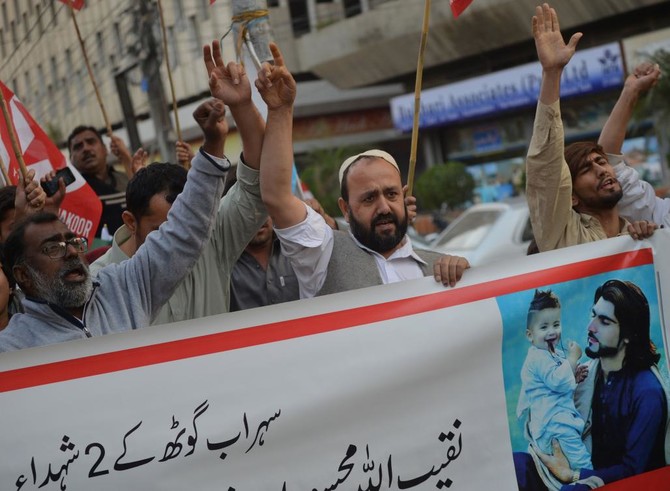
KARACHI: The family of Naqeeb Mehsud, the aspiring Pashtun male model who was killed on Jan. 13 in what they claim was a falsely staged police encounter, told Arab News on Tuesday that they have been approached by “influential friends” of fugitive senior superintendent of police Rao Anwar and pressured to drop terrorism charges against him.
Mehsud, 27, was one of four men killed in an encounter with a police team headed by Anwar on the outskirts of Goth Usman Khaskheli. Anwar has claimed that Mehsud was a terrorist involved in several murders and with ties to Daesh.
Mehsud’s family are adamant that they will not drop their case against the group.
“We will not succumb to any pressure. Our struggle will continue until Anwar and his accomplices are hanged,” Noor Rehman Mehsud, Naqeeb’s cousin, told Arab News.
Meanwhile, police have intensified their efforts to arrest Anwar and his core team members for their extrajudicial killings.
“We are conducting raids and a police party, headed by SSP Zulfikar Mehar, has reached Islamabad to arrest Rao Anwar,” Superintendent Abid Qaimkhani told Arab News.
Qaimkhani said six policemen have so far been arrested but confirmed that none of Anwar’s core team members, including DSP Qamar, SHO Amanullah Marwat, officials Chaudhry Faisal and Shoaib Shooter, and constable Raza, had yet been apprehended.
Inspector General Dino Khawaja of the Sindh police, who have already missed the deadline set by Pakistan’s Supreme Court to arrest Anwar, sent a letter on Monday to the chiefs of Inter-Services Intelligence (ISI), Intelligence Bureau (IB) and Military Intelligence (MI), seeking their help in locating the police officer who, according to Khawaja, has damaged the image of the police force.
Activists have raised questions about the police investigation and the competence of those running the search for the fugitive officer.
“If Rao Anwar is at large after the Sindh police chief has requested help from the intelligence agencies — and after the Sindh government has approached other provinces for help — it would imply that he is either smarter than all of them or that the state machinery is incompetent,” Jibran Nasir, a rights activist, told Arab News.
He pointed out that Anwar was known to enjoy the patronage of political leaders, real estate tycoons and intelligence agencies alike, adding that it was notable Anwar had been posted in District Malir for almost a decade, an unusually long time.
Nasir said he was concerned that if Mehsud’s family dropped the terrorism charges Anwar could easily escape conviction under the diyat (compensation) law.
“All that Naqeeb’s father, his relatives, and thousands of those who raised their voice for justice in this case on different forums want is a legal precedent that can bring an end to such dreadful extrajudicial killings in the future,” said Ali Arqam, an activist who first broke the news of Naqeeb’s murder on social media.
Members of the Mehsud and other Pashtun tribes began a protest march toward Islamabad on January 26. They were expected to reach the federal capital on Thursday and to gather at the National Press Club.
Mehsud’s father, Mohammed Khan, stressed that the issue was not just his son’s murder, but those of all victims of extrajudicial killings.
“I would not let another Naqeeb die like this in the future,” he said.

Naqeeb Mehsud’s family vow to see his killers ‘hanged’
Modi’s rooftop solar push slowed by reluctant lenders, states
- The shortfalls represent the latest challenge to India’s efforts to nearly double clean energy capacity to 500 gigawatts by 2030
SINGAPORE/MUMBAI/BHUBANESWAR, India: Indian Prime Minister Narendra Modi’s push to accelerate the rollout of rooftop solar power is falling short of targets despite heavy subsidies due to loan delays and limited support from state utilities, vendors and analysts say.
The shortfalls represent the latest challenge to India’s efforts to nearly double clean energy capacity to 500 gigawatts by 2030, and come as the government plans to suspend clean energy tendering targets amid a mounting backlog of awarded projects yet to be built.
Challenges to plans to increase solar uptake may mean India maintains its reliance on coal-fired power.
India’s Ministry for New and Renewable Energy created its subsidy program for residential solar panel installations in February 2024, covering up to 40 percent of the costs.
But residential installations at 2.36 million are well below the ministry’s target of 4 million by March, according to data from the program’s website.
“Banks’ reluctance to lend and states’ hesitance to promote the schemes could derail India’s efforts to transition away from coal,” said Shreya Jai, the lead energy analyst at research firm Climate Trends in New Delhi.
Roughly three in five rooftop solar applications filed on the scheme’s website are yet to be approved while about 7 percent have been rejected, according to government data on the program, known as the PM Surya Ghar.
In a statement to Reuters about the pending applications, the renewable energy ministry pointed to accelerating installations which have benefited over 3 million households, and said the scheme enables state-owned utilities to reduce subsidy payouts to keep residential power bills in check.
“The loan rejection rate varies across states,” the statement said.
Under PM Surya Ghar, consumers apply and select a vendor who handles paperwork and arranges bank financing for solar panels. After loan approval and installation, the vendor submits proof, after which the government subsidy is credited to the bank.
BANK DELAYS
However, banks have been rejecting or delaying loans for numerous reasons including lack of documentation, which they say is necessary to protect public funds.
“We are working with the government to push for some standard documentation, because it is necessary to avoid bad loans. Currently if loans go bad, banks can take away these panels but what will we do with these panels?” said a senior official at a major government-owned bank.
Chamrulal Mishra, a solar vendor in the eastern Indian state of Odisha, said applications are often rejected because the customer has missed electricity payments or because land records are still in the name of deceased relatives.
Residents there dispute the claims that they have missed payments, which they attribute to administrative errors after a change in utility ownership decades prior.
A spokesperson for India’s Department of Financial Services, which regulates the country’s banks, said they have responded to consumer feedback to allow co-applicants for loans to clear up title claims and the simplification of documentation requirements.
The Renewable Energy Association of Rajasthan said some banks are making collateral demands for loans under 200,000 Indian rupees ($2,208.87), despite scheme guidelines not requiring them to, which is constraining solar power additions.
State Bank of India and Punjab National Bank, some of the country’s largest lenders, did not reply to requests for comment on the matter.
State-owned utilities are also not promoting rooftop solar as much, as they are concerned about the loss of revenue as sales move off the electric grid.
“Wealthier households typically have high electricity consumption, tariffs and reliable roof access. When they shift from the grid, it leaves a larger financial burden,” said Niteesh Shanbog, an analyst at Rystad Energy.