JOHANNESBURG: South Africa’s deputy president is acting more like a president these days, while talk surrounding his scandal-tainted boss is about how and when he would quit.
That makes for awkward leadership in one of Africa’s biggest economies, where a power transition from President Jacob Zuma to his deputy, Cyril Ramaphosa, appears to be taking shape even though the president’s term runs until 2019 elections.
An early exit for Zuma is being considered by ruling African National Congress party officials amid impatience among South Africans who hope change at the top could reduce high-level corruption that has hurt the economy and the ANC’s popularity and diminished South Africa’s international image.
A flashpoint for frustration could come on Feb. 8 when Zuma is scheduled to deliver the state of the nation address in parliament. If he speaks, there likely would be protests both inside and outside the chamber. On Wednesday, Mmusi Maimane, the main opposition leader, asked the parliament speaker to postpone the speech until the ruling party resolves its internal conflict and South Africa has a new president.
For now, South Africa seems to have two leaders, one on the way out and one poised to take over. Ramaphosa, who emerged from Zuma’s shadow after replacing him as head of the ruling party in December, represented the country last week in a high-profile visit to the World Economic Forum in Davos, Switzerland.
In a speech back home on Tuesday, Ramaphosa delivered an anti-corruption message widely viewed as a coded attack on Zuma and his associates.
“We remain resolute that no act of corruption will go unpunished, regardless of the identity of the perpetrator,” Ramaphosa said, adding that national development “cannot take root in a sea of patronage, greed and willful economic sabotage.”
Zuma, meanwhile, returned on the same day from an African Union summit in Ethiopia, where he also talked about corruption. He acknowledged a problem in Africa but called it “quite exaggerated” at times and said entities outside the continent encourage African corruption for their own benefit.
Zuma’s office said he also hosted a dinner commemorating the 100th birthday of Nelson Mandela, who died in 2013. Some South African media characterized the dinner as an informal farewell to fellow leaders.
The Ethiopia trip contrasted with Ramaphosa’s up-tempo appearance among world leaders at Davos, where he promised that South Africa was entering a “new era” of clean government and business confidence.
A former union leader during apartheid, Ramaphosa built a reputation as a shrewd ANC negotiator during the early 1990s transition from white minority rule to democracy and later became a wealthy businessman.
Zuma, also a figure in the anti-apartheid movement, has been embroiled in scandals, including multi-million-dollar upgrades to his private home with state money and his association with the Guptas, a business family accused of looting state enterprises and influencing Cabinet ministers for their own benefit. Both Zuma and the Guptas have denied wrongdoing.
High-profile investigations have picked up pace since Ramaphosa became ruling party leader.
On Tuesday, Lucky Montana, a former CEO of South Africa’s passenger rail agency, told a parliamentary inquiry that he resisted pressure to appoint Gupta associates to the agency’s board. Parliament is investigating similar allegations of corruption and mismanagement at other state-owned enterprises, including power utility Eskom.
Under pressure in recent weeks to step aside and improve the ruling party’s image ahead of the 2019 elections, Zuma has appointed a commission of inquiry to look into corruption allegations. He could be looking to secure benefits after the presidency including protection from prosecution, according to analysts.
The options for an early Zuma exit include resignation; his recall by the ruling party’s leadership; and impeachment or a vote of no-confidence in parliament, where the ANC holds a majority.
Maimane, leader of the opposition Democratic Alliance, said that as long as Zuma is president and Ramaphosa is head of the ruling party, the country is left “not knowing which direction is being pursued.”


![]()
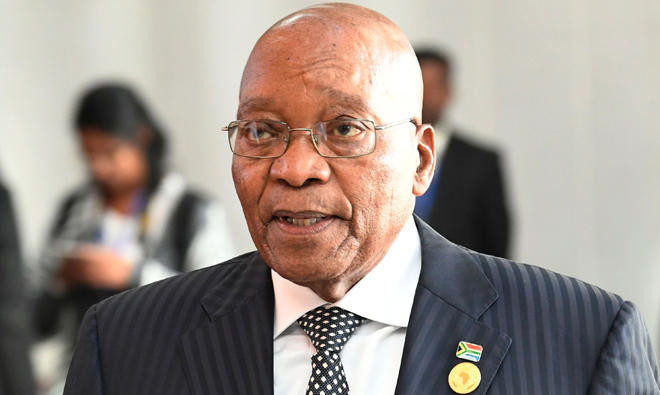
Growing pressure for Zuma to quit
Growing pressure for Zuma to quit

Latest updates


© 2026 SAUDI RESEARCH & PUBLISHING COMPANY, All Rights Reserved And subject to Terms of Use Agreement.