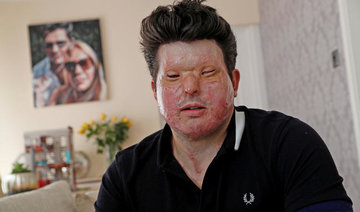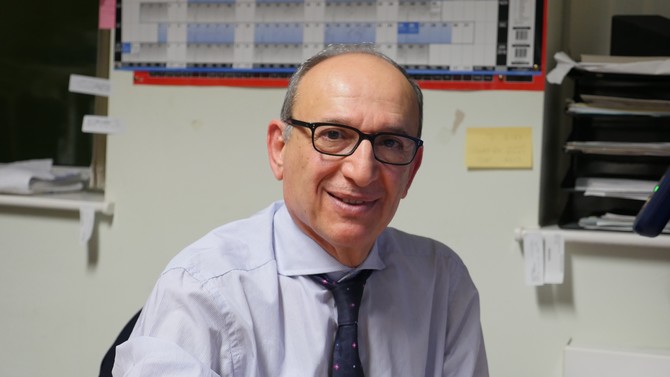
LONDON: A leading reconstructive surgeon has called on the UK government to ramp-up action to prevent acid attacks as hospitals face a spike in the number of victims of the “sickening” crime.
Naguib El-Muttardi, who frequently treats patients maimed in the assaults, said gang violence is behind the increase and called on the Home Office to crack-down on the sale and possession of corrosive substances.
The availability of sulfuric acid, he said, was particularly worrying, as criminal gangs often use the industrial chemical in attacks.
“It’s easy to get,” El-Muttardi told Arab News. “It should be considered a weapon and not be so easy to get.”
Part of a team at St. Andrew’s Center for Plastic surgery and Burns at Broomfield Hospital, one of the world’s leading burns units, El-Muttardi and his colleagues have been faced with a marked increase in the number of acid attack patients, with most cases taking place in East London.
“They are usually young people,” he said. “Most of them are in gangs.”
According to statistics released by London’s Metropolitan Police Service, there were more than 400 acid attacks in the city last year — a 65 percent increase from two years ago when just 260 similar assaults were registered.
While elsewhere in the world, acid attacks are associated closely with so-called “honor crimes” and domestic violence, in the UK corrosive substances — often sprayed in the faces of victims — have been adopted as a new weapon of choice by young criminals for use in robberies and gang violence, according to El-Muttardi and other experts on the issue.

Acid attacks in London have increased dramatically since 2014.
Those involved in the crimes, he said, “are trying to do harm without killing.” Instead, the attacks leave victims with horrific and often prominent disfiguration.
Dr. Johann Grundlingh, a consultant in emergency medicine and intensive care, who has treated acid attack victims, said the purpose of the attacks is to “brand people.”
“As an attack itself, you’re not trying to kill the other person— it’s a deliberate attempt to ruin someone’s life.”
El-Muttardi was part of the team which treated Naomi Oni, who was left with extensive burns to her face after being doused with acid in 2012 when she was just 20. Her case featured in a recent BBC documentary on the issue. Helping victims, who are often in the prime of their lives is a unique challenge, El-Muttardi said. “They are looking for a future, and they will be left with a permanent mark on their face.”
Doctors prevent victims from seeing their disfigured faces until weeks after the initial attack, El-Muttardi said, explaining that the shock is often too much to handle. Victims such as Oni, El-Muttardi said, require years of treatment, with multiple surgeries and long-standing psychological support. Even after several courses of skin grafts and laser treatments usually requiring weeks in hospital, El-Muttardi said patients are discharged and face a new life marked by the stigma of severe facial scars, he said.
While the resources required to treat a single case vary dramatically depending on the severity of the burn, El-Muttardi acknowledged that treatment is often “very expensive.”
The surgeon, who is originally from Libya but has been practicing medicine in the UK for more than two decades, said that while he has treated acid attack cases for the past 10 years, his team has seen the numbers rising. “We noticed that the number is increasing every year,” he said.
Both El-Muttardi and Grundlingh said they have already treated acid attack victims since New Year. Both expressed concerns that the attacks will continue to increase unless the government adopts restrictions on the sale of the most dangerous acids and implements harsher measures against those found carrying corrosive substances in public.
The sale and circulation of acid, El-Muttardi said, “must be controlled.” Grundlingh agreed. “The legislation needs to be reviewed to look at how acid or corrosive substances are supplied to the public,” he said.
Victoria Atkins, the Minister for Crime, Safeguarding and Vulnerability, said: “There is no place in society for sickening attacks on people involving acids or other corrosive substances that can result in huge distress and life changing injuries.”
The Home Office is reviewing new legislation that would regulate acid similarly to knives.
GOVERNMENT MUST ACT TO REDUCE ‘SHOCKING ASSAULTS’ SAYS MP
An MP has accused the government of dragging its feet as the capital has witnessed an increase in acid attacks.
“They’ve just got to get a move on,” said Stephen Timms, who represents East Ham in the House of Commons. With more than 400 acid attacks in London last year, the government promised to issue clearer sentencing guidelines for perpetrators, to restrict the sale of sulfuric acid and to make carrying corrosive substances in public a criminal offense. While applauding the pledge to act, Labour MP Timms said the issue must be prioritized.
“The commitment to act has been made, we welcome that. We now need the government to get on and bring forward the legislation to make the changes they’ve promised,” he told Arab News. “We need them to deliver.”
Meanwhile, Steve O’Connell, the chair of the London Assembly’s police and crime committee, said that he was equally concerned.
“What is shocking is that acid attacks have gone through the roof in numbers,” he told Arab News. “But to make it even more disturbing, few suspects have been charged.”
While the number of acid attacks has increased 65 percent over the past two years, suspects were unidentified in more than a third of the incidents, according to statistics released by the Metropolitan Police.

Acid attacks in London have increased dramatically since 2014.
Criminals have increasingly used acid in gang violence and as a way to incapacitate victims before stealing their personal belongings or mopeds. While the attacks often leave the victims with horrific facial scarring, the punishment for those found guilty of the assaults has been inconsistent, Timms said at a press conference on Friday.
“There have been some tough sentences and there have been some amazingly lenient sentences, and nobody quite knows what the courts are supposed to do. We need tougher, more consistent sentencing,” he explained.
The UK lags far behind other parts of the world which have cracked down on acid attackers. In Pakistan, those found guilty of assaults with corrosive substances are regularly jailed for several decades, while some perpetrators in the UK are eligible for release after serving just five years.
Meanwhile, the number of acid attacks in the UK is distressingly high, say authorities.
“The UK now has one of the highest rates of recorded acid and corrosive substance attacks per capita in the world and this number appears to be rising,” said assistant chief constable Rachel Kearton, the national lead on acid attacks, at a press conference last month.
As thugs in East London have turned to acid instead of knives as a way to skirt existing criminal codes, the mayor of Tower Hamlets, John Biggs, also called on the Government to “increase the severity of sentencing” for perpetrators.
“It’s about changing the climate or to make it very clear that this is not a clear way to get around the law. It is an absolute criminal activity,” he said. He also joined Timms in demanding that the Home Office treat carrying acid in public as a criminal offense, to be punished like carrying a knife in public.
According to statistics released by the Metropolitan Police, there were 36 acid attacks in Tower Hamlets alone between January and October last year. “It puts the fear of God into people. They’re absolutely terrified,” said Biggs. But while the government has repeatedly promised action, the attacks have continued, particularly in East London.
“Just last week I was dealing with someone who had quite a lot of acid thrown on him,” said Grundlingh, a consultant in emergency medicine at an East London hospital. “If this was happening in the golf clubs of Surrey, it would have been acted upon a lot more quickly,” Biggs acknowledged.
“This is a priority for my constituents.” Tower Hamlets, along with other boroughs including Newham which has also seen a high number of attacks, has been forced to take local action instead. Scores of local businesses have voluntarily signed up to an “acid charter” issued last month, vowing not to sell acid products such as drain cleaner or ammonia to under 18s or “anyone who may cause harm” with the substances.