LOS ANGELES: Jeremy Piven, who has strongly denied allegations of sexual misconduct from at least three women, is facing further accusations that date back decades, an online news site reported Saturday.
Three additional women claim Piven acted in a physically aggressive or threatening manner, BuzzFeed News reported in a story that included the actor’s rejection of the allegations as “false.”
The women said they were speaking out because of frustration over Piven’s previous denials.
One incident allegedly involved a high school student working as an extra in 1985 on Piven’s first film, “Lucas,” when he was 17. The other encounters took place in the 1990s, BuzzFeed said.
Two of the women are identified in the BuzzFeed story. The third, described as an executive with an international organization, asked that her name be withheld, the website said.
A publicist who had been representing Piven referred requests for comment to his manager at Silver Lining Entertainment in Beverly Hills. A call to the company’s listed phone number by The Associated Press wasn’t answered Saturday night.
A lawyer representing Piven didn’t immediately respond to an emailed request for comment.
One woman told BuzzFeed that Piven followed her into a set trailer, held her down and attempted to grope her. She fended him off and fled, she said.
Another said she met Piven in 1996 when he was appearing on the Ellen DeGeneres sitcom “Ellen” and she was an extra. She described a consensual romantic encounter at Piven’s home that changed when he allegedly exposed himself and tried to force himself on her, BuzzFeed reported.
The third woman alleged that Piven pushed her against a hotel room wall in Montreal in the early 1990s and attempted to force himself on her, BuzzFeed reported.
The Associated Press withheld the names of the two women identified in the story because it does not typically name people who say they were targeted by sexual misconduct unless it has their consent.
In a statement to BuzzFeed, Piven said the claims “are false. ... I have never forced myself on anyone, nor have I ever exposed myself or restrained anyone against their will. To the contrary, if any woman ever said no, I stopped.”
Last fall, The New York Times published allegations of sexual harassment and assault against Hollywood mogul Harvey Weinstein, who has denied any non-consensual sex. The report unleashed a range of accusations against other prominent men in entertainment, media and politics.
A number of the men facing allegations have lost their jobs or work. Piven’s freshman CBS crime drama, “Wisdom of the Crowd” was left up in the air after 13 episodes aired and the network said in November it wouldn’t expand its order, but didn’t say outright that the show was canceled.


Actor Jeremy Piven faces, denies more misconduct allegations
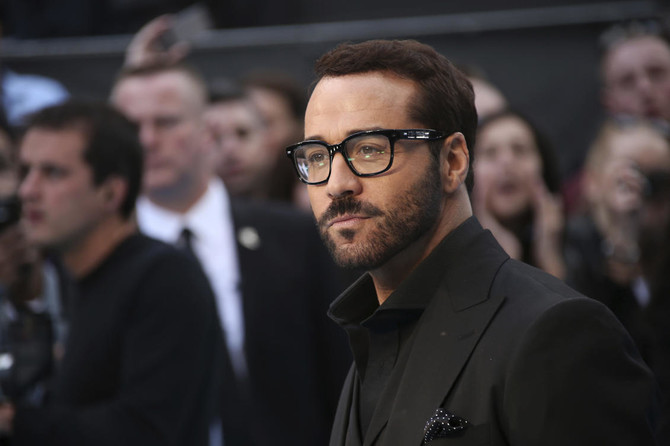
Actor Jeremy Piven faces, denies more misconduct allegations



Art Cairo spotlights pioneering artist Inji Efflatoun
CAIRO: Art Cairo 2026 returned to Egypt’s bustling capital from Jan. 23-26, with visitors treated to gallery offerings from across the Middle East as well as a solo museum exhibition dedicated to pioneering Egyptian artist Inji Efflatoun.
While gallery booths hailed from across the Arab world, guests also had the chance to explore the oeuvre of the politically charged artist, who died in 1989.
Many of the pieces in the 14-work exhibition were drawn from the collection of the Egyptian Museum of Modern Art and cover four main periods of the artist’s work, including her Harvest, Motherhood, Prison and Knoll series.

Efflatoun was a pivotal figure in modern Egyptian art and is as well known for her work as her Marxist and feminist activism.
“This is the third year there is this collaboration between Art Cairo and the Ministry of Culture,” Noor Al-Askar, director of Art Cairo, told Arab News.
“This year we said Inji because (she) has a lot of work.”
Born in 1924 to an affluent, Ottoman-descended family in Cairo, Efflatoun rebelled against her background and took part heavily in communist organizations, with her artwork reflecting her abhorrence of social inequalities and her anti-colonial sentiments.

One untitled work on show is a barbed statement on social inequalities and motherhood, featuring a shrouded mother crouched low on the ground, working as she hugs and seemingly protects two infants between her legs.
The artist was a member of the influential Art et Liberte movement, a group of staunchly anti-imperialist artists and thinkers.
In 1959, Efflatoun was imprisoned under Gamal Abdel Nasser, the second president of Egypt. The artist served her sentence for four years across a number of women’s prisons in the deserts near Cairo — it was a period that heavily impacted her art, leading to her post-release “White Light” period, marked dynamic compositions and vibrant tones.
Grouped together, four of the exhibited works take inspiration from her time in prison, with powerful images of women stacked above each other in cell bunkbeds, with feminine bare legs at sharp odds with their surroundings.

The bars of the prison cells obstruct the onlooker’s view, with harsh vertical bars juxtaposed against the monochrome stripes of the prison garb in some of her works on show.
“Modern art, Egyptian modern art, most people, they really don’t know it very well,” Al-Askar said, adding that there has been a recent uptick in interest across the Middle East, in the wake of a book on the artist by UAE art patron Sultan Sooud Al-Qassemi.
“So, without any reason, all the lights are now on Inji,” Al-Askar added.
Although it was not all-encompassing, Art Cairo’s spotlight on Efflatoun served as a powerful starting point for guests wishing to explore her artistic journey.


