MANSEHRA: Police in the Mansehra district of Khyber Pakhtunkhwa Province (KPK) have introduced 10-day community-service penalties for habitually negligent drivers — a first in Pakistan.
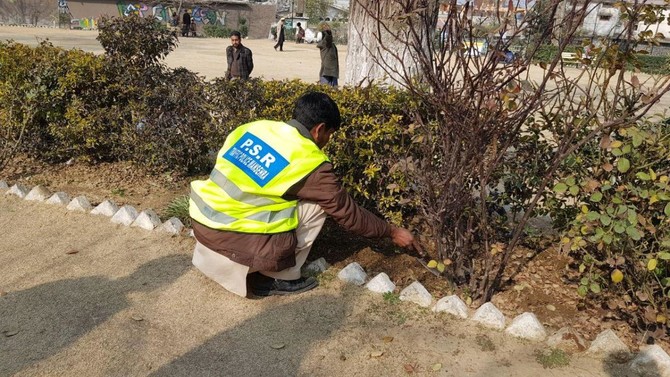
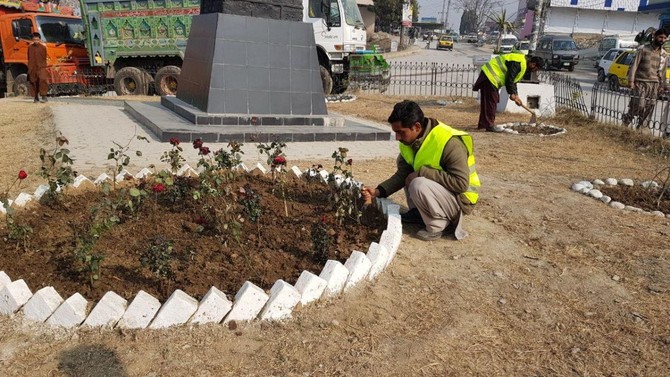
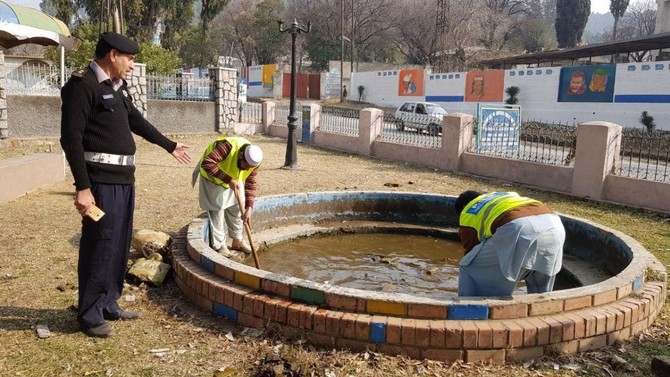
The offenders will have their licenses confiscated and will only get them back once they have completed their community service, which will involve socially beneficial tasks working in government departments including forestry, municipal administration, sanitation, and even traffic police.
Inspector Jamal Zeb of Mansehra traffic police told Arab News that offenders were only required to undertake community service for one hour a day, making it possible for them to go about their everyday lives.
“If someone does not wish to do it, he is made to do a short driving course at the traffic police driving school instead,” he added.
Syed Shahzad Nadeem Bukhari, the district’s senior police officer, explained that after an individual receives their 10th traffic ticket, his department is authorized to cancel the driver’s license.
Those drivers, Bukhari said “can work with any official unit for 10 days.” He added that the new scheme is designed “to promote a sense of public and civic service among people.”
Bukhari added that he had observed similar systems in certain developed countries as well. He hopes the initiative will help reduce road accidents in and around the city.
However, Noor Alam Khan, a KP-based lawyer, believes that while the police have the right to cancel driving licenses, the implementation of punishment is strictly the domain of the provincial assembly.
“If this unique mode of disciplining people has to be introduced, then the provincial assembly should turn it into a law and implement it in all districts,” he said.
But Bukhari deemed this unnecessary. “We have talked to heads of different government departments,” he said. “They are interested in our initiative since they need workforce. If someone is not interested in doing the one-hour social work for 10 days, he can opt to pay 4,000 rupees ($40) to take the driving course, since that is another way of reclaiming the license.”

Pakistan’s Mansehra introduces community service for traffic offenders
Israel says Netanyahu will meet with Trump on Wednesday about Iran talks
- Israeli Prime Minister Benjamin Netanyahu will meet with US President Donald Trump in Washington on Wednesday about the US talks with Iran
JERUSALEM: Israeli Prime Minister Benjamin Netanyahu will meet with US President Donald Trump in Washington on Wednesday about American talks with Iran, his office said Saturday, while Iran’s foreign minister threatened US military bases in the region a day after the discussions.
“The prime minister believes that all negotiations must include limiting the ballistic missiles, and ending support for the Iranian axis,” Netanyahu’s office said in a brief statement, referring to Tehran’s support for militant groups, including Hezbollah in Lebanon and Hamas in the Palestinian territories. Trump and Netanyahu last met in December.
There was no immediate White House comment.
The US and the Islamic Republic of Iran held indirect talks on Friday in Oman that appeared to return to the starting point on how to approach discussions over Tehran’s nuclear program.
Trump called the talks “very good” and said more were planned for early next week. Washington was represented by Middle East special envoy Steve Witkoff and Jared Kushner, Trump’s son-in-law.
Trump has repeatedly threatened to use force to compel Iran to reach a deal on its nuclear program after sending the aircraft carrier USS Abraham Lincoln and other warships to the region amid Tehran’s crackdown on nationwide protests that killed thousands.
Gulf Arab nations fear an attack could spark a regional war, with memories fresh of the 12-day Israel-Iran war in June.
For the first time in negotiations with Iran, the US on Friday brought its top military commander in the Middle East to the table. US Navy Adm. Brad Cooper, head of the military’s Central Command, then visited the USS Abraham Lincoln on Saturday with Witkoff and Kushner, the command said in a statement.
Iranian Foreign Minister Abbas Araghchi told journalists Friday that “nuclear talks and the resolution of the main issues must take place in a calm atmosphere, without tension and without threats.” He said that diplomats would return to their capitals, signaling that this round of negotiations was over.
On Saturday, Araghchi told the Al Jazeera satellite news network that if the US attacks Iran, his country doesn’t have the ability to strike the US “and therefore has to attack or retaliate against US bases in the region.”
He said there is “very, very deep distrust” after what happened during the previous talks, when the US bombed Iranian nuclear sites during last year’s Israel-Iran war.
Araghchi also said the “missile issue” and other defense matters are “in no way negotiable, neither now nor at any time in the future.”
Tehran has maintained that these talks will be only on its nuclear program.
However, Al Jazeera reported that diplomats from Egypt, Turkiye and Qatar offered Iran a proposal in which Tehran would halt enrichment for three years, send its highly enriched uranium out of the country and pledge to “not initiate the use of ballistic missiles.”
US Secretary of State Marco Rubio said Wednesday that the talks needed to include all those issues.
Israel, a close US ally, believes Iran is pursuing a nuclear weapon and wants its program scrapped, though Iran has insisted that its atomic plans are for peaceful purposes. Israel also wants a halt to Iran’s ballistic missile program and its support for militant groups in the region.
Araghchi, speaking at a forum in Qatar on Saturday, accused Israel of destabilizing the region, saying that it “breaches sovereignties, it assassinates official dignitaries, it conducts terrorist operations, it expands its reach in multiple theaters.” He criticized Israel’s treatment of Palestinians and called for “comprehensive and targeted sanctions against Israel, including an immediate arms embargo.”
“The prime minister believes that all negotiations must include limiting the ballistic missiles, and ending support for the Iranian axis,” Netanyahu’s office said in a brief statement, referring to Tehran’s support for militant groups, including Hezbollah in Lebanon and Hamas in the Palestinian territories. Trump and Netanyahu last met in December.
There was no immediate White House comment.
The US and the Islamic Republic of Iran held indirect talks on Friday in Oman that appeared to return to the starting point on how to approach discussions over Tehran’s nuclear program.
Trump called the talks “very good” and said more were planned for early next week. Washington was represented by Middle East special envoy Steve Witkoff and Jared Kushner, Trump’s son-in-law.
Trump has repeatedly threatened to use force to compel Iran to reach a deal on its nuclear program after sending the aircraft carrier USS Abraham Lincoln and other warships to the region amid Tehran’s crackdown on nationwide protests that killed thousands.
Gulf Arab nations fear an attack could spark a regional war, with memories fresh of the 12-day Israel-Iran war in June.
For the first time in negotiations with Iran, the US on Friday brought its top military commander in the Middle East to the table. US Navy Adm. Brad Cooper, head of the military’s Central Command, then visited the USS Abraham Lincoln on Saturday with Witkoff and Kushner, the command said in a statement.
Iranian Foreign Minister Abbas Araghchi told journalists Friday that “nuclear talks and the resolution of the main issues must take place in a calm atmosphere, without tension and without threats.” He said that diplomats would return to their capitals, signaling that this round of negotiations was over.
On Saturday, Araghchi told the Al Jazeera satellite news network that if the US attacks Iran, his country doesn’t have the ability to strike the US “and therefore has to attack or retaliate against US bases in the region.”
He said there is “very, very deep distrust” after what happened during the previous talks, when the US bombed Iranian nuclear sites during last year’s Israel-Iran war.
Araghchi also said the “missile issue” and other defense matters are “in no way negotiable, neither now nor at any time in the future.”
Tehran has maintained that these talks will be only on its nuclear program.
However, Al Jazeera reported that diplomats from Egypt, Turkiye and Qatar offered Iran a proposal in which Tehran would halt enrichment for three years, send its highly enriched uranium out of the country and pledge to “not initiate the use of ballistic missiles.”
US Secretary of State Marco Rubio said Wednesday that the talks needed to include all those issues.
Israel, a close US ally, believes Iran is pursuing a nuclear weapon and wants its program scrapped, though Iran has insisted that its atomic plans are for peaceful purposes. Israel also wants a halt to Iran’s ballistic missile program and its support for militant groups in the region.
Araghchi, speaking at a forum in Qatar on Saturday, accused Israel of destabilizing the region, saying that it “breaches sovereignties, it assassinates official dignitaries, it conducts terrorist operations, it expands its reach in multiple theaters.” He criticized Israel’s treatment of Palestinians and called for “comprehensive and targeted sanctions against Israel, including an immediate arms embargo.”
© 2026 SAUDI RESEARCH & PUBLISHING COMPANY, All Rights Reserved And subject to Terms of Use Agreement.