Bill Clinton repays a favor to Fleetwood Mac at MusiCares ceremony

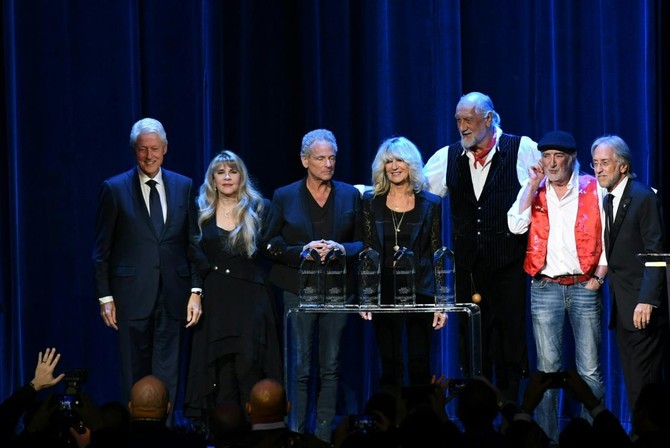
(From L-R) Former US president Bill Clinton, Stevie Nicks, Lindsey Buckingham, Christine McVie, Mick Fleetwood, John McVie and Recording Academy president Neil Partnow pose on stage at the 2018 MusiCares Person Of The Year gala at Radio City Music Hall in New York on January 26, 2018. (AFP)
Updated 27 January 2018
Follow

Bill Clinton repays a favor to Fleetwood Mac at MusiCares ceremony

NEW YORK: Their 1977 song “Don’t Stop” helped power Bill Clinton into the White House in 1992, and on Friday it was the former US president doing the honors for Fleetwood Mac.
Clinton presented Fleetwood Mac with statuettes as the 2018 MusicCares honorees, making them the first band to win the annual award given to a musician for creative achievements and charitable work.
Clinton chose the British-American band’s single “Don’t Stop” as the theme song for his 1992 presidential campaign, helping to revive their popularity and encouraging the fractious soft rock band to reunite for his inaugural ball in 1993.
“They let me use it as a theme song and I have been trying to live by it ever since,” Clinton told the audience at Radio City Music Hall in New York.
“I owe a great deal to all of them,” he added.
At the concert and ceremony on Friday, Miley Cyrus, Lorde, Keith Urban, Harry Styles and Juanes were among musicians across genres to perform their own interpretations of Fleetwood Mac’s biggest hits over a 50-year career.
Band members Mick Fleetwood, John McVie, Stevie Nicks, Christine McVie and Lindsey Buckingham ended the three-hour celebration by taking to the stage to perform “Go Your Own Way” and “Little Lies.”
Fleetwood Mac formed in London in 1967 and went on to become one of the best-selling bands in the world, with more than 100 million records sold, including Grammy-winning 1977 album “Rumours” and hit singles “Songbird,” “Rhiannon” and “Dreams.”
After romantic and creative tensions, some members going solo and several changes of line-up, Fleetwood, McVie, Nicks, Buckingham and Christine McVie put their differences behind them and reunited in 2014 for the first time since 1998, and embarked on a sell-out world tour.
“Fleetwood Mac is well known for being a dysfunctional family... and it was certainly much of the fuel for our material,” said Buckingham.
“But what we are feeling really more now than ever in our career is love,” he added.
Proceeds from the annual MusiCares gala support members of the music industry in times of financial and medical need.
Friday’s event, held two days before the Grammy Awards, raised some $7 million for MusiCares, Recording Academy chairman Neil Portnow said.
Previous recipients include Tom Petty, Bob Dylan, Barbra Streisand, Bruce Springsteen and Paul McCartney.


Creators spotlight graphic novels as powerful literacy tools at Dubai literature festival

Updated 22 January 2026
Follow

Creators spotlight graphic novels as powerful literacy tools at Dubai literature festival

DUBAI: Comic creators Jamie Smart, John Patrick Green and Mo Abedin joined the Emirates Airline Festival of Literature in Dubai this week to discuss the growing role of comics in classrooms and how graphic novels are reshaping children’s relationship with reading.

Smart is the author of the bestselling “Bunny vs. Monkey” series, Green is known for his popular “The InvestiGators” books about crime-solving alligators, and Abedin is the UAE-based creator of the sci-fi graphic novel “Solarblader."


A post shared by @jamiefumboo

A key point shared by all three speakers was that comics should be valued as a complete art form rather than a stepping stone to prose. Abedin described comics as “a very high art form,” explaining that the medium taught readers how to process complex ideas such as emotion, empathy and culture through visual storytelling. 

He added that comics allowed readers to slow down and engage on their own terms because “the reader is also able to control the pace of the narrative.”

For Smart, the power of comics lies in the emotional connection they create. He spoke about how the word “comics” immediately takes him back to childhood, recalling being “eight years old and going down the newsagent” and spending hours reading. That sense of joy, he said, is what many reluctant readers respond to. He noted that parents often tell him, “My child would not read a book, a single book … until they picked up a comic,” adding that comics inform readers even when they are simply entertaining. “They can just be an emotional, heartfelt story,” he said.

Green focused on how comics function as a visual language that readers learn over time. He described them as “almost a separate language,” noting that some adults struggle at first because they are unsure how to read a page — whether to follow images or text. But that flexibility is what gives comics their strength, allowing readers to choose how they experience a story and giving them more agency than prose or film.

The panel also discussed re-reading as a powerful part of the comics experience. Children often race through a book for the plot, then return to notice visual details, background jokes and character expressions, building deeper comprehension with each reading.

By the end of the session, all three agreed that comics should be studied and respected as their own form of literature — one that welcomes readers of all levels, builds confidence and makes reading feel like discovery rather than obligation.