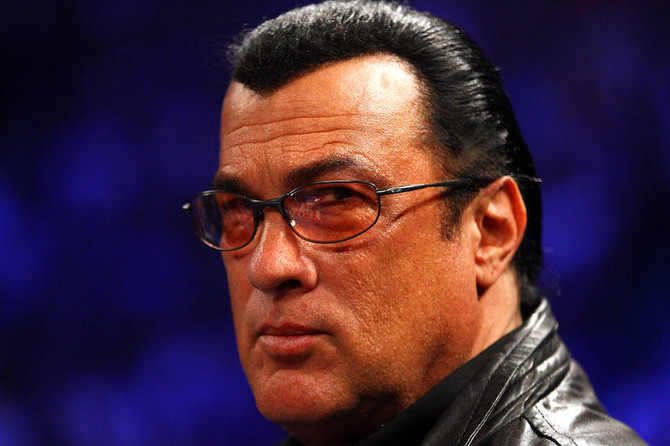
NEW YORK: A once-aspiring actress has alleged Steven Seagal raped her at a wrap party for the film “On Deadly Ground,” claiming he undressed her and assaulted her on his bed while she focused on a photo of Seagal’s wife on the nightstand.
Regina Simons called the alleged assault “very predatory, very aggressive and traumatizing” during an interview that aired Friday on NBC’s “Megyn Kelly Today.” She was 18 at the time.
Seagal’s lawyer did not immediately return calls for comment Friday.
Simons said she was surprised to find that she was the only one invited to Seagal’s 1993 party to celebrate the end of filming. She had been an extra and said “before I knew it, he was on top of me and I couldn’t move.” She says she froze and “felt like I left my body.”
During the alleged attack, Simons said she remembers looking at a photo of Seagal and “the lady from ‘Weird Science.’” At the time, Seagal was married to Kelly LeBrock, who starred in “Weird Science.”
Simon said she reported her allegations to Beverly Hills, California police, where the incident occurred.
Other women have accused Seagal of sexual misconduct. Jenny McCarthy said the action star sexually harassed her during a 1995 audition, while Portia de Rossi accused Seagal of unzipping his pants during an audition.
A Seagal spokesman denied McCarthy’s accusations to The Daily Beast. McCarthy told the same story to Movieline in 1998.

Woman accuses film star Steven Seagal of rape in 1993
Paraplegic engineer first wheelchair user to blast into space
- An ecstatic Benthaus said she laughed all the way up — the capsule soared more than 105 kilometers — and tried to turn upside down once in space. “It was the coolest experience,” she said shortly after landing.
WEST TEXAS: A paraplegic engineer from Germany blasted off on a dream-come-true rocket ride with five other passengers, leaving her wheelchair behind to float in space while beholding Earth from on high.
Severely injured in a mountain bike accident seven years ago, Michaela Benthaus became the first wheelchair user in space, launching from West Texas with Jeff Bezos’ company Blue Origin. She was accompanied by a retired SpaceX executive also born in Germany, Hans Koenigsmann, who helped organize and, along with Blue Origin, sponsored her trip. Their ticket prices were not divulged.
An ecstatic Benthaus said she laughed all the way up — the capsule soared more than 105 kilometers — and tried to turn upside down once in space. “It was the coolest experience,” she said shortly after landing.
The 10-minute space-skimming flight required only minor adjustments to accommodate Benthaus, according to the company. That’s because the autonomous New Shepard capsule was designed with accessibility in mind, “making it more accessible to a wider range of people than traditional spaceflight,” said Blue Origin’s Jake Mills, an engineer who trained the crew and assisted them on launch day.
Among Blue Origin’s previous space tourists: those with limited mobility and impaired sight or hearing, and a pair of 90-year-olds.
For Benthaus, Blue Origin added a patient transfer board so she could scoot between the capsule’s hatch and her seat. The recovery team also unrolled a carpet on the desert floor following touchdown.