DAVOS DIARY: Spare a thought for the poor, overworked media

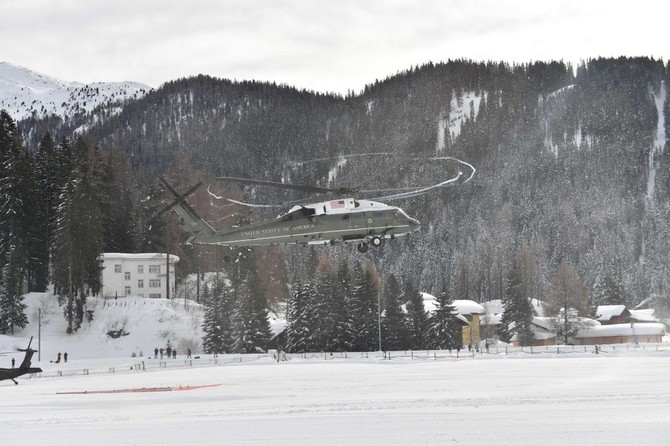
The Davos media scrum donned their snow boots for the arrival of Marine One helicopter, carrying US President Donald Trump on Thursday. (AFP)
Updated 25 January 2018
Follow

DAVOS DIARY: Spare a thought for the poor, overworked media

DAVOS: The week in Davos is a meeting of the “masters of the universe” — the businessmen, financiers and policymakers who determine the lives of ordinary mortals.
But it is also a gathering of the world’s media: The print, online and broadcast journalists whose job it is to tell those mortals what is happening 1,500 meters above sea level at the World Economic Forum (WEF) annual meeting. Although I doubt I will get much sympathy, I have to tell you that it is a tough journalist gig.
If you exploit the opportunities Davos presents to the full, you can easily start your day with a breakfast briefing at 7 a.m. and finish it at 1 a.m. the following morning, after one of the legendary Davos “nightcap” events.
After a few rushed hours of sleep, it is the same all over again the next day. It is grueling.
But I have noticed that members of the media at the WEF fall into two distinct categories.
There are the honest, down-to-earth working hacks, like yours truly, whose job it is to actually report on the event.
With so much on offer, doing the actual writing has to be squeezed into gaps in the formal WEF agenda, or rushed out before the early-morning breakfast. (Filing copy after the nightcap events is not advised.)
In contrast to these Stakhanovite tradesmen, there is the “thinking media” — the armies of editors, columnists, opinion writers and other experts. They have a much easier time.
These rarified souls come to Davos to “get a feel” for global opinion, or to “feel the pulse” of the decision-making classes. If they are doing the job properly, their day is no shorter than that of the reporting press, but much easier because they are not filling every spare moment writing.
A week on the slopes, with the aim of filing 1,000 words of opinion at the end of it, does not sound too strenuous, does it?
The bane for all these journalists — tradesmen or thinkers — is the news desk back at HQ, whether it is in London, New York or Jeddah. News editors see Davos as a gigantic opinion-polling exercise of the world’s elite. “Just ask a few people there,” you hear.
Easier said than done. I bumped into an old colleague from the British press the other day, just after the Financial Times broke the story about the “Presidents Club” that raised charitable money using distantly dubious methods.
My friend had been tasked with “getting the Davos view” on the FT story, but was having a hard time. “Nobody here has read it,” he said.


Closing Bell: Saudi main index closes higher at 10,596 

Updated 23 December 2025
Follow

Closing Bell: Saudi main index closes higher at 10,596 

RIYADH: Saudi equities closed higher on Tuesday, with the Tadawul All Share Index rising 43.59 points, or 0.41 percent, to finish at 10,595.85, supported by broad-based buying and strength in select mid-cap stocks. 

Market breadth was firmly positive, with 170 stocks advancing against 90 decliners, while trading activity saw 161.96 million shares change hands, generating a total value of SR3.39 billion. 

Meanwhile, the MT30 Index closed higher, gaining 6.52 points, or 0.47 percent, to 1,399.11, while the Nomu Parallel Market Index edged marginally lower, slipping 3.33 points, or 0.01 percent, to 23,267.77. 

Among the session’s top gainers, Al Masar Al Shamil Education Co. surged 9.99 percent to close at SR26.20, while Saudi Cable Co. jumped 9.98 percent to SR147.70.  
Cherry Trading Co. rose 4.18 percent to SR25.44, and United Carton Industries Co. advanced 4.09 percent to SR26.46. 

Al Yamamah Steel Industries Co. also posted solid gains, climbing 4.07 percent to end at SR32.70.  

On the downside, Emaar The Economic City led losses, slipping 3.55 percent to SR10.32, followed by Derayah REIT Fund, which fell 2.92 percent to SR5.31. 

Derayah Financial Co. declined 2.13 percent to SR26.62, while United International Holding Co. retreated 1.96 percent to SR155.20, and Gulf Union Alahlia Cooperative Insurance Co. eased 1.92 percent to SR10.70.  

On the announcements front, Red Sea International Co. said it signed a SR202.8 million contract with Webuild S.P.A. to provide integrated facilities management services for the Trojena project at Neom. 

The agreement covers operations and maintenance for the project’s Main Camp and Spike Camp, including accommodation and housekeeping, catering, security, IT and communications, utilities, waste management, fire safety and emergency response, as well as other supporting services.  

The contract runs for two years, with the financial impact expected to begin in the first quarter of 2026. Shares of Red Sea International closed up 0.99 percent at SR34.74. 

Al Moammar Information Systems Co. disclosed that it received an award notification from Humain to design and build a data center dedicated to artificial intelligence technologies, with a total value exceeding 155 percent of the company’s 2024 revenue, inclusive of VAT. 

The contract is expected to be formally signed in February 2026, underscoring the scale of the project and its potential impact on the company’s future revenues.  

MIS shares ended the session 2.82 percent higher at SR156.70, reflecting positive investor sentiment following the announcement.