LONDON: When Saudi Arabia announced its plan to embark on a program of renewable energy construction last year, the largest renewable energy project in the Kingdom was Saudi Aramco’s solar car park, according to Michael Liebreich, founder of Bloomberg New Energy Finance, the clean-energy research group.
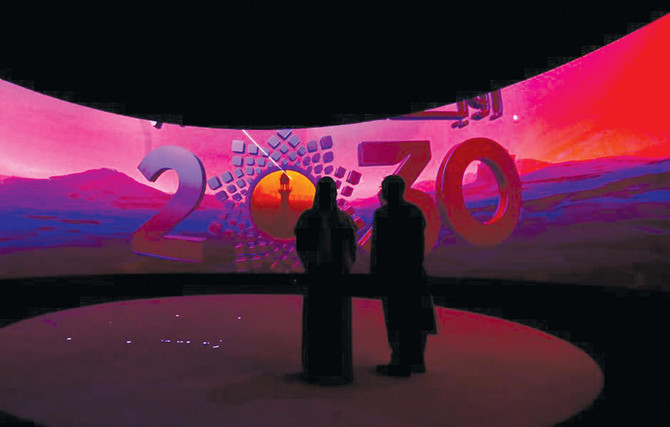
But things move fast in the country these days, and clean energy is no exception. As part of the Vision 2030 program, Saudi Arabia plans to supply 9,500MW, or 10 percent of its power demand, from renewable sources by 2023 — and it fully expects to exceed this target.
“Saudi Arabia is now tendering for projects. It has done the first few and is getting a very good price for them, and it has a local champion in ACWA Power, which will deliver them,” Liebreich told Arab News. “But there’s a long way to go. It needs to build gigagwatts of this stuff, integrate it into the grid and figure out what that means for its power system.”
In 2018 alone, the Kingdom is seeking investment of up to $7 billion to build about 4,000MW of renewable energy capacity.
Saudi Arabia, the world’s largest oil producer, is looking to generate more energy from renewable sources, in part to reduce its greenhouse gas emissions as part of the Paris Accord on climate change, but also to allow it to sell oil abroad at full price rather than use it domestically where it is subsidized. Developing a renewable energy industry is also part of its Vision 2030 efforts to diversify the economy away from its dependence on oil and gas.
The Kingdom has come late to the renewable energy party, despite its abundant wind and solar resources, but as a result has benefited from the learning process that has taken place in the industry in the rest of the world, said Adnan Amin, director general of the International Renewable Agency.
“Saudi Arabia’s move into renewables is very significant. They are looking to mobilize about $50 billion,” said Amin. “It makes absolute economic sense for Saudi Arabia to embark on this as quickly as they are doing. The opportunity cost of burning oil for power is 90 percent of the cost of a barrel of oil, leaving aside the environmental issues.
“Renewables are incredibly cheap now. The latest bids for Saudi solar projects are around 2.5 US cents per kWh, which is about a quarter of the cost of oil,” he said. “They are also considering how to develop a local industry to create jobs domestically.”
Speaking at a recent renewables conference in Abu Dhabi, Turki Mohammed Al-Shehri, head of the Renewable Energy Project Development Office (Repdo), said that the ultimate aim of the National Renewable Energy Program was to create a globally competitive local industry. To this end, it has imposed demanding rules requiring 30 percent local content for projects awarded last year. In 2018, this requirement rises to 40-60 percent and from 2019 onwards, Repdo wants to see more than 60 percent of equipment being made domestically.
Al-Shehri conceded that there are trade-offs between local content, a low levelized cost of energy (LCOE), meeting deadlines, complying with renewable energy targets and creating jobs. “If we go for the lowest LCOE, we will have to sacrifice local content, for example.”
Even the huge growth in capacity planned between now and 2023 will not be enough to attract investment into local manufacturing facilities, Al-Shehri said. “We have to look beyond the 9.5GW. To capture local content, we need a 10-year pipeline of projects.”
Saudi authorities also hope to export renewable energy to the rest of the worldto complement the oil they export today, Amin said. “We see great potential to export cheap green energy from the region.”
Saudi Arabia may have lagged behind other nations in rolling out renewables, but the scale of its current ambitions — even as it remains the world’s most important oil producer — send an important message that renewable energy is here to stay.
“There is a new understanding that an energy transformation is underway and it is bringing very significant changes to energy systems around the world,” Amin said.


![]()
Saudi Arabia makes up for lost time in clean energy race
Saudi Arabia makes up for lost time in clean energy race

Latest updates




Recommended


© 2026 SAUDI RESEARCH & PUBLISHING COMPANY, All Rights Reserved And subject to Terms of Use Agreement.