LONDON: British economic growth unexpectedly picked up speed in the last three months of 2017, according to official data which showed the impact of Brexit still weighing on the economy but not as heavily as once feared by investors.
Gross domestic product grew at its fastest pace of the year, rising by 0.5 percent from the previous three months. That was faster than the median forecast for quarterly growth to remain at 0.4 percent in a Reuters poll of economists.
However, the Office for National Statistics said the big picture remained one of a slower and more uneven expansion in the world’s sixth-biggest economy.
In 2017 as a whole, growth was 1.8 percent compared with 1.9 percent in 2016, better than many forecasters had predicted at the time of the Brexit referendum but the slowest since 2012.
Sterling added to its recent strong rise against the US dollar and also climbed against the euro. British government bond prices briefly pared their gains.
“Today’s data is another positive surprise for the economy that puts pressure on the Bank of England to raise interest rates for a second time sooner rather than later,” Jasper Lawler, head of research at London Capital Group, said.
The BoE said last month it expected the economy might have slowed slightly in late 2017. Its interest rate-setters are due to announce their next decision on borrowing costs on February 8.
They raised rates for the first time in more than a decade in November.
Most economists have said they expect the next rate hike in late 2018 but some think it could come as soon as May.
Britain’s economy grew more weakly than other big rich nations for much of last year as the impact of the 2016 Brexit vote pushed up inflation and many businesses turned cautious ahead of the departure from the EU in March 2019.
However, Britain has been helped by the recovery in the world economy last year which is expected to carry on in 2018.
Bank of England Governor Mark Carney said earlier on Friday Britain’s economy could start to grow more quickly later this year, if there is clarity about Britain’s future relationship with the EU.
“Despite a slight uptick in the latest quarter, the underlying picture is of slower and uneven growth across the economy,” ONS statistician Darren Morgan said.
While recruitment agencies, letting agents and office management firms helped boost growth, companies which relied on spending by consumers had a much slower fourth quarter.
Manufacturers, who have ridden the wave of strong demand from the recovery in the global economy, also grew strongly.
“If the world economy is really picking up, the UK probably should be performing even stronger than it currently is, and highlights what the UK might lose out from in the event that it has to renegotiate all its trade deals once again,” Commerzbank economist Peter Dixon said.
Compared with the same period in 2016, growth between October and December slowed to 1.5 percent, its weakest pace since the first quarter of 2013 and down from growth of 1.7 percent in the third quarter.
The Reuters poll had pointed to growth of 1.4 percent.
Friday’s data showed Britain’s dominant services sector grew by 0.6 percent in the fourth quarter, gaining pace after growth of 0.4 percent in the third quarter, the ONS said.
In November alone, services output growth was the strongest since August 2016, jumping by 0.4 percent from October.
The ONS said it was expecting no monthly growth in services in December given the scale of November’s increase.
Industrial output slowed to show growth of 0.6 percent from 1.3 percent in the third quarter after the Forties oil pipeline, Britain’s biggest, was closed for more than two weeks in December after the discovery of a crack.
Britain’s construction sector shrank by 1.0 percent, its worst quarterly performance since the third quarter of 2012.
The preliminary estimates of GDP do not include a breakdown of spending, and are heavily based on estimated data.


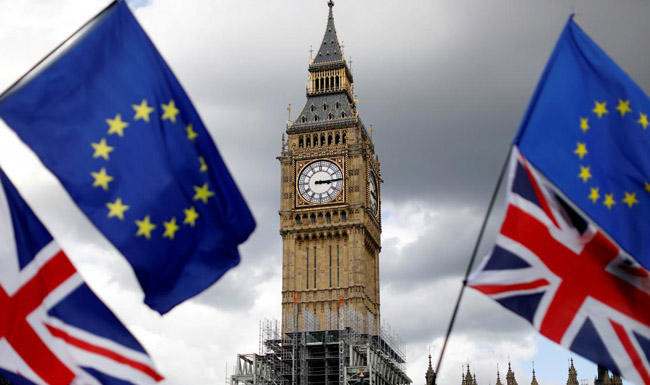
UK economy unexpectedly picks up speed, but feels Brexit impact
UK economy unexpectedly picks up speed, but feels Brexit impact



European gas prices soar almost 50% as Iran conflict halts Qatar LNG output
- Analysts warn prolonged disruption could push prices higher
- Some shipments of oil, LNG through Strait of Hormuz suspended
- Benchmark Asian LNG price up almost 39 percent
LONDON: Benchmark Dutch and British wholesale gas prices soared by almost 50 percent on Monday, after major liquefied natural gas exporter Qatar Energy said it had halted production due to attacks in the Middle East.
Qatar, soon to cement its role as the world’s second largest LNG exporter after the US, plays a major role in balancing both Asian and European markets’ demand of LNG.
Most tanker owners, oil majors and trading houses have suspended crude oil, fuel and liquefied natural gas shipments via the Strait of Hormuz, trade sources said, after Tehran warned ships against moving through the waterway.
Europe has increased imports of LNG over the past few years as it seeks to phase out Russian gas following Russia’s invasion of Ukraine.
Around 20 percent of the world’s LNG transits through the Strait of Hormuz and a prolonged suspension or full closure would increase global competition for other sources of the gas, driving up prices internationally.
“Disruptions to LNG flows would reignite competition between Asia and Europe for available cargoes,” said Massimo Di Odoardo, vice president, gas and LNG research at Wood Mackenzie.
The Dutch front-month contract at the TTF hub, seen as a benchmark price for Europe, was up €14.56 at €46.52 per megawatt hour, or around $15.92/mmBtu, by 12:55 p.m. GMT, ICE data showed.
Prices were already some 25 percent higher earlier in the day but extended gains after QatarEnergy’s production halt.
Benchmark Asian LNG prices jumped almost 39 percent on Monday morning with the S&P Global Energy Japan-Korea-Marker, widely used as an Asian LNG benchmark, at $15.068 per million British thermal units, Platts data showed.
“If LNG/gas markets start to price in an extended period of losses to Qatari LNG supply, TTF could potentially spike to 80-100 euros/MWh ($28-35/mmBtu),” Warren Patterson, head of commodities strategy at ING, said. The British April contract was up 40.83 pence at 119.40 pence per therm, ICE data showed.
Europe is also relying on LNG imports to help fill its gas storage sites which have been depleted over the winter and are currently around 30 percent full, the latest data from Gas Infrastructure Europe showed. In the European carbon market, the benchmark contract was down €1.10 at €69.17 a tonne


