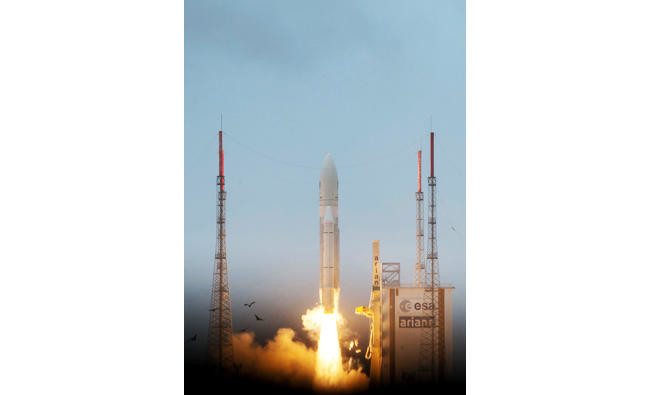
KOUROU: Two commercial satellites have been successfully placed in orbit by an Ariane 5 rocket, Arianespace said Thursday, despite mission control briefly losing contact with the craft.
“Both satellites were confirmed separated, acquired and they are on orbit,” Arianespace said in an updated statement after the lift-off from the Kourou Space Center in French Guiana.
The European space workhorse blasted off at 7.20 p.m. (2220 GMT) carrying satellites for Luxembourg’s SES and the United Arab Emirate’s Yahsat in the first launch of the year for Arianespace.
Around an hour after the launch, CEO Stephane Israel announced that controllers had “lost contact” with the craft in what he described as an “anomaly.”
In their updated statement the company said a tracking station in Brazil was unable to track the craft shortly after ignition of the rocket’s upper stage.
“This lack of telemetry lasted throughout the rest of powered flight,” the statement said. But both satellites were later “communicating with their respective control centers.”
Since it was founded in 1980, Arianespace has put more than 550 satellites into orbit including for Europe’s Galileo GPS system.
In September the company aborted the launch of an Ariane 5 rocket carrying two commercial satellites in the final countdown as the main engine was being ignited.
An Ariane 5 lift-off was also aborted at main engine ignition in March 2011.

Arianespace has ‘lost contact’ with Ariane 5 rocket
Apple to update EU browser options, make more apps deletable
- iPhone maker came under pressure from regulators to make changes after the EU’s sweeping Digital Markets Act took effect on March 7
- Apple users will be able to select a default browser directly from the choice screen after going through a mandatory list of options
STOCKHOLM: Apple will change how users choose browser options in the European Union, add a dedicated section for changing default apps, and make more apps deletable, the company said on Thursday.
The iPhone maker came under pressure from regulators to make changes after the EU’s sweeping Digital Markets Act took effect on March 7, forcing big tech companies to offer mobile users the ability to select from a list of available web browsers on a “choice screen.”
The new rules require mobile software makers to show the choice screen where users can select a browser, search engine and virtual assistant as they set up their phones, which earlier came with preferred options from Apple and Google.
In an update later this year, Apple users will be able to select a default browser directly from the choice screen after going through a mandatory list of options.
A randomly ordered list of 12 browsers per EU country will be shown to the user with short descriptions, and the chosen one will be automatically downloaded, Apple said. The choice screen will also be available on iPads through an update later this year.
Apple released a previous update in response to the new rules in March, but browser companies criticized the design of its choice screen, and the Commission opened an investigation on March 25 saying it suspected that the measures fell short of effective compliance.
The company said it has been in dialogue with the European Commission and believes the new changes will address regulators’ concerns.
It also plans to introduce a dedicated area for default apps where a user will be able to set defaults for messaging, phone calls, spam filters, password managers and keyboards.
Users will also be able to delete certain Apple-made apps such as App Store, Messages, Camera, Photos and Safari. Only Settings and Phone apps would not be deletable.