LONDON: The British government is under renewed pressure to outlaw Hezbollah in the UK by making no distinction between its military and political wings.
In the House of Commons, Labour chair of the friends of Israel Joan Ryan moved a motion on Thursday that called for Hezbollah to be designated a terrorist organisation and for Britain to impose a complete ban to bring it into line with Canada, the US, the Arab League and the Netherlands.
Currently, Hezbollah’s military wing in is proscribed but not its political organisation which is based in Lebanon and supported by Iran.
“There is no distinction and we need to be clear about that,” Ryan said in the UK parliament.
She listed the string of deadly attacks carried out by Hezbollah in recent decades and said the organization, “Has wreaked death and destruction throughout the Middle East” while helping to drive Iran’s expansionism in the region.
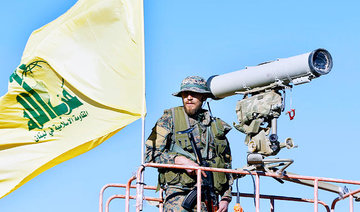
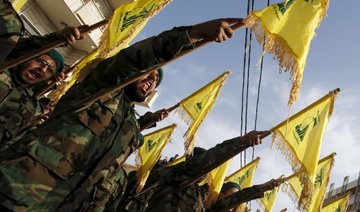
Hezbollah’s mounting military capability poses a growing threat to the Middle East she continued. “It has trebled the size of its fighting force from 17,000 to 45,000 men…it now has an estimated 120,000 to 140,000 rockets and missiles – an arsenal larger than that of many states.”
Ryan also accused the group of “aiding and abetting the Assad regime’s butchery in Syria”.
UK government policy currently opposes changing the designation for fear of further destabilizing Lebanon.
Speaking in favour of full proscription, Conservative MP David Jones said that "Hezbollah is the most destabilising influence in Lebanon," and described the group as "a dangerous, aggressive terrorist organisation."
Ian Austin was one of several Labour MPs to defy a party briefing note circulated prior to the debate advising MPs to vote against a full ban and stating that: “Full proscription could be a move against dialogue and meaningful peace negotiations in the Middle East.”
“The idea Hezbollah is a partner for peace is misguided,” Austin said.
Speaking in support of the motion, Conservative MP Theresa Villiers said Hizbollah had been responsible for numerous terrorist attacks around the world, with the “most notorious” at a Jewish centre in Buenos Aries, Argentina where a bomb killed 85 and injured hundreds in 1994. An Argentinian inquiry pointed the finger at Hezbollah and Iran.
Villiers added that Hezbollah been a “deeply malevolence presence in the Syrian civil war”.
The Ryan motion has not received support from the UK government or the Labour shadow cabinet and is unlikely to gain traction.
But Ryan said: “Hezbollah is a terrorist organisation, driven by an anti-semitic ideology which seeks the destruction of Israel. It has wreaked death and destruction throughout the Middle East. It makes no distinction between its political and military wings, and neither should the British government. “
David Ibsen, the executive director of the Counter Extremism Project, said that Hezbollah itself does not recognise a distinction between these entities and emphasised the need for “a new realism in the UK about the nature of Hezbollah.”
“There is no ‘military’ and ‘political’ wings of Hezbollah, it is one pernicious terrorist organisation founded and bankrolled by Iran. Hezbollah’s top officials brazenly acknowledge this fact.”
Arab governments have expressed mounting concern over Iran’s growing sphere of influence in the Middle East and its use of Hezbollah to engineer an expanded role in regional conflicts.
A statement released by the Arab League last November accused Tehran and its proxy of destabilising the region.
Ibsen said: “Thousands of Hezbollah fighters made the crucial difference in Syria for Bashar al-Assad and have trained Houthi rebels in Yemen on behalf of their Iranian benefactors.”
A spokesperson for Syria Solidarity UK outlined the “extensive crimes against Syrian civilians” carried out by Hezbollah, which “took part in the mass displacement of hundreds of thousands” of people in Aleppo and other areas.
“The failure of British MPs to come together to protect civilians in Syria has allowed Hezbollah to expand, has increased the threat of terrorism, and has worsened the refugee crisis,” the spokesperson said.
Pressure to extend the ban has intensified in recent weeks following a US crackdown on Hezbollah’s international financing networks with the launch of a new ‘narco-terrorism’ task force to investigate the group’s cross-border drug trafficking and money laundering activities.
During a speech on January 12 in which he described the Iranian regime as “the world’s leading state sponsor of terror,” President Trump called on all US allies to re-classify Hezbollah in its entirety as a terrorist organisation and take stronger steps to “confront Iran’s other malign activities.”
Visiting Lebanon on Tuesday, the U.S. Treasury’s Assistant Secretary for Terrorist Financing Marshall Billingslea “urged Lebanon to take every possible measure to ensure (Hezbollah) is not part of the financial sector,” according to a statement by the US embassy in Beirut.
Hezbollah is one of 60 groups listed as foreign terrorist organisations by the US State Department.
In addition to bringing the UK’s position into closer alignment with Trump’s hardline stance on Iran, a move to extend the ban would also answer voices from the Israel lobby, which has repeatedly called for a crackdown on the group.
Michael McCann, director at the Israel Britain Alliance, described the UK’s designation of Hezbollah as “wrong headed” and said it “bears responsibility for the murder of innocents across the globe.”
“Hezbollah’s operations breach the 2000 UK Terrorism Act and the group must be banned, it’s that simple,” he said.


![]()

British government under pressure to impose total ban on Hezbollah
British government under pressure to impose total ban on Hezbollah
Latest updates



Recommended


© 2026 SAUDI RESEARCH & PUBLISHING COMPANY, All Rights Reserved And subject to Terms of Use Agreement.