KINSHASA: The UN mission in the Democratic Republic of Congo on Wednesday reported a surge in summary “executions” in the country, notably in the southern Kasai region.
In 2017, “state agents” carried out 1,176 extra-judicial killings, “including at least 89 women and 213 children,” the United Nations Mission in Congo (MONUSCO) said in an annual report on human rights violations in the DRC.
Such killings have tripled over the past two years, MONUSCO said, adding that it condemned the increase.
The armed forces accounted for nearly two-thirds — 64 percent — of extra-judicial killings by state agents, it said.
Across the country, a total of 6,497 violations and abuses — committed not just by state agents but also by armed groups — were recorded in 2017.
This was a rise of more than 25 percent over 2016, which itself saw a 30 percent rise over 2015.
A sprawling, mineral-rich country in central Africa, the DRC is in the grip of several conflicts, including political and ethnic unrest as well as violence by militia groups.
The rise in arbitrary killings last year is mainly explained by the “persistent crisis” in three provinces constituting the Kasai region, where at least 752 people were executed, the report said.
Violence in Kasai erupted after a tribal chieftain known as the Kamwina Nsapu, who rebelled against the regime of President Joseph Kabila, was killed in August 2016.
More than 3,000 people have died and some 1.4 million have been displaced since then.
The Kamwina Nsapu’s militia was responsible for the death of at least 79 civilians, including seven women and nine children, the report said.
Another militia, the Bana Mura, sometimes operating with the support of army soldiers, killed at least 67 civilians, including nine women and 21 children, it added.
Two UN experts were killed last March while investigating violence in Kasai, where the United Nations has counted more than 80 mass graves.
The rise in extra-judicial killings comes as the government has cracked down on a number of anti-government demonstrations across the country.
On Sunday, six people were killed in Kinshasa during a protest that demanded Kabila leave power, according to the UN.
Scores were injured and dozens arrested when security forces opened fire on the Catholic Church-organized rally.
UN Secretary-General Antonio Guterres on Monday called for “credible investigations” into the killings.
Congolese authorities have “systematically resorted to unjustified and disproportionate restrictions to fundamental freedoms and acts of harassment” of political opponents, journalists and human rights activists in an attempt to “silence the voices seen as critics,” the MONUSCO report stated.
As well as criticizing the crisis-hit country, the report also praised some of the work done by the judiciary, stating that at least 150 army soldiers and 51 national police agents were sentenced in 2017 over human rights violations.
The report praised efforts by judicial authorities to fight against what it called “impunity.”
But the recent protests have also raised diplomatic tensions between Kinshasa and Europe, particularly its former colonial overseer Belgium, which has condemned the violence against demonstrators.
On Wednesday the DR Congo told Belgium it was willing to “promptly” shutter Shengen House, a quasi consulate in Kinshasa that represents 17 EU members plus Norway, AFP learned via a Congo government source.
The building helps process visas for any Congolese citizens wanting to head EU countries that are part of the Schengen region.
The letter sent by Kinshasa also said authorities planned to close down Belgium’s development agency in the country.
The Belgian foreign ministry said it had yet to authenticate that the request was genuine, Bela press agency reported.
France, the United Kingdom, the US and Canada have also condemned the recent killing of protesters.


![]()
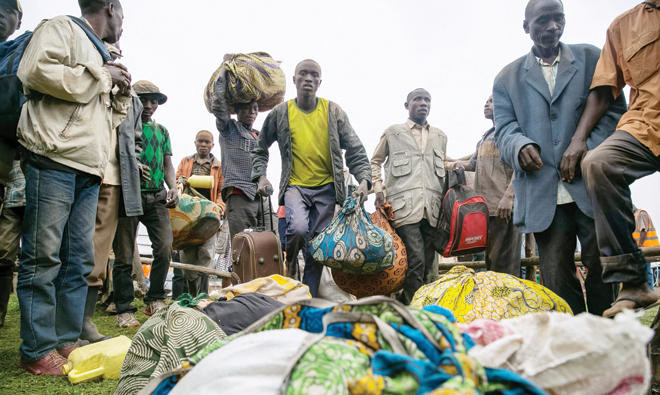

United Nations hits out at surge in extra-judicial ‘executions’ in Congo
United Nations hits out at surge in extra-judicial ‘executions’ in Congo


UK to deploy aircraft carrier group to Arctic this year: PM
- The HMS Prince of Wales is the Royal Navy’s largest warship
MUNICH, Germany: The UK will deploy its aircraft carrier group to the North Atlantic this year in a “powerful show of force” against Russian threats in the Arctic, British officials said Saturday.
“I can announce today that the UK will deploy our carrier strike group to the North Atlantic and the High North this year, led by HMS Prince of Wales, operating alongside the US, Canada and other NATO allies in a powerful show of our commitment to Euro-Atlantic security,” Prime Minister Keir Starmer told the Munich security conference.
The group will include Royal Navy warships, F-35 jets and helicopters in what has been dubbed “Operation Firecrest,” the ministry of defense said in a statement.
It will be a “powerful show of force … to deter Russian aggression and protect vital undersea infrastructure.”
The HMS Prince of Wales is the Royal Navy’s largest warship and US aircraft are also expected to operate from its deck.
The operation will involve thousands of personnel from all three services of the Armed Forces, the MoD statement added.
“The deployment will include activity under NATO’s Arctic Sentry mission, launched this week, strengthening the Alliance’s security in a region where melting sea ice is opening new routes and increasing threat from hostile state activity,” the ministry said.
France has also announced that it will deploy its aircraft carrier group in the region in 2026.
Starmer told the Munich conference that Britain must be “ready to fight.”
Leaders must not dither as “Russia has proved its appetite for aggression,” he said.
“The road ahead is straight and it is clear. We must build our hard power, because that is the currency of the age,” he added.
“We must be able to deter aggression, and, yes, if necessary, we must be ready to fight.”
The defense ministry said the deployment would reinforce “NATO’s deterrence at a time of rising Russian threats in the region.”
It added that “over the past two years, there has been a 30 percent increase in Russian navy vessels threatening UK waters.”
US President Donald Trump has also unnerved European countries by saying Greenland, an autonomous Danish territory in the Arctic, should come under US control.
Trump said last month however that an understanding had been reached with NATO secretary general Mark Rutte that would give the United States greater influence in the mineral-rich and strategically placed territory.
“I can announce today that the UK will deploy our carrier strike group to the North Atlantic and the High North this year, led by HMS Prince of Wales, operating alongside the US, Canada and other NATO allies in a powerful show of our commitment to Euro-Atlantic security,” Prime Minister Keir Starmer told the Munich security conference.
The group will include Royal Navy warships, F-35 jets and helicopters in what has been dubbed “Operation Firecrest,” the ministry of defense said in a statement.
It will be a “powerful show of force … to deter Russian aggression and protect vital undersea infrastructure.”
The HMS Prince of Wales is the Royal Navy’s largest warship and US aircraft are also expected to operate from its deck.
The operation will involve thousands of personnel from all three services of the Armed Forces, the MoD statement added.
“The deployment will include activity under NATO’s Arctic Sentry mission, launched this week, strengthening the Alliance’s security in a region where melting sea ice is opening new routes and increasing threat from hostile state activity,” the ministry said.
France has also announced that it will deploy its aircraft carrier group in the region in 2026.
Starmer told the Munich conference that Britain must be “ready to fight.”
Leaders must not dither as “Russia has proved its appetite for aggression,” he said.
“The road ahead is straight and it is clear. We must build our hard power, because that is the currency of the age,” he added.
“We must be able to deter aggression, and, yes, if necessary, we must be ready to fight.”
The defense ministry said the deployment would reinforce “NATO’s deterrence at a time of rising Russian threats in the region.”
It added that “over the past two years, there has been a 30 percent increase in Russian navy vessels threatening UK waters.”
US President Donald Trump has also unnerved European countries by saying Greenland, an autonomous Danish territory in the Arctic, should come under US control.
Trump said last month however that an understanding had been reached with NATO secretary general Mark Rutte that would give the United States greater influence in the mineral-rich and strategically placed territory.
Latest updates


Recommended


© 2026 SAUDI RESEARCH & PUBLISHING COMPANY, All Rights Reserved And subject to Terms of Use Agreement.