UN envoy says Syria talks at ‘very critical moment’

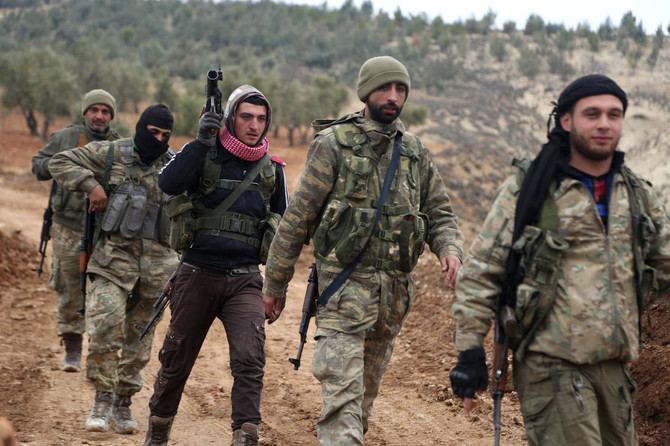
Pro-Turkey Syrian fighters (AFP)
Updated 25 January 2018
Follow

UN envoy says Syria talks at ‘very critical moment’

VIENNA: The UN special envoy for Syria said that peace talks due to resume in Vienna on Thursday are taking place at a crucial moment.
“Definitely I am optimistic because it is the only way to be at such moments,” Staffan de Mistura said on Wednesday. “It is a very, very critical moment.”
He said a “full delegation of the opposition and a full delegation of the government” would be in the Austrian capital for the two days of talks.
France’s foreign minister said meanwhile in Paris that the Vienna talks are the “last hope” for reaching a political solution to the seven-year war.
“There is no prospect of a political solution today except, and it’s the last hope, the meeting that opens tomorrow in Vienna led by the United Nations and with all the stakeholders present,” Jean-Yves Le Drian said.
Speaking in parliament, Le Drian also highlighted a “considerable worsening of the humanitarian situation” in Afrin, where Turkish forces are carrying out an offensive against a Kurdish militia, as well as in Idlib and in Eastern Ghouta.
The talks hosted by de Mistura in the Austrian capital come after eight previous rounds in Geneva that failed to get the warring parties even to talk to each other.
The discussions have repeatedly stumbled over the fate of Syrian President Bashar Assad.
Representatives from his government have refused to meet the opposition directly until it drops demands that he leave office.

Nasr Al-Hariri from the main opposition group, the Syrian Negotiations Commission (SNC), said late Wednesday in Vienna that the next two days would be “a real test for all the sides.”
They will be “a real test for the opposition for how much they are committed to those international solutions; and also to the regime, how much the regime is going to be engaging; as well as the international community and how serious they are about reaching a political solution,” Hariri told reporters through an interpreter.
The talks come ahead of a peace conference in the Russian Black Sea resort of Sochi backed by Russia, Iran and Turkey on January 30.
Moscow initially hoped to convene peace talks in Sochi last November but those efforts collapsed following a lack of agreement among co-sponsors.
Syria’s main opposition group has said it would need “full and clear information” before agreeing to take part, but government representatives have said they will attend.
The Sochi summit specifically aims to set up new constitution for post-war Syria — something which the UN’s de Mistura also hopes to make progress on.
Western countries view the Sochi track with skepticism, concerned that Russia and Iran will carve out a settlement that will favor their ally Assad.
Syria’s complex, multi-sided war has claimed more than 340,000 lives, forced millions to flee their homes and left Syria in ruins.
Bolstered by Moscow’s intervention in 2015, Damascus has regained the upper hand militarily, retaking large swathes of rebel-held territory.
Russian-backed Syrian forces have also dealt severe blows to the Daesh group, whose self-proclaimed “caliphate” in Iraq and Syria has largely collapsed.
In December the first Russian troops began returning home after President Vladimir Putin ordered a pullout, saying their mission had been largely completed.
De Mistura has called on Putin to push the Assad regime to hold new elections, saying a military victory alone was not enough to “win the peace.”
Israel defends Somaliland move at UN amid concerns over Gaza motives

Women walk in front of a gas station, in the city of Hargeisa, Somaliland. (AFP file photo)
Updated 7 sec ago
Follow

Israel defends Somaliland move at UN amid concerns over Gaza motives

  • Some states question if recognition part of a bid to relocate Palestinians or establish military bases
  • US President Donald Trump's peace plan for Gaza states: "No one will be forced to leave Gaza, and ⁠those who wish to leave will be free to do so and free to return"
  • US accuses Security Council of double standards after Western countries recognized Palestinian state

UNITED NATIONS: Israel defended on Monday its formal recognition of the self-declared Republic of Somaliland, but several countries at the ​United Nations questioned whether the move aimed to relocate Palestinians from Gaza or to establish military bases.
Israel became the first country to recognize Somaliland as an independent and sovereign state on Friday.
The 22-member Arab League, a regional organization of Arab states in the Middle East and parts of Africa, rejects “any measures arising from this illegitimate recognition aimed at facilitating forced displacement of the Palestinian people or exploiting northern Somali ports to establish military bases,” Arab League UN Ambassador Maged Abdelfattah Abdelaziz told the UN Security Council.
“Against the backdrop of Israel’s previous references to Somaliland of the ‌Federal Republic of ‌Somalia as a destination for the deportation of Palestinian people, ‌especially ⁠from ​Gaza, its unlawful ‌recognition of Somaliland region of Somalia is deeply troubling,” Pakistan’s Deputy UN Ambassador Muhammad Usman Iqbal Jadoon told the council.
Israel’s UN mission did not immediately respond to a request for comment on the remarks or address any of them in its statement at the council meeting. In March, the foreign ministers of Somalia and Somaliland said they had not received any proposal to resettle Palestinians from Gaza.
US President Donald Trump’s peace plan for Gaza states: “No one will be forced to leave Gaza, and ⁠those who wish to leave will be free to do so and free to return.”
Israel’s coalition government, the most right-wing ‌and religiously conservative in its history, includes far-right politicians who advocate the ‍annexation of both Gaza and the West ‍Bank and encouraging Palestinians to leave their homeland.
Somalia’s UN Ambassador Abukar Dahir Osman said ‍council members Algeria, Guyana, Sierra Leone and Somalia “unequivocally reject any steps aimed at advancing this objective, including any attempt by Israel to relocate the Palestinian population from Gaza to the northwestern region of Somalia.”

SOMALILAND VS PALESTINIAN STATE
Somaliland has enjoyed effective autonomy — and relative peace and stability — since 1991 when Somalia descended into civil war, but ​the breakaway region has failed to receive recognition from any other country.
“It is not a hostile step toward Somalia, nor does it preclude future dialogue between ⁠the parties. Recognition is not an act of defiance. It is an opportunity,” Israel’s Deputy UN Ambassador Jonathan Miller told the council.
In September, several Western states, including France, Britain, Canada and Australia announced they would recognize a Palestinian state, joining more than three-quarters of the 193 UN members who already do so.
Deputy US Ambassador to the UN Tammy Bruce said: “This council’s persistent double standards and misdirection of focus distract from its mission of maintaining international peace and security.”
Slovenia’s UN Ambassador Samuel Zbogar disputed her argument, saying: “Palestine is not part of any state. It is illegally occupied territory ... Palestine is also an observer state in this organization.”
He added: “Somaliland, on the other hand, is a part of a UN member state and recognizing it goes against ... the UN Charter.”
Israel said last week that it would seek immediate cooperation with ‌Somaliland in agriculture, health, technology and the economy. The former British protectorate hopes Israeli recognition will encourage other nations to follow suit, increasing its diplomatic heft and access to global markets.