VIENNA: The UN special envoy for Syria said that peace talks due to resume in Vienna on Thursday are taking place “at a very, very critical moment.”
“Definitely I am optimistic because it is the only way to be at such moments,” Staffan de Mistura said on Wednesday. “It is a very, very critical moment.”
He said a “full delegation of the opposition and a full delegation of the government” would be in the Austrian capital for the two days of talks.
France’s foreign minister said meanwhile in Paris that the Vienna talks are the “last hope” for reaching a political solution to the seven-year war.
“There is no prospect of a political solution today except, and it’s the last hope, the meeting that opens tomorrow in Vienna led by the United Nations and with all the stakeholders present,” Jean-Yves Le Drian said.
Speaking in parliament, Le Drian also highlighted a “considerable worsening of the humanitarian situation” in Afrin, where Turkish forces are carrying out an offensive against a Kurdish militia, as well as in Idlib and in Eastern Ghouta.
The talks hosted by de Mistura in Vienna come after eight previous rounds in Geneva that failed to get the warring parties even to talk to each other.
The discussions have repeatedly stumbled over the fate of Syrian President Bashar Assad.
Representatives from his government have refused to meet the opposition directly until it drops demands that he leave office.
The talks come ahead of a peace conference in the Russian Black Sea resort of Sochi backed by Russia, Iran and Turkey on January 29-30.
Moscow initially hoped to convene peace talks in Sochi last November but those efforts collapsed following a lack of agreement among co-sponsors.
Syria’s main opposition group has said it would need “full and clear information” before agreeing to take part, but government representatives have said they will attend.
Syria’s complex, multi-sided seven-year war has claimed more than 340,000 lives, forced millions to flee their homes and left Syria in ruins.
Bolstered by Russia’s intervention in 2015, Damascus has regained the upper hand militarily, retaking large swathes of rebel-held territory.
Russian-backed Syrian forces have also dealt severe blows to the Daesh group, whose self-proclaimed “caliphate” in Iraq and Syria has largely collapsed.
In December the first Russian troops began returning home after President Vladimir Putin ordered a pullout, saying their mission had been largely completed.
De Mistura has called on Putin to push the Assad regime to hold new elections, saying a military victory alone was not enough to “win the peace.”


![]()
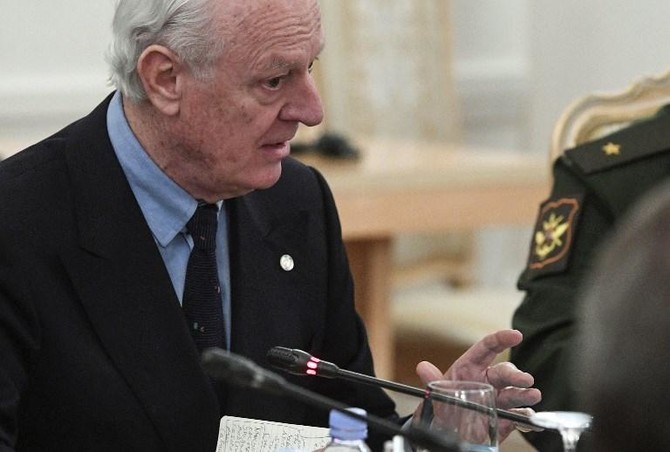
UN Syria envoy says Vienna talks at ‘very critical moment’
UN Syria envoy says Vienna talks at ‘very critical moment’


Latest updates


© 2026 SAUDI RESEARCH & PUBLISHING COMPANY, All Rights Reserved And subject to Terms of Use Agreement.