

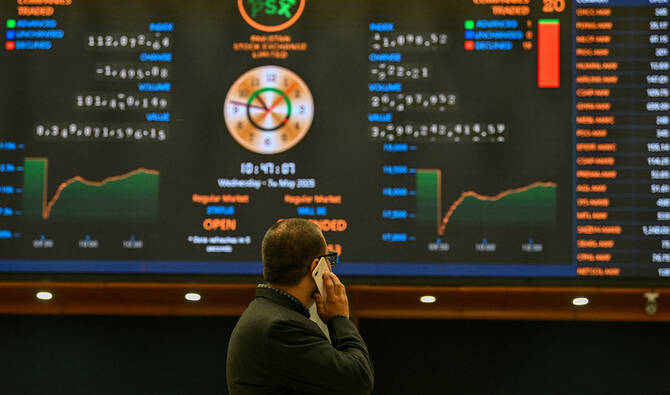

KARACHI: Pakistan’s benchmark stock index has shed nearly 10 percent from its January peak, as mounting geopolitical tensions, external financing concerns and domestic political noise triggered sustained selling across sectors, markets analysts said on Friday.
The KSE-100 Index, which touched an intraday high of 191,032.73 points on January 26, has since fallen 17,863 points to close the week at 173,169.71 on Friday, according to Pakistan Stock Exchange (PSX) data.
Analysts say the retreat reflects a mix of global risk aversion and local policy concerns, with investors trimming exposure amid uncertainty over oil prices, an impending International Monetary Fund (IMF) review and political developments at home.
“Investors worldwide are feeling nervous, especially with the growing tensions between the United States and Iran,” Amreen Soorani, who works with Pakistan’s largest Shariah-compliant mutual fund Al Meezan Investments Management Limited, told Arab News.
“This anxiety is pushing oil prices up and making people want to pull their cash out of riskier markets like Pakistan and put it into safer investments,” she continued.
Soorani said foreign and local investors were actively pulling out “a lot of money” from the stock market.
“There aren’t enough new buyers stepping in to scoop up all those shares, making the prices take a steep dive,” she added.
Political developments have also weighed on market sentiment.
In recent weeks, tensions intensified following reports about incarcerated former prime minister Imran Khan’s medical condition, prompting protests by his supporters in different parts of the country.
“Rising political uncertainty surrounding the potential release of Imran Khan has increased risk perception and foreign outflows,” said Adnan Sami Sheikh, vice president research at Pakistan Kuwait Investment Company Limited.
He said the index fell from its peak “amid a confluence of geopolitical and macroeconomic pressures that have unsettled investor sentiment.”
Sheikh also pointed to uncertainty around the financial close of the Reko Diq copper and gold project following heightened security concerns raised during Barrick’s recent earnings call.
The issue, he noted, has weighed on major index constituents including Oil & Gas Development Company Limited (OGDCL) and Pakistan Petroleum Limited (PPL), both of which hold stakes in the project.
Since Jan. 26, OGDCL’s shares have fallen about 13 percent to Rs283.76, while PPL has declined 17 percent to Rs223.74, PSX data show.
External financing concerns have added to the pressure, with investors focused on the reported short-term rollover of a $2 billion United Arab Emirates deposit and the International Monetary Fund’s upcoming review under Pakistan’s loan programs.
The IMF’s staff mission is due next week to begin reviewing Pakistan’s economic performance under its Extended Fund Facility and Resilience and Sustainability Facility programs from Feb. 25.
Domestic monetary policy has also played a role.
Sana Tawfik, head of research at Arif Habib Limited, said stocks began declining after the State Bank of Pakistan decided to keep its key policy rate unchanged at 10.5 percent on Jan. 26, contrary to market expectations of a cut.
“The monetary policy was implemented on 26th January when contrary to market expectations the interest rate was not cut,” she said.
Despite the sell-off, analysts say underlying macroeconomic indicators remain stable, though vulnerable to external shocks.
“After this correction, valuations are expected to become attractive because the fundamentals are intact unless there is an external shock,” Tawfik said, referring to escalating US-Iran tensions and their potential impact on global oil prices.
“Internally, the macroeconomic indicators are good, but any external shock can be a concern. The key risk is geopolitics,” she added.
Soorani echoed that view, noting that the decline has pushed valuations lower, with stocks now trading at less than eight times their annual earnings.
“The actual businesses behind these stocks are still making money, and their core corporate fundamentals broadly haven’t changed,” she said. “Because of this, the overall reasons to invest are intact.”


