DAVOS: Khalid Al-Falih, Saudi energy minister and chairman of Aramco, said that the value of the forthcoming initial public offering (IPO) in the national oil company will be determined by the markets, and not by the company itself or the government.
Al-Falih told a session of the annual meeting of the World Economic Forum (WEF) in Davos that the Aramco IPO should be seen in the context of the much wider economic agenda in the Kingdom, including the rest of the multibillion-dollar privatization program.
“Aramco is on the top of that list, but the valuation is not a single target. (Crown Prince) Mohammed bin Salman and all the others involved in the privatization process realize it (the value of the IPO) is going to be a market-determined value. We cannot set the price of the shares, the market will do that.”
Official estimates of the valuation of the IPO have so far been set at $2 trillion for the whole company, which would give a value of $100 billion for the sale of a 5 percent stake, as has been suggested in official statements about the IPO, slated for 2018.
“Aramco is a great company and that has been proven for decades. It will be listed when the time is right. We (Aramco) and the government have done a lot to prepare for that. But the valuation is for the market to do, not the company or the government,” Al-Falih said.
He added that Saudi Arabia had 260 billion barrels of oil reserves, according to a “conservative” estimate. “The Kingdom is more interested in optimizing the value of those 260 billion barrels. So the global framework we are working in is to reduce boom and bust, which is destructive and bad for jobs and for consumers.”
Al Falih’s comments came on a CNN panel session entitled “The New Energy Equation” with leaders of the global oil and gas industry. Also on the panel were Russian Energy Minister Alexander Novak, US Energy Secretary Rick Perry, his Indian counterpart Dharmendra Pradhan, and Daniel Yergin, prize-winning author and industry analyst.
The panel was asked if it thought the output-cuts alliance between Russia and OPEC, which has helped reduce global production and led to a recent recovery in the oil price, would last through 2018.
Novak said: “The deal between OPEC and non-OPEC, under the leadership of Al-Falih, showed that it is not only possible to overcome economic but also political difficulties. It has proven to be efficient and can be used in the future.”
Al-Falih said that the OPEC target remained to balance production and demand for oil: “We have got to be careful we don’t go out of balance for a while and for the glut to resurface. We have got to manage this fragile market and stay the course. Everyone if focused on that for 2018.
“I think it’s highly unlikely we’ll exit the deal in 2018. We should aim for a gradual smooth exit in 2019,” he added.
On the “shale revolution” — which has enabled the US to become a major producer of oil and driven down the price — Perry said: “I don’t think shale will be a spoiler for the world oil industry. The reforms going on on Saudi Arabia, Mexico and India can drive consumption and innovation.”
Novak said: “We should not be afraid of shale oil production in general. It is still a small part of overall global production.
The panel was generally skeptical that the era of “peak oil” — when global production would start to deteriorate — was imminent. Pradhan said: “India will be depending on conventional energy sources for the next 20 years. We are a developing country and I am confident that our requirement will continue to grow.”
Yergin agreed saying, “I think we’re seeing about as strong demand for oil as we’ve ever seen, and I don’t think it will peak until 2035-40.”


![]()
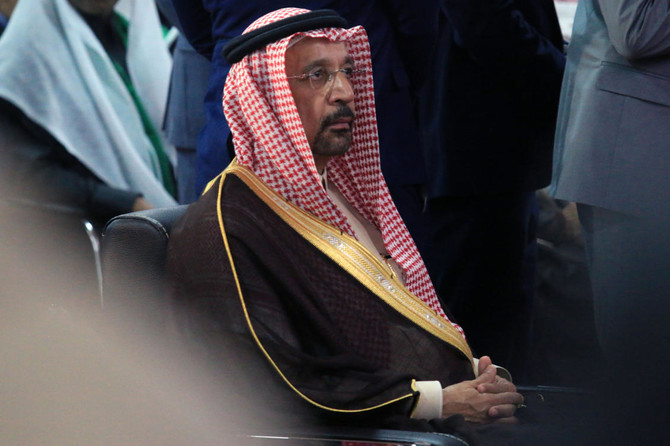
Markets, not government, will decide value of Saudi Aramco IPO: Energy minister
Markets, not government, will decide value of Saudi Aramco IPO: Energy minister
- Official estimates of the valuation of the IPO have so far been set at $2 trillion for the whole company
- Kingdom is more interested in optimizing the value of its 260 billion barrels of oil reserves — oil minister
Related


Latest updates


© 2026 SAUDI RESEARCH & PUBLISHING COMPANY, All Rights Reserved And subject to Terms of Use Agreement.