Russian investors eye Aramco share deal ahead of IPO

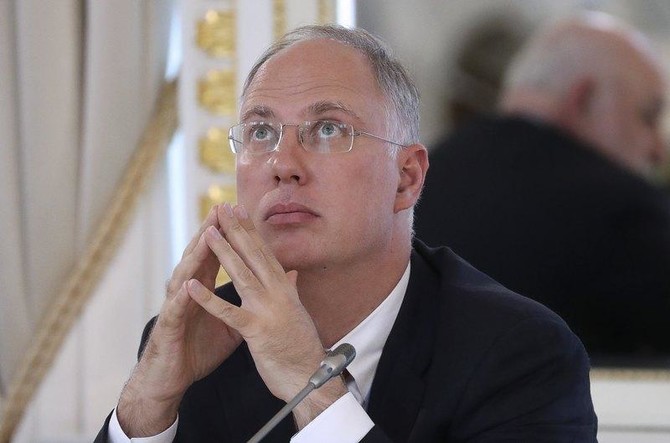
Kirill Dmitriev, CEO of the Russian Direct Investment Fund which is reported to be interested in particpated in the planned Saudi Aramco IPO. (Reuters)
Updated 24 January 2018
Follow

Russian investors eye Aramco share deal ahead of IPO

DAVOS: Russian investors have approached Saudi Aramco with a proposal to take a stake in the Kingdom’s oil giant as it gears up for an initial public offering on local and global stock markets later this year.

The approach is being considered, alongside several other options for the sale of shares in Aramco, but so far no decision has been taken on whether it will proceed to a full deal, according to people familiar with the Russian move, who did not want to be identified. They were speaking at the World Economic Forum annual meeting in Davos.
There is also the possibility of a joint investment by Russian and Chinese investors. Several institutions from the two counties have formed joint vehicles for investment, with a big emphasis on energy and other infrastructure projects.
Reuters reported that Kirill Dmitriev, head of the Russian Direct Investment Fund, was considering an investment in Aramco as part of a long-term strategy for Russia and Saudi Arabia to coordinate energy policy more closely.
“We see great interest in the Aramco IPO from Russian pension funds as well as from our Chinese partners,” Dmitriev told Reuters.
Aramco has already said it is considering a wide range of options for the IPO, which would be by far the biggest in history if it meets official valuations.
Policymakers in the Kingdom have said they would sell 5 percent of Aramco, with an official valuation of $2 trillion on the whole company.
If the Russians bought $10 billion of shares — as has been speculated — it would represent 10 percent of the shares in sale in an IPO at the official valuation.
Options under discussion include a big sale on an international stock exchange in conjunction with a listing on the Tadawul market in Riyadh; an option for a private sale of shares to foreign investors; or a trade sale at the same time as a Riyadh listing with a commitment to sell more on a global exchange later on.
Policymakers have repeatedly committed to undertake an IPO In 2018, without specifying the exact form the share offering would take.
Aramco’s priority is to maximize the valuation of the IPO as a way of demonstrating the value of Aramco to the KIngdom, and in comparison with its international peers in the oil industry.
Aramco has by far the biggest reserves of crude of any oil company in the world, and even after agreeing cuts with non-OPEC member Russia last year, still exports more oil than any other company.
Independent valuations of Aramco’s reserves are in progress, and regarded as essential to helping achieve IPO targets.


First EU–Saudi roundtable on critical raw materials reflects shared policy commitment

Updated 16 January 2026
Follow

First EU–Saudi roundtable on critical raw materials reflects shared policy commitment

RIYADH: The EU–Saudi Arabia Business and Investment Dialogue on Advancing Critical Raw Materials Value Chains, held in Riyadh as part of the Future Minerals Forum, brought together senior policymakers, industry leaders, and investors to advance strategic cooperation across critical raw materials value chains.

Organized under a Team Europe approach by the EU–GCC Cooperation on Green Transition Project, in coordination with the EU Delegation to Saudi Arabia, the European Chamber of Commerce in the Kingdom and in close cooperation with FMF, the dialogue provided a high-level platform to explore European actions under the EU Critical Raw Materials Act and ResourceEU alongside the Kingdom’s aspirations for minerals, industrial, and investment priorities.

This is in line with Saudi Vision 2030 and broader regional ambitions across the GCC, MENA, and Africa.

ResourceEU is the EU’s new strategic action plan, launched in late 2025, to secure a reliable supply of critical raw materials like lithium, rare earths, and cobalt, reducing dependency on single suppliers, such as China, by boosting domestic extraction, processing, recycling, stockpiling, and strategic partnerships with resource-rich nations.

The first ever EU–Saudi roundtable on critical raw materials was opened by the bloc’s Ambassador to the Kingdom, Christophe Farnaud, together with Saudi Deputy Minister for Mining Development Turki Al-Babtain, turning policy alignment into concrete cooperation.

Farnaud underlined the central role of international cooperation in the implementation of the EU’s critical raw materials policy framework.

“As the European Union advances the implementation of its Critical Raw Materials policy, international cooperation is indispensable to building secure, diversified, and sustainable value chains. Saudi Arabia is a key partner in this effort. This dialogue reflects our shared commitment to translate policy alignment into concrete business and investment cooperation that supports the green and digital transitions,” said the ambassador.

Discussions focused on strengthening resilient, diversified, and responsible CRM supply chains that are essential to the green and digital transitions.

Participants explored concrete opportunities for EU–Saudi cooperation across the full value chain, including exploration, mining, and processing and refining, as well as recycling, downstream manufacturing, and the mobilization of private investment and sustainable finance, underpinned by high environmental, social, and governance standards.

From the Saudi side, the dialogue was framed as a key contribution to the Kingdom’s industrial transformation and long-term economic diversification agenda under Vision 2030, with a strong focus on responsible resource development and global market integration.

“Developing globally competitive mineral hubs and sustainable value chains is a central pillar of Saudi Vision 2030 and the Kingdom’s industrial transformation. Our engagement with the European Union through this dialogue to strengthen upstream and downstream integration, attract high-quality investment, and advance responsible mining and processing. Enhanced cooperation with the EU, capitalizing on the demand dynamics of the EU Critical Raw Materials Act, will be key to delivering long-term value for both sides,” said Al-Babtain.

Valere Moutarlier, deputy director-general for European industry decarbonization, and directorate-general for the internal market, industry, entrepreneurship and SMEs at European Commission, said the EU Critical Raw Materials Act and ResourceEU provided a clear framework to strengthen Europe’s resilience while deepening its cooperation with international partners.

“Cooperation with Saudi Arabia is essential to advancing secure, sustainable, and diversified critical raw materials value chains. Dialogues such as this play a key role in translating policy ambitions into concrete industrial and investment cooperation,” she added.