Zimbabwe president promises elections by July and says will respect result

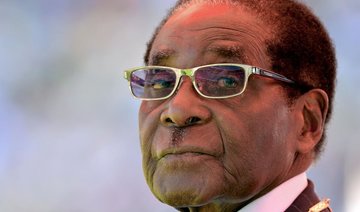
Zimbabwe’s President Emmerson Mnangagwa attends the annual World Economic Forum (WEF) on January 24, 2018 in Davos, eastern Switzerland. Zimbabwe’s new president, Emmerson Mnangagwa, said that the country would go to the polls before July, in the first elections since Robert Mugabe was ousted after 37 years in power. (AFP)
Updated 24 January 2018
Follow

Zimbabwe president promises elections by July and says will respect result

DAVOS: Zimbabwe’s new President Emmerson Mnangagwa said on Wednesday the country will hold transparent elections by July and he would respect the result if the opposition wins.
The election will be the first big test of his legitimacy since he took power in November when the military ousted Robert Mugabe who ruled for 37 years. It will also test the country’s electoral system after complaints of rigging at previous votes.
Mnangagwa, 75, told the World Economic Forum in Davos the nation was “open for business.”
Government spending ballooned under Mugabe and was in part used as patronage. More than 90 percent of the budget went on civil servant salaries, leaving little extra for investment needed to boost growth.
In the latter half of Mugabe’s rule, Zimbabwe’s economy collapsed, particularly after violent and chaotic seizures of thousands of white-owned commercial farms.
The issuance of billions of dollars of domestic debt to pay for a bloated civil service also triggered a collapse in the value of the currency and fueled galloping inflation.
Mnangagwa said he would welcome former commercial farmers to return. “We don’t want to think along racial lines, that is the philosophy of the past. Farmers are farmers,” he said.
Some former cabinet ministers who served under Mugabe have been charged with corruption and Mnangagwa said Mugabe would not be immune from prosecution.
“We have not given anyone any immunity,” he said, but added that Mugabe had been given a “very lucrative package” that included a salary, allowances and first-class travel.
“We will do everything to allow the family to live in peace and undisturbed,” he said.


Cambodia demands Thailand withdraw troops, week into border truce

Updated 3 sec ago
Follow

Cambodia demands Thailand withdraw troops, week into border truce

PHNOM PENH: Cambodia called on neighboring Thailand on Saturday to pull out its forces from areas Phnom Penh claims as its own, one week since a truce halted deadly clashes along their disputed border.
The decades-old dispute between the Southeast Asian neighbors erupted into military clashes several times last year, with fighting in December killing dozens of people and displacing around one million on both sides.
The two countries agreed a truce on December 27, ending three weeks of clashes.
Cambodia says that during that period, Thailand seized several areas across four border provinces.
In a statement on Saturday, Phnom Penh’s foreign ministry demanded the withdrawal of “all Thai military personnel and equipment from the territory of the Kingdom of Cambodia to positions fully consistent with the legally established boundary.”
The Thai army has rejected claims it had used force to seize Cambodia territory, insisting its forces were present in areas that had always belonged to Thailand.
The Cambodian foreign ministry also called on Thailand to immediately end “all hostile military activities” along the frontier and “within Cambodian territory.”
The two nations’ border conflict stems from a dispute over the colonial-era demarcation of their 800-kilometer (500-mile) border, where both sides claim territory and centuries-old temple ruins.
On Friday, Cambodia’s Information Minister Neth Pheaktra accused Thailand of launching the “illegal annexation” of the border village of Chouk Chey.
The Thai army disputed Phnom Penh’s narrative, and Prime Minister Anutin Charnvirakul said his country “has never breached another country’s sovereignty and has acted in line with international regulations.”
Anutin was speaking on Friday while visiting troops deployed to the border province of Surin.