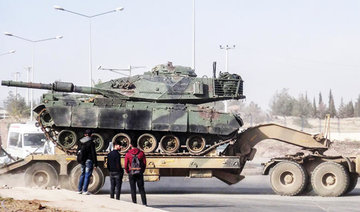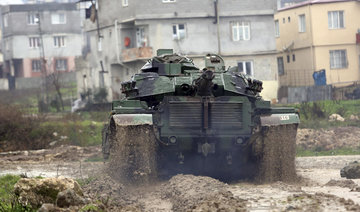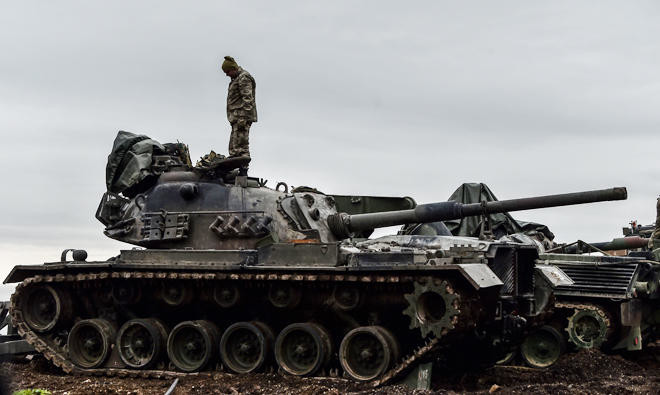
ANKARA: Turkey’s “Olive Branch” military operation against Kurdish militias in northern Syria has forced the US to reconsider its priorities in the conflict.
The offensive on the city of Afrin, which began on Saturday, targets the People’s Protection Units (YPG) and their political wing the Democratic Union Party (PYD), which Ankara considers terror groups linked to the outlawed Kurdistan Workers’ Party (PKK), which is blacklisted as a terrorist organization by Ankara and its Western allies. The YPG denies it is a terror outfit.
The YPG is the Pentagon’s main partner in its fight against Daesh in Syria. America has supplied it with weapons and training.
As Turkey pushed ahead with its operation in Afrin, fears grew of an escalation in tension with the US, despite both countries being NATO allies.
But, at least in their public statements, US military officials have expressed their understanding of Ankara’s domestic security concerns.
Pentagon spokesman Maj. Adrian Rankine-Galloway said that if YPG fighters battling Daesh in northern Syria move to Afrin, and if the military equipment provided by the US is used for any purpose other than fighting Daesh, the US will withdraw its support for the group.
“We are only providing training, advice and support to forces that conduct operations against Daesh,” Galloway told Turkey’s state-run Anadolu Agency.
Washington’s extension of an olive branch to Turkey on such a sensitive issue seems to have produced positive results on the Turkish side and marks a new phase in relations between the two powers.
On Wednesday, Turkish President Recep Tayyip Erdogan pushed the blame away from the Trump administration and toward former US President Barack Obama for failing to “keep his promises to Turkey in Syria,” particularly in Manbij, a city currently held by the YPG.
“The operation during Mr. Obama’s administration aimed to clear terrorists from Manbij. But he failed to keep his promise and cheated us,” Erdogan said.
Presidential spokesman Ibrahim Kalin told CNN Turk on Tuesday that the prerequisite for Turkey to cooperate with the US in Syria is that Washington ends its support to the YPG and takes back the arms it provided to the group.
Burak Bilgehan Ozpek, a Middle East expert from TOBB University of Economics and Technology in Ankara, said Washington’s latest moves to appease Turkey are part of a broader Western strategy to attempt to persuade Turkey not to expand its Afrin operation to Manbij, as Erdogan as threatened.
“Not only the US, but also other key NATO countries, like the UK and the Netherlands, made key statements in recent days as a strategic maneuver empathizing with Ankara’s security concerns and condemning the YPG,” Ozpek told Arab News.
“The Western community noticed Russia’s game plan in Syria — with it giving a green light to launch the Afrin offensive — because Moscow’s main goal is to shift Turkey away from NATO, to sow discord between Turkey and the West, disintegrate the alliance, and establish a more asymmetrical relationship pattern.”
Such a game plan, if it succeeded, would deprive NATO of its second largest military force and leave Russia free to step into the vacuum by deepening ties with Turkey.
But Ozpek said Russia’s tactic has so far failed to produce enough of a split between Turkey and the US, adding that Moscow has also “completely lost the trust of Syrian Kurds.”
On Tuesday, a high-level US delegation visited Ankara to discuss the details of Turkey’s operation in Afrin. On the same day, Turkish Foreign Minister Mevlut Cavusoglu met his American counterpart Rex Tillerson on the sidelines of a conference in Paris.
Those meetings came the day after White House spokeswoman Sarah Huckabee Sanders acknowledged that the US takes Turkey’s security concerns seriously and “is committed to working with Turkey as a NATO ally.”
This remark followed a claim by State Department spokeswoman Heather Nauert that “Russia is trying to drive a wedge between the two NATO allies.”
Mete Sohtaoglu, a Middle East researcher, said the US does not want to create the perception of a threat to Ankara if the YPG fighters it supports relocate. He stressed that the US currently only partners with the YPG to combat Daesh on “the eastern flank of the Euphrates.” To the west of the river, he said, “the Daesh threat is non-existent.”
“The fight against Daesh is the main driver of America’s myopic relationship with the YPG,” Megan Gisclon, a researcher on US-Turkey relations at the Istanbul Policy Center, told Arab News.
“Since the YPG forces currently in Afrin are not working with the US in the campaign to defeat Daesh, the US has no allegiance to these factions,” she added.