JERUSALEM: US Vice President Mike Pence visited Jerusalem's Western Wall on Tuesday while Palestinians held a general strike after denouncing his fervently pro-Israel speech the previous day as "messianic".
The devout Christian's speech to the Israeli parliament on Monday laden with biblical references was praised by Israelis as perhaps the best they could ever hope for from a US administration, but Palestinians saw it as confirming some of their worst fears.
Pence proudly reaffirmed US President Donald Trump's December 6 declaration of Jerusalem as Israel's capital and pledged to move the embassy to the disputed city by the end of 2019.
"The friendship between our peoples has never been deeper," he said.
On Tuesday, as he wrapped up his trip, Pence, who was boycotted by the Palestinians, visited one of the holiest sites in Judaism, the Western Wall.
The site lies in Israeli-annexed east Jerusalem, the sector the Palestinians want as the capital of their future state, and many Israelis were likely to interpret it as Pence further backing their claim over the entire city.
"Very inspiring," Pence said after the visit during which he was not accompanied by Israeli government officials.
Pence followed in the footsteps of Trump, who in May became the first sitting US president to visit the Western Wall.
In December, a US senior administration official said: "We cannot envision any situation under which the Western Wall would not part of Israel."
Pence also toured Jerusalem's Yad Vashem Holocaust memorial accompanied by Israeli Prime Minister Benjamin Netanyahu on Tuesday and met President Reuven Rivlin.
He said the White House believes the Jerusalem declaration "will set the table for the opportunity to move forward in meaningful negotiations to achieve a lasting peace and end the decades-long conflict".
He departed in the late afternoon to return to the United States.


![]()
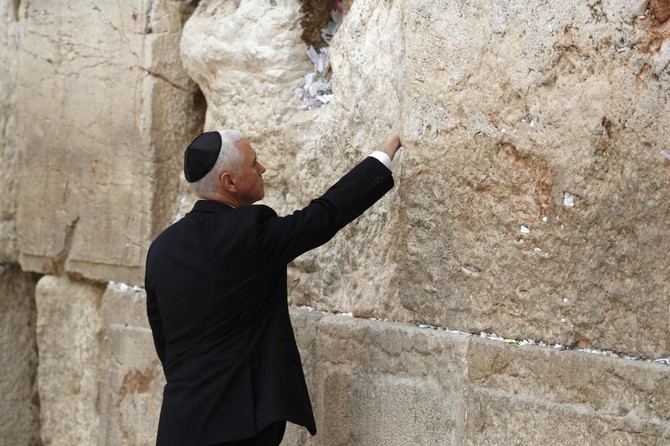
Pence visits Western Wall after pro-Israel speech
Pence visits Western Wall after pro-Israel speech


Latest updates


© 2026 SAUDI RESEARCH & PUBLISHING COMPANY, All Rights Reserved And subject to Terms of Use Agreement.