

UN readies aid as Turkey attacks Kurdish enclave in Syria

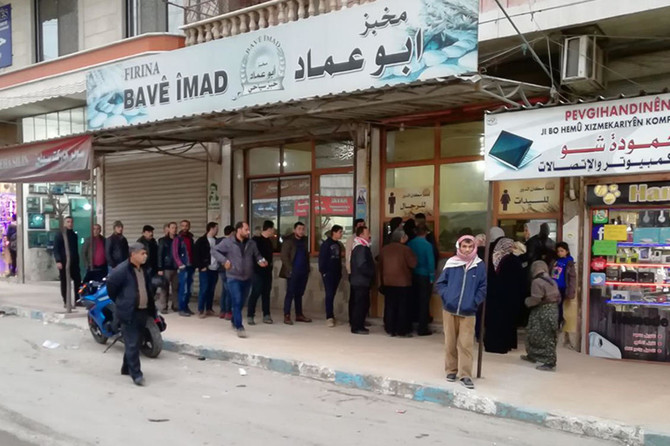
People stand in a queue to enter a bakery in the Syrian northwestern town of Afrin, located in a Kurdish region bordering Turkey, on January 22, 2018. The United Nations said it is ready to help people who might flee from the Afrin enclave, where Turkish troops are on the offensive against Kurdish fighters. (AFP)
Updated 22 January 2018
Follow

UN readies aid as Turkey attacks Kurdish enclave in Syria

DAMASCUS: The United Nations is ready to help people who might flee from the Afrin enclave, where Turkish troops are on the offensive against Kurdish fighters, the top UN official in Syria said Monday.
Ali Al-Za’tari told The Associated Press in his office in western Damascus that they are following the news but “it is still not clear” if people are fleeing the region.
On Saturday, Turkey began an offensive aimed at driving out a US-allied Kurdish militia, which Ankara views as a threat because of its links to Kurdish insurgents fighting in Turkey. Turkey says it aims to create a 30-kilometer (20-mile) deep “secure zone” in Afrin.
“If and when we have verification of people in need, wherever they move to we will be able to assist,” Al-Za’tari said.
Elsewhere in Syria, Al-Za’tari described conditions in the besieged rebel-held Damascus suburbs known as eastern Ghouta as “terrible,” saying that no aid has entered the area since December.
“Access sometimes is very difficult, or even near impossible because of ongoing fighting,” he said.
Government forces have been pounding eastern Ghouta for weeks, killing and wounding dozens of people. Insurgents have fired shells into Damascus, also killing and wounding dozens, including nine dead on Monday alone, including a three-year old child, according to hospital officials and state media.

Last month, Syria’s government allowed the evacuation of nearly 30 critically ill people from eastern Ghouta, where hundreds requiring medical treatment have been prevented from reaching hospitals minutes away.
Government forces had recently tightened their siege on the area, home to some 400,000 people, leading to severe shortages of food, fuel and medicine as winter set in, according to opposition activists.
“For people who are civilians I can only say that it’s quite difficult because the access that they have to basic necessities is rather constrained, the prices of commodities are high (and) medical services are low,” said Al-Za’tari. “We need to get assistance into Ghouta regardless of the control party or authority in that region.”
Al-Za’tari said there are currently about 500,000 people living in 10 besieged areas around Syria. He added that if those who are hard to reach are added, the figure rises to about 3 million.
The UN official said there are about 6 million Syrians who are internally displaced. Another 5 million have fled to neighboring countries.
“We don’t have yet the conducive environment for refugees to return to Syria,” Al-Za’tari said, citing difficulties related to security, documentation and housing.
He said the UN spent $1.7 billion in Syria last year through the humanitarian response plan. He said they plan to spend $3.5 billion this year.
Tourism on hold as Middle East war casts uncertainty

Updated 2 sec ago
Follow

Tourism on hold as Middle East war casts uncertainty

  • Cancelled flights, postponed trips and a great deal of uncertainty: the war in the Middle East is casting a long shadow over the tourism outlook for the region
PARIS: Cancelled flights, postponed trips and a great deal of uncertainty: the war in the Middle East is casting a long shadow over the tourism outlook for a region that has become a prized destination for travelers worldwide.
“My last group of tourists left three days ago, and all the other groups planned for March have been canceled,” said Nazih Rawashdeh, a tour guide near Irbid, in northern Jordan.
“This is the start of the high season here. It’s catastrophic,” he told AFP.
“And yet there’s no problem in Jordan. It’s perfectly safe.”
Across the world, tour operators are scrambling to find solutions for clients stranded in the region or who had trips planned there.
“The priority is getting those already there back home,” said Alain Capestan, president of the French tour operator Comptoir des Voyages.
He said however that the war was also affecting customers who have traveled to other parts of the world, as the Gulf region is home to several major aviation hubs — Dubai, Abu Dhabi and Doha.
Like other companies, the German tour operators surveyed by AFP — Alltours, Dertour, Schauinsland-Reisen — announced they would cover the cost of extra nights for clients stranded in the Middle East. They also canceled trips to the UAE and Oman until at least March 7.
Swiss operator MSC Cruises, which has a ship stranded in Dubai, told AFP on Thursday it was sending five charter flights to airlift nearly 1,000 passengers.
The firm said it expected the passengers to be out of the region by Saturday, without specifying the destinations of the flights or the nationalities of the holidaymakers.
The British travel industry association ABTA said agencies “would not be sending customers to the region for as long as the British Foreign Office advises against all non-essential travel.”
Customers whose holidays were canceled in recent days will be able to rebook or receive a refund, it said.
- Economic impact -
The war is disrupting a sector that had been booming in the region.
According to UN Tourism, in 2025 around 100 million tourists visited the Middle East — nearly seven percent of all international tourists recorded worldwide. That figure had grown three percent year-on-year and 39 percent compared to the pre-pandemic period.
Depending on the destination, Europeans make up a large share of visitors, followed by tourists from South Asia, the Americas, and other Middle Eastern countries.
For example, nearby markets accounted for 26 percent of total visitors to Dubai in 2025, according to its Ministry of Tourism and Economy.
Against this backdrop analysts Oxford Economics warns that “a decline in tourist flows to the region will deal a more severe economic blow than in the past, as tourism’s share of GDP has grown, as has employment in the sector.”
“We estimate inbound arrivals to the Middle East could decline 11-27 percent year-on-year in 2026 due to the conflict, compared to our December forecast that projected 13 percent growth,” said Director of Global Forecasting Helen McDermott.
That would translate, according to the firm, to between 23 and 38 million fewer international visitors compared to the prior scenario, and a loss of $34 to $56 billion in tourist spending.
After Covid and then the conflict in Gaza, tourists had been coming back, said Rawashdeh, the Jordanian tour guide.
“For the past six months, people working in tourism here had hope. And now there’s a war. This is going to be terrible for the economy,” he said.
“We’ve definitely noticed an understandable slowdown in new bookings from our partners right now, but we fully expect that to bounce back as soon as things settle down and travelers feel more confident,” said Ibrahim Mohamed, marketing director of Middle East Travel Alliance, which offers direct tours to American and British operators.
He remains optimistic: “The Middle East has always been an incredibly resilient market, and demand always bounces back fast once stability returns.”