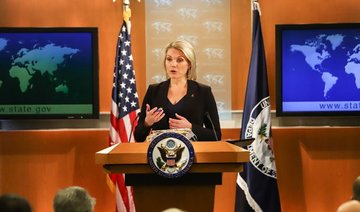
ANKARA: Turkey claimed the capture of 15 Kurdish-held villages on Monday on the third day of Operation Olive Branch aimed at driving out Syrian Kurdish forces of the People’s Protection Units (YPG) from their Afrin enclave in northwest Syria.
Turkish artillery shelled YPG targets inside Syria and ground troops opened a new front by moving on Afrin from the town of Azaz to the east.
The Britain-based Syrian Observatory for Human Rights said 21 civilians, six of them children, had been killed in the operation.
Ankara denied causing civilian casualties, and Foreign Minister Mevlut Cavusoglu accused the YPG of sending out “nonsense propaganda and baseless lies.”
France called for a UN Security Council meeting on Monday to discuss concerns over flashpoint areas in Syria, including the Turkish offensive. But President Recep Tayyip Erdogan said Turkey had Russia’s support for the operation and would not back down. “We are determined. Afrin will be sorted out. We will take no step back,” he said in a televised speech in Ankara.
In a sign of the risks to Turkey, 11 rockets fired from Syria hit the Turkish border town of Reyhanli on Sunday, killing one Syrian refugee and wounding 46 people, 16 of them Syrian.
Turkey’s Prime Minister Binali Yildirim said 170 Kurdish military targets had been destroyed since Saturday and the Turkish army had suffered no losses.
Turkish authorities detained 24 people on Monday accused of posting “terror propaganda” on social media in support of the YPG and against the military operation. Ankara views the YPG and its political wing the PYD (Democratic Union Party) as terrorist groups linked to the outlawed PKK.
NATO Deputy Secretary-General Rose Gottemoeller met Turkish officials in Ankara on Monday and said all countries had the right to self-defense, provided “this is done in a proportionate and measured way.”
Turkey claims to have captured up to 8km of territory in Afrin, and Naim Baburoglu, a military strategist and retired Turkish brigadier general, told Arab News he did not expect the operation to last much longer.
“In each military operation, there should be a political objective which precedes military targets,” he said. “For this one, Turkey wants to neutralize the PYD, to prevent a Kurdish corridor from reaching to the Mediterranean shores and to preserve Syria’s territorial integrity.”
Afrin was merely a tactical operation, he said, while the strategic objective was to eradicate the PYD threat east of the Euphrates, and the offensive was likely to be extended in that direction.
“If not, Turkey’s territorial integrity and border security will still be under threat from the PYD presence in the region in the short to medium term,” Baburoglu said.
Kerim Has, a lecturer in Turkish-Russian relations at Moscow University, warned that if the Turkish army suffered heavy losses in the offensive and sought further Russian military, political and diplomatic support, this would change the whole picture in Syria, Turkey and throughout the region.
“Requests to Russia from Ankara in such a scenario can directly cause a sharp and irrevocable break in Turkey-NATO relations,” he told Arab News.
The US State Department has already asked Turkey to restrict the scope of the operation and “to exercise restraint.” Defense Secretary Jim Mattis said Turkey had been “candid” and had informed Washington beforehand about its operation.
Sakir Dincsahin, a Middle East expert from Hasan Kalyoncu University in Gaziantep, told Arab News: “Russia’s influence in the region has risen considerably and it has become a real power broker in Syria. So Moscow’s diplomatic support for the operation contributes a lot to its success.”
Washington was losing influence over Turkey because of its close partnership with the YPG and its latest attempt to establish a Kurdish-led border security force, he said.
“And at the same time it will also suffer an enormous image loss as it is currently not in a position to safeguard its local PYD/PKK allies from Turkish attacks.”

Turkey claims capture of 15 villages on Day 3 of Afrin offensive
Rubio plans to visit Israel next week as US-Iran tensions remain high after latest talks
TEL AVIV: Secretary of State Marco Rubio will make a quick trip to Israel early next week, the State Department said, as tensions between the United States and Iran remain high after their latest nuclear talks and American forces gather in the region.
The US Embassy in Israel had earlier urged staff who want to leave to depart, joining other nations in encouraging people to leave the region and signaling that US military action might be imminent. The announcement of Rubio’s visit could indicate a longer timeline for any potential strike.
A confidential report from the UN nuclear watchdog meanwhile confirmed that Iran has not offered inspectors access to sensitive nuclear sites since they were heavily bombed during the 12-day war launched by Israel last June. As a result, it said it could not confirm Iran’s claims that it stopped uranium enrichment after the US and Israeli strikes.
The report was circulated to member countries and seen by The Associated Press.
US President Donald Trump has threatened military action if Iran does not agree to a far-reaching deal on its nuclear program. Iran insists it has the right to enrich uranium for peaceful purposes and denies seeking a nuclear weapon.
Those wishing to leave ‘should do so TODAY’
The State Department said in a statement that Rubio would visit Israel on Monday and Tuesday to “discuss a range of regional priorities including Iran, Lebanon, and ongoing efforts to implement President Trump’s 20-Point Peace Plan for Gaza.” It offered no other details.
Israeli Prime Minister Benjamin Netanyahu has long urged tougher US action against Iran, and has warned that Israel will repond to any Iranian attack.
The announcement of Rubio’s visit came just hours after the US Embassy in Jerusalem implemented “authorized departure” status for non-essential personnel and family members, which means that eligible staffers can leave the country voluntarily at government expense.
In an email, US Ambassador Mike Huckabee urged staff considering departure to do so quickly, advising them to focus initially on getting any flight out of Israel and to then make their way to Washington.
“Those wishing to take AD should do so TODAY,” Huckabee wrote, using an acronym for “authorized departure.”
“While there may be outbound flights over the coming days, there may not be,” he added, in an email that was recounted to The Associated Press by someone involved with the US mission who wasn’t authorized to share details.
On a town hall meeting Friday after the email was sent, Huckabee told staff that he was encouraging airlines to keep flying.
Vance to meet with mediator
Iran and the United States on Thursday walked away from another round of nuclear negotiations in Geneva without a deal. Technical discussions are scheduled to take place in Vienna next week.
US Vice President JD Vance was to meet later on Friday in Washington with Oman’s foreign minister, Badr Al-Busaidi, who has been mediating the talks, according to a person with knowledge of the meeting who spoke on condition of anonymity because the meeting is private.
Earlier, Al-Busaidi said that there had been significant progress made on Thursday, though officials from Iran and the United States haven’t announced steps forward.
Iranian Foreign Minister Abbas Araghchi on Thursday said “what needs to happen has been clearly spelled out from our side,” without offering specifics. Iran has long demanded relief from heavy international sanctions in return for taking steps to limit but not end its nuclear program.
Flights suspended as people are urged to leave
The US has gathered a massive fleet of aircraft and warships in the Middle East, with one aircraft carrier already in place and another heading to the region. Iran says it will respond to any US attack by targeting American forces in the region, potentially including those stationed in US bases in allied Arab countries.
Airlines such as Netherlands-based KLM have already announced plans to suspend flights out of Tel Aviv’s Ben Gurion International Airport, and other embassies have also made plans for authorized departures from Israel and neighboring countries.
Britain’s Foreign Office said that “due to the security situation, UK staff have been temporarily withdrawn from Iran.” It said the embassy was operating remotely.
Australia on Wednesday “directed the departure of all dependents of Australian officials posted to Israel in response to the deteriorating security situation in the Middle East.” China, India and several European countries with missions in Iran have advised citizens to avoid travel to the country.
China’s Foreign Ministry also advised its citizens already in Iran to leave, according to a statement reported by Chinese state media.
The US Embassy in Israel had earlier urged staff who want to leave to depart, joining other nations in encouraging people to leave the region and signaling that US military action might be imminent. The announcement of Rubio’s visit could indicate a longer timeline for any potential strike.
A confidential report from the UN nuclear watchdog meanwhile confirmed that Iran has not offered inspectors access to sensitive nuclear sites since they were heavily bombed during the 12-day war launched by Israel last June. As a result, it said it could not confirm Iran’s claims that it stopped uranium enrichment after the US and Israeli strikes.
The report was circulated to member countries and seen by The Associated Press.
US President Donald Trump has threatened military action if Iran does not agree to a far-reaching deal on its nuclear program. Iran insists it has the right to enrich uranium for peaceful purposes and denies seeking a nuclear weapon.
Those wishing to leave ‘should do so TODAY’
The State Department said in a statement that Rubio would visit Israel on Monday and Tuesday to “discuss a range of regional priorities including Iran, Lebanon, and ongoing efforts to implement President Trump’s 20-Point Peace Plan for Gaza.” It offered no other details.
Israeli Prime Minister Benjamin Netanyahu has long urged tougher US action against Iran, and has warned that Israel will repond to any Iranian attack.
The announcement of Rubio’s visit came just hours after the US Embassy in Jerusalem implemented “authorized departure” status for non-essential personnel and family members, which means that eligible staffers can leave the country voluntarily at government expense.
In an email, US Ambassador Mike Huckabee urged staff considering departure to do so quickly, advising them to focus initially on getting any flight out of Israel and to then make their way to Washington.
“Those wishing to take AD should do so TODAY,” Huckabee wrote, using an acronym for “authorized departure.”
“While there may be outbound flights over the coming days, there may not be,” he added, in an email that was recounted to The Associated Press by someone involved with the US mission who wasn’t authorized to share details.
On a town hall meeting Friday after the email was sent, Huckabee told staff that he was encouraging airlines to keep flying.
Vance to meet with mediator
Iran and the United States on Thursday walked away from another round of nuclear negotiations in Geneva without a deal. Technical discussions are scheduled to take place in Vienna next week.
US Vice President JD Vance was to meet later on Friday in Washington with Oman’s foreign minister, Badr Al-Busaidi, who has been mediating the talks, according to a person with knowledge of the meeting who spoke on condition of anonymity because the meeting is private.
Earlier, Al-Busaidi said that there had been significant progress made on Thursday, though officials from Iran and the United States haven’t announced steps forward.
Iranian Foreign Minister Abbas Araghchi on Thursday said “what needs to happen has been clearly spelled out from our side,” without offering specifics. Iran has long demanded relief from heavy international sanctions in return for taking steps to limit but not end its nuclear program.
Flights suspended as people are urged to leave
The US has gathered a massive fleet of aircraft and warships in the Middle East, with one aircraft carrier already in place and another heading to the region. Iran says it will respond to any US attack by targeting American forces in the region, potentially including those stationed in US bases in allied Arab countries.
Airlines such as Netherlands-based KLM have already announced plans to suspend flights out of Tel Aviv’s Ben Gurion International Airport, and other embassies have also made plans for authorized departures from Israel and neighboring countries.
Britain’s Foreign Office said that “due to the security situation, UK staff have been temporarily withdrawn from Iran.” It said the embassy was operating remotely.
Australia on Wednesday “directed the departure of all dependents of Australian officials posted to Israel in response to the deteriorating security situation in the Middle East.” China, India and several European countries with missions in Iran have advised citizens to avoid travel to the country.
China’s Foreign Ministry also advised its citizens already in Iran to leave, according to a statement reported by Chinese state media.
© 2026 SAUDI RESEARCH & PUBLISHING COMPANY, All Rights Reserved And subject to Terms of Use Agreement.