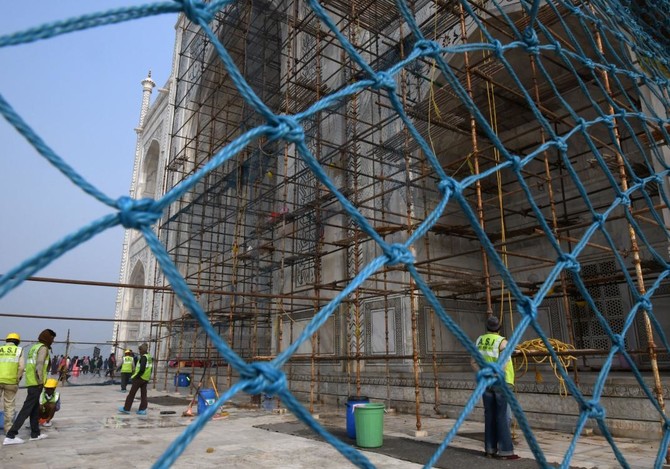
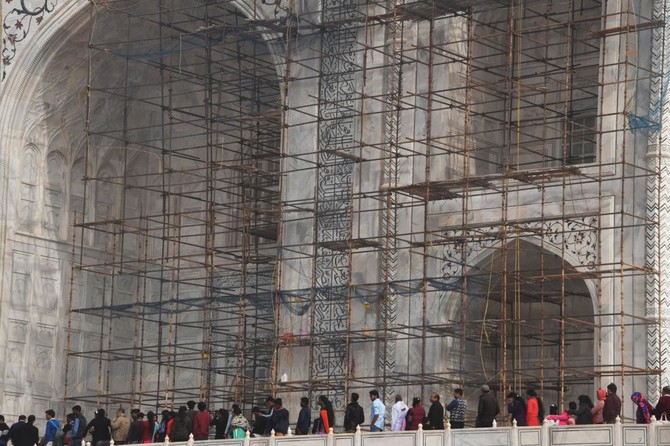
AGRA, India: Tourist Muskan Mahuwakar pictured the Taj Mahal as a dazzling vision of symmetry and beauty but upon reaching the monument, she — like thousands of other visitors — was disappointed to find it covered in scaffolding, its once white marble now yellowing due to pollution.
Building restoration at India’s most popular tourist attraction is now into its fourth year, with work yet to even begin on its imposing dome.
“It’s disappointing not to get a perfect frame of this immaculate structure,” Mahuwakar, a history student, said on her first visit to the Taj, as nearby cleaners armed with colorful plastic buckets and large mops desperately tried to scrub some luster back into the stained stone.
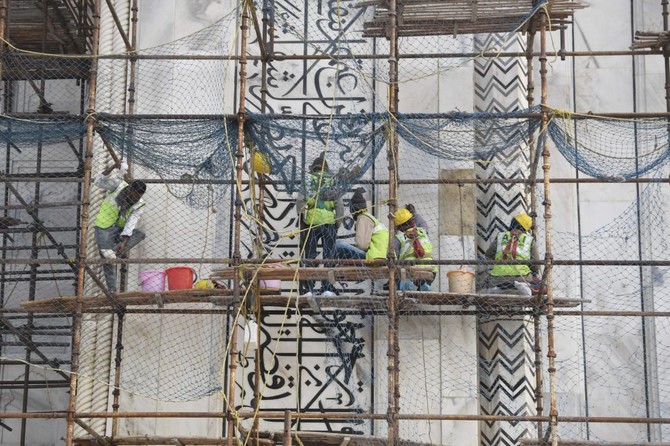
Other restoration teams scale the facade, blocking views to the ornate Islamic carvings engraved on its walls. The interruption to the serenity of visiting one of the seven modern wonders of the world.
“The repair has been going on for so long. Of course, old monuments need to be conserved, but we must find solutions that are quick and effective,” Mahuwakar said, casting a dejected look at the scaffolding around.
Pollution and old age are taking their toll on the 17th century mausoleum, nestled on the south bank of the Yamuna river in Agra, but critics warn that even the options authorities are using to try to fix, may be exacerbating the problem.
Mudpacks have been applied in stages to draw out stains but critics say the process is as damaging as bleaching the fine stone.
Authorities reject this, but admit they are concerned about how to proceed with handling the fragile central dome.
There are fears this inevitable work risks damaging the unmistakable feature of the Taj and will put off tourists.
Experts warn that iron scaffolding risks leaving irrevocable scars on the fine marble. But bamboo frames are inadequate for such heights, leaving few options for those charged with executing the daunting task.
“We have to clean the dome, but the challenge is how to erect the scaffolding,” Bhuvan Vikrama, the government archaeologist overseeing restoration efforts, said.
“The structure is almost 400 years old, so we can’t put any extra load on it. In righting the wrong, we should not wrong the right.”
It remains unclear when work will begin or for how long the central dome will be encased in scaffolding.
Fodor’s Travel, a publisher of tourism guidebooks, has advised readers to avoid the Taj until at least 2019 lest visitors be disappointed.
The number of local tourists is also being capped to 40,000 a day in a bid to reduce wear and tear on the monument to love, which was built by Mughal emperor Shah Jahan for his beloved wife Mumtaz Mahal, who died giving birth in 1631.Currently daily visitor numbers average 10,000-15,000 but can be much higher at weekends, going up to around 70,000. According to government figures, nearly 6.5 million people — mainly from India — visited the historic complex in 2016.
Anyone wanting to see the main crypt, which houses marble graves inlaid with semi-precious stones, will also have to pay for a pricier ticket.
But critics warn that restoration is only half the solution, pointing to the industrial factories across the river that near continuously belch out noxious fumes, leaving the air thick with smog.
This toxic haze from this and from dung and garbage burning in and around Agra is responsible for discoloring the Taj, experts say.
Efforts to curb these pollutants, including banning motor vehicles within 500 meters of the building, have failed to clear up the air.
M C Mehta, a lawyer, said his battles in court to shift polluting industries — including a huge crematorium — had fallen on deaf ears.
“No one wants to take hard decisions,” Mehta said.
“The Taj used to be surrounded by lush greenery, but now there is nothing. Taj is in the last stage of cancer. It is dying, it is gasping for breath.”


![]()
![]()
![]()
![]()
No end to eyesores at India’s Taj Mahal as restoration work drags on

No end to eyesores at India’s Taj Mahal as restoration work drags on


Latest updates


© 2026 SAUDI RESEARCH & PUBLISHING COMPANY, All Rights Reserved And subject to Terms of Use Agreement.