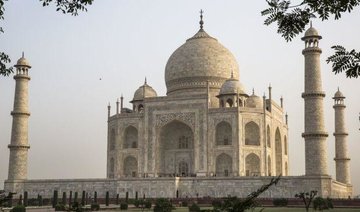
AGRA, India: Authorities in India are trying to figure out how workers will scale the Taj Mahal’s majestic but delicate dome as they complete the first thorough cleaning of the World Heritage site since it was built 369 years ago.
Work on the mausoleum’s minarets and walls is almost finished, after workers began the makeover in mid-2015.
They’ve been using a natural mud paste to remove yellow discoloration and return the marble to its original brilliant white. Called fuller’s earth, it’s the same clay that some people smother on their skin as a beauty treatment.
But the metal scaffolding used so far is too heavy and rigid for the dome, said Bhuvan Vikrama, the superintending archaeologist from the Archaeological Survey of India. He said they’re considering other options, including designing and constructing special bamboo scaffolding.
He said there’s a precedent, after bamboo scaffolding was used on the dome in the early 1940s when some conservation work was carried out.
Vikrama said rain was enough to clean most of the Taj Mahal in the past but air pollution over the last 25 years had taken its toll.
“It became visibly clear it was all yellow,” he said. “It even started becoming black in the shaded areas not washed by rains.”
He said work on the dome would likely take 10 months, starting next year and finishing in 2019. The makeover was costing a total of about $500,000.
The work has prompted Fodor’s Travel guide to include the Taj Mahal on its list of places not to visit next year.
“Unless your dream Taj Mahal visit involves being photographed standing in front of a mud-caked and be-scaffolded dome, maybe give it until 2019 at the earliest,” the guide recommends.
Vikrama disagrees, saying photographs from the 1940s with scaffolding on the dome are interesting and historically important.
“If the tourism even fluctuates, we should not bother about that,” he said. “Tourists should also appreciate they are witnessing the work going on, the right kind of efforts for the preservation of monuments.”
The Taj Mahal typically attracts between 7 and 8 million visitors a year. Built by Mughal Emperor Shah Jahan in memory of his wife Mumtaz Mahal, people are attracted as much by the love story as the spectacular architecture.
“It’s the most beautiful thing I’ve ever seen,” said Kent Scheibel, a tourist from Los Angeles who was visiting the site this week. “It’s a living, breathing thing that emanates the absolute beauty of the human spirit.”

India’s cleaning quandary: How to scale the Taj Mahal dome?
Cambodia takes back looted historic artifacts handled by British art dealer
- The objects were returned under a 2020 agreement between the Ministry of Culture and Fine Arts and the family of the late Douglas Latchford, a British art collector and dealer who allegedly had the items smuggled out of Cambodia
PHNOM PENH, Cambodia: Cambodian officials on Friday received more than six dozen historic artifacts described as part of the country’s cultural heritage that had been looted during decades of war and instability.
At a ceremony attended by Deputy Prime Minister Hun Many, the 74 items were unveiled at the National Museum in Phnom Penh after their repatriation from the United Kingdom.
The objects were returned under a 2020 agreement between the Ministry of Culture and Fine Arts and the family of the late Douglas Latchford, a British art collector and dealer who allegedly had the items smuggled out of Cambodia.
“This substantial restitution represents one of the most important returns of Khmer cultural heritage in recent years, following major repatriations in 2021 and 2023 from the same collection,” the Culture Ministry said in a statement. “It marks a significant step forward in Cambodia’s continued efforts to recover, preserve, and restore its ancestral legacy for future generations.”
The artifacts were described as dating from the pre-Angkorian period through the height of the Angkor Empire, including “monumental sandstone sculptures, refined bronze works, and significant ritual objects.” The Angkor Empire, which extended from the ninth to the 15th century, is best known for the Angkor Wat archaeological site, the nation’s biggest tourist attraction.
Latchford was a prominent antiquities dealer who allegedly orchestrated an operation to sell looted Cambodian sculptures on the international market.
From 1970 to the 1980s, during Cambodia’s civil wars and the communist Khmer Rouge ‘s brutal reign, organized looting networks sent artifacts to Latchford, who then sold them to Western collectors, dealers, and institutions. These pieces were often physically damaged, having been pried off temple walls or other structures by the looters.
Latchford was indicted in a New York federal court in 2019 on charges including wire fraud and conspiracy. He died in 2020, aged 88, before he could be extradited to face charges.
Cambodia, like neighboring Thailand, has benefited from a trend in recent decades involving the repatriation of art and archaeological treasures. These include ancient Asian artworks as well as pieces lost or stolen during turmoil in places such as Syria, Iraq and Nazi-occupied Europe. New York’s Metropolitan Museum of Art is one of the prominent institutions that has been returning illegally smuggled art, including to Cambodia.
“The ancient artifacts created and preserved by our ancestors are now being returned to Cambodia, bringing warmth and joy, following the country’s return to peace,” said Hun Many, who is the younger brother of Prime Minister Hun Manet.