Egypt targets slew of government flotations

Vehicles drive by in front of Central Bank of Egypt Headquarters in Cairo Dec. 30. The government owns stakes in a number of banks, some of which may be earmarked for priviatization. (Reuters)
Updated 21 January 2018
Follow

Egypt targets slew of government flotations

CAIRO: Egypt is looking to offer shares in eight to 10 state companies on the stock exchange over the next 18 months, Finance Minister Amr El-Garhy told Reuters on Sunday, as part of a drive to attract foreign investors.

The flotations will be the first batch in a program to float stakes in dozens of state-owned companies over the next three to five years in areas including oil, services, chemicals, shipping and real estate.

“The companies will include companies listed on the exchange and those not listed,” Garhy told Reuters by phone, referring to the first batch.
He did not specify the sectors or sizes of the companies under consideration.

The government said previously that it expected the first share offering would be in oil company ENPPI, in the first quarter of 2018.

Egypt’s stock market has taken off since the country floated its pound currency in November 2016, with the Egyptian blue-chip index gaining about 80 percent since then.

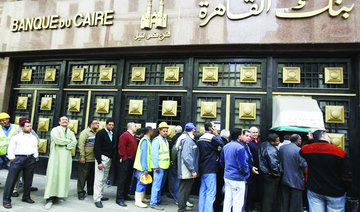
The government has said previously it plans to offer 20 percent of state-owned Banque du Caire as well as a 40 percent stake in the Arab African International Bank (AAIB), in which the central bank owns a stake.

The state owns vast swathes of Egypt’s economy, including three of its largest banks — National Bank of Egypt, Banque Du Caire, the United Bank of Egypt — along with much of its oil industry and real estate sector.

The last time state-owned companies were listed on the exchange was in 2005 when shares of Telecom Egypt, the state’s landline monopoly, and oil companies Sidi Kerir Petrochemicals and AMOC were floated.

Saudi tourism employment surpasses 1m as hospitality sector expands 

Updated 08 January 2026
Follow

Saudi tourism employment surpasses 1m as hospitality sector expands 

RIYADH: Saudi Arabia’s tourism workforce surpassed 1 million in the third quarter of 2025, underscoring the sector’s rapid expansion as the Kingdom continues to develop its hospitality infrastructure and visitor economy. 

According to the latest Tourism Establishments Statistics report released by the General Authority for Statistics, the total number of employees in tourism activities reached approximately 1,009,691 in the third quarter of 2025, marking a 6.4 percent increase compared to the same period in 2024, when employment stood at 948,629. 

The growth in employment comes alongside a significant rise in the number of licensed tourism hospitality facilities, which increased by 40.6 percent year on year to reach 5,622 in the third quarter. Of these, serviced apartments and other hospitality facilities accounted for 52.6 percent, while hotels represented 47.4 percent. 

The robust growth reflected in the latest tourism statistics aligns directly with the goals of Vision 2030, as the Kingdom aims to double tourism’s gross domestic product contribution to 10 percent. The sector is also seeking to create 1.6 million jobs, and attract 150 million visitors annually by 2030.

The report showed that non-Saudi employees made up the majority of the tourism workforce, numbering 764,520 and accounting for 75.7 percent of the total. Saudi nationals employed in the sector reached 245,171, representing 24.3 percent of all tourism workers. 

In terms of gender distribution, male employees dominated the sector with 875,658 workers, while female employees totaled 134,033, making up just 13.3 percent of the workforce. 

Hotel performance showed positive momentum, with the average room occupancy rate rising to 49.1 percent during the quarter, an increase of 2.9 percentage points from 46.1 percent in the same period a year earlier. 

In contrast, serviced apartments and other hospitality facilities experienced a slight dip in occupancy, recording 57.4 percent compared to 58 percent in the same quarter of 2024. 

The average daily room rate in hotels decreased by 3.6 percent to SR341 ($90.9), down from SR354 in the third quarter of 2024. Meanwhile, serviced apartments and similar facilities saw their average daily rate rise by 4.1 percent to SR208, up from SR200 a year earlier. 

The average length of stay in hotels was 4.1 nights, down 1 percent from 4.2 nights in the third quarter of 2024. For serviced apartments and other hospitality facilities, the average stay was 2.1 nights, reflecting a marginal decrease of 0.2 percent year-on-year. 

The statistics draw on administrative records, surveys and secondary data to capture activity across the Kingdom’s tourism sector, GASTAT said.