DUBAI: Iran’s supreme leader has ordered the Revolutionary Guard to loosen its hold on the economy, the country’s defense minister said, raising the possibility that the paramilitary organization might privatize some of its vast holdings.
The comments this weekend by Defense Minister Gen. Amir Hatami appear to be a trial balloon to test the reaction of the idea, long pushed by Iran’s President Hassan Rouhani, a relative moderate. Protests over the country’s poor economy last month escalated into demonstrations directly challenging the government.
But whether the Guard would agree remains unclear, as the organization is estimated to hold around a third of the country’s entire economy.
Hatami, the first non-Guard-affiliated military officer to be made defense minister in nearly 25 years, made the comments in an interview published Saturday by the state-run IRAN newspaper. He said Supreme Leader Ayatollah Ali Khamenei ordered both the country’s regular military and the Guard to get out of businesses not directly affiliated to their work.
“Our success depends on market conditions,” the newspaper quoted Hatami as saying.
He did not name the companies that would be privatized. The Guard did not immediately acknowledge the supreme leader’s orders in their own publications, nor did Khamenei’s office.
The Guard formed out of Iran’s 1979 revolution as a force meant to protect its political system, which is overseen by Shiite clerics. It operated parallel to the country’s regular armed forces, growing in prominence and power during the country’s long and ruinous war with Iraq in the 1980s. It runs Iran’s ballistic missile program, as well its own intelligence operations and expeditionary force.
In the aftermath of the 1980s war, authorities allowed the Guard to expand into private enterprise.
Today, it runs a massive construction company called Khatam Al-Anbia, with 135,000 employees handling civil development, the oil industry and defense issues. Guard firms build roads, man ports, run telecommunication networks and even conduct laser eye surgery.
The exact scope of all its business holdings remains unclear, though analysts say they are sizeable. The Washington-based Foundation for Defense of Democracies, which long has been critical of Iran and the nuclear deal it struck with world powers, suggests the Guard controls “between 20 and 40 percent of the economy” of Iran through significant influence in at least 229 companies.
In his comments, Hatami specifically mentioned Khatam Al-Anbia, but did not say whether that too would be considered by the supreme leader as necessary to privatize. The Guard and its supporters have criticized other business deals attempting to cut into their piece of the economy since the nuclear deal.


![]()
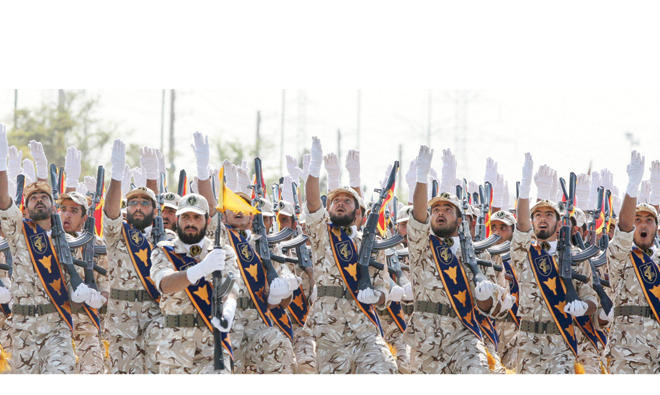
Iran likely to loosen Revolutionary Guard’s grip on economy
Iran likely to loosen Revolutionary Guard’s grip on economy


Latest updates


Recommended


© 2026 SAUDI RESEARCH & PUBLISHING COMPANY, All Rights Reserved And subject to Terms of Use Agreement.