Israel won’t prosecute embassy guard over Jordan shootings: sources

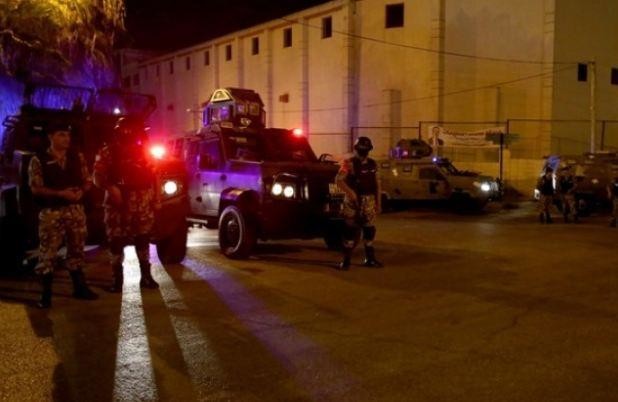
Security forces stand guard outside the Israeli embassy in the residential Rabiyeh neighbourhood of the Jordanian capital Amman following an 'incident'. (AFP)
Updated 21 January 2018
Follow

Israel won’t prosecute embassy guard over Jordan shootings: sources

JERUSALEM: Israel will not prosecute a guard from its embassy in Amman who killed two Jordanians in July, as had long been demanded by the kingdom, two Israeli sources said on Sunday.
Instead, the Foreign Ministry and Shin Bet security agency will review protocols surrounding the actions taken by the guard, and his conduct, “and share the results with the Jordanians,” a diplomatic source said.
The killings led to a rift between the countries, which both said last week had been mended.
Jordan said Israel had apologized for the embassy deaths, would compensate the victims’ next of kin and “implement and follow up legal measures” in the case.
Jordanian officials were not immediately available to comment on the diplomatic source’s account. Israel’s Foreign Ministry spokesman declined comment.
Amman had previously demanded a homicide trial for the guard, whose repatriation under diplomatic immunity and hero’s welcome by Prime Minister Benjamin Netanyahu angered Jordanians.
Israel said in the aftermath of the incident that the guard had acted in self-defense, shooting a workman who stabbed and wounded him lightly, and that the second Jordanian was killed by stray fire.
Asked on Sunday whether criminal prosecution of the guard was possible, a second Israeli official told Reuters on condition of anonymity: “No way.”
The guard’s prospects of remaining in the Israeli secret service may be in doubt, however, after a Jordanian newspaper published his name and photograph.
Other fine-print elements of the reconciliation deal were designed to limit legal culpability for Israel, the diplomatic source said.
Israel would not pay damages to the next of kin directly, but instead provide a $5 million lump sum for the Jordanian government to disburse as compensation, that source said. The money is also meant to cover the needs of the family of a Jordanian shot dead by an Israeli border guard in 2014.
Two sources close to the families confirmed the payout sum.
The Israeli diplomatic source said the Netanyahu government had not apologized for the shooting of the alleged assailant but rather “voiced regret.”
On Thursday, a Jordanian government spokesman said Israel had sent a memorandum stating its “deep regrets and apologies.”
Yet Israel distinguishes between the two expressions of contrition, seeing in the latter a potential admission of guilt.
A deal reconciling Israel and Turkey over the killing of 10 pro-Palestinian Turks who tried to breach the Gaza blockade in 2010 included Israel voicing regret and paying $20 million into a Turkish fund that compensated the bereaved and injured.
In return, Ankara agreed not to seek the criminal prosecution of Israeli marines who raided the activists’ ship.
Jordan signed a peace treaty with Israel in 1994.
Three years later, during Netanyahu’s first term as prime minister, relations were strained when Israeli secret agents were caught spraying poison into the ear of Palestinian Hamas leader Khaled Meshaal on an Amman street.
The assassination team was repatriated in return for an antidote for Meshaal and the release of Hamas’s spiritual leader, Ahmed Yassin, from an Israeli jail.
On Saturday night in a Twitter posting, Netanyahu expressed appreciation for behind-the-scenes efforts by US envoys Jared Kushner and Jason Greenblatt to help end the crisis with Jordan.


Tunisia’s famed blue-and-white village threatened after record rains

Updated 31 January 2026
Follow

Tunisia’s famed blue-and-white village threatened after record rains

  • The one-time home of French philosopher Michel Foucault and writer Andre Gide, the village is protected under Tunisian preservation law, pending a UNESCO decision on its bid for World Heritage status

SIDI BOU SAID, Tunisia: Perched on a hill overlooking Carthage, Tunisia’s famed blue-and-white village of Sidi Bou Said now faces the threat of landslides, after record rainfall tore through parts of its slopes.
Last week, Tunisia saw its heaviest downpour in more than 70 years. The storm killed at least five people, with others still missing.
Narrow streets of this village north of Tunis — famed for its pink bougainvillea and studded wooden doors — were cut off by fallen trees, rocks and thick clay. Even more worryingly for residents, parts of the hillside have broken loose.
“The situation is delicate” and “requires urgent intervention,” Mounir Riabi, the regional director of civil defense in Tunis, recently told AFP.
“Some homes are threatened by imminent danger,” he said.
Authorities have banned heavy vehicles from driving into the village and ordered some businesses and institutions to close, such as the Ennejma Ezzahra museum.

- Scared -

Fifty-year-old Maya, who did not give her full name, said she was forced to leave her century-old family villa after the storm.
“Everything happened very fast,” she recalled. “I was with my mother and, suddenly, extremely violent torrents poured down.”
“I saw a mass of mud rushing toward the house, then the electricity cut off. I was really scared.”
Her Moorish-style villa sustained significant damage.
One worker on site, Said Ben Farhat, said waterlogged earth sliding from the hillside destroyed part of a kitchen wall.
“Another rainstorm and it will be a catastrophe,” he said.
Shop owners said the ban on heavy vehicles was another blow to their businesses, as they usually rely on tourist buses to bring in traffic.
When President Kais Saied visited the village on Wednesday, vendors were heard shouting: “We want to work.”
One trader, Mohamed Fedi, told AFP afterwards there were “no more customers.”
“We have closed shop,” he said, adding that the shops provide a livelihood to some 200 families.

- Highly unstable -

Beyond its famous architecture, the village also bears historical and spiritual significance.
The village was named after a 12th-century Sufi saint, Abu Said Al-Baji, who had established a religious center there. His shrine still sits atop the hill.
The one-time home of French philosopher Michel Foucault and writer Andre Gide, the village is protected under Tunisian preservation law, pending a UNESCO decision on its bid for World Heritage status.
Experts say solutions to help preserve Sidi Bou Said could include restricting new development, building more retaining walls and improving drainage to prevent runoff from accumulating.
Chokri Yaich, a geologist speaking to Tunisian radio Mosaique FM, said climate change has made protecting the hill increasingly urgent, warning of more storms like last week’s.
The hill’s clay-rich soil loses up to two thirds of its cohesion when saturated with water, making it highly unstable, Yaich explained.
He also pointed to marine erosion and the growing weight of urbanization, saying that construction had increased by about 40 percent over the past three decades.
For now, authorities have yet to announce a protection plan, leaving home and shop owners anxious, as the weather remains unpredictable.