LONDON: The rapid growth of US shale producers will shortly knock Saudi Arabia from second to third place among the world’s oil-producing titans, with only Russia ahead, the International Energy Agency said on Friday.
With Venezuelan output plummeting amid political and economic turmoil, the IEA indicated the Kingdom could lose its number two position in 2018.
“Very soon US crude production may overtake that of Saudi Arabia and also rival Russia’s,” it said.
The backdrop is a tightening market amid a significant fall in Venezuelan production, geopolitical uncertainty, continuing falls in inventory levels and OPEC/Russia supply cuts.
But the upshot, said the agency, is likely to be a sizeable pick-up in non-OPEC production. After adding in barrels from Brazil, Canada and other growth countries, and allowing for falls in Mexico, China and elsewhere, total non-OPEC production will increase by 1.7 million barrels per day (bpd), IEA said in its latest world oil market report.
The agency said: “This represents, after the downturn in 2016 and the steady recovery in 2017, a return to the heady days of 2013-2015 when US-led growth averaged 1.9 million bpd.
The factors contributing to investor interest in oil include the possible unraveling of the Iran nuclear deal and recent demonstrations in the country, disruption to the industry in Libya, and the closure of the Forties pipeline system.
Although these factors might have faded somewhat, there are others at work, said the IEA. “The general perception that the market has been tightening is clearly the overriding factor and, within this overall picture, there is mounting concern about Venezuela’s production.
A plunge in Venezuelan supply cut OPEC crude output to 32.23 million bpd in December, boosting compliance to 129 percent. Declines are accelerating in Venezuela, which posted the world’s biggest unplanned output fall in 2017.”
Said the IEA: “Venezuelan production is now about half the level inherited by president Chavez in 1999 - and in December output was 490,000 bpd a day lower than a year ago, having fallen to 1.61 million bpd.
The agency said it was reasonable to assume that the decline will continue, but it was impossible to say at what rate. But if output and exports sank further, it was fair to assume other producers would probably step in with the flexibility to deliver oil similar in quality to Venezuela’s shipments to the US and elsewhere, including China.
Market tightening in the final months of 2017 was evident and continued into 2018. OECD commercial stocks declined for the fourth consecutive month in November, by 17.9 million barrels, with a large fall in middle distillates, said IEA. Preliminary data for December suggested a further fall of 42.7 million barrels.
“Additionally, global crude oil markets saw an exceptionally tight fourth quarter in 2017 as the large draw in OECD crude stocks coincided with a decline in Chinese implied crude balances.”
On the demand side, estimates for 2017 and 2018 were roughly unchanged at 97.8 million bpd and 99.1 million bpd respectively.
“The slowdown in 2018 demand growth is mainly due to the impact of higher oil prices, changing patterns of oil use in China, recent weakness in OECD demand and the switch to natural gas in several non-OECD countries. Production was steady on a year ago as non-OPEC gains of nearly 1 mb/d offset declines in OPEC.”
The price of Brent crude oil closed earlier this week above $70 for the first time since Dec. 2, 2014, and money managers have placed record bets on the recent upward momentum continuing. Whether or not the recent price rise has run out of steam and “seventy really is plenty” remained to be seen, said the agency.
“However, such are the geopolitical uncertainties and the ever-dynamic prospects for US shale that we should expect a volatile year,” it added.


![]()
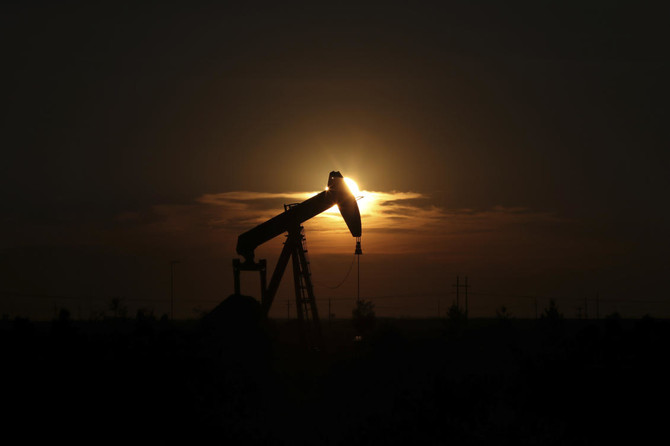
US crude output to overtake Saudi Arabia “very soon”
US crude output to overtake Saudi Arabia “very soon”


Latest updates


© 2026 SAUDI RESEARCH & PUBLISHING COMPANY, All Rights Reserved And subject to Terms of Use Agreement.