Daesh leader’s arrest prevented attacks in Lebanon: Interior minister

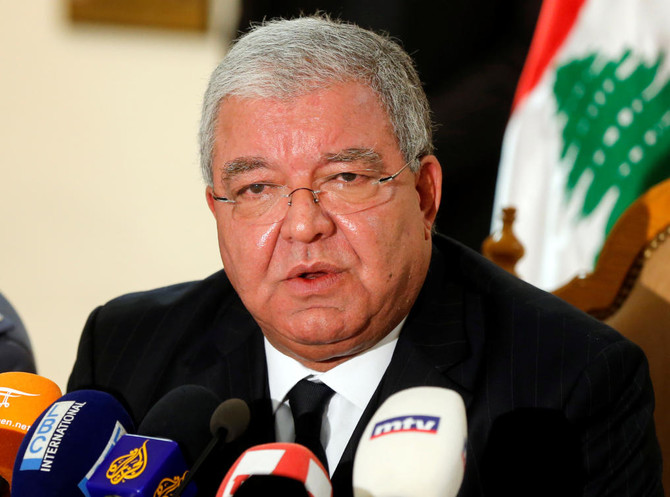
Lebanon’s Interior Minister Nohad Machnouk talks during a news conference in Beirut, Lebanon, January 19, 2018. (Reuters)
Updated 20 January 2018
Follow

Daesh leader’s arrest prevented attacks in Lebanon: Interior minister

BEIRUT: Lebanon’s interior minister said Internal Security Forces (ISF) in June 2017 arrested Abu Jaafar Al-Iraqi, a Daesh leader, preventing terrorist attacks during the Christmas holidays.

Nohad Machnouk visited the ISF directorate on Friday and was accompanied by Gen. Emad Othman, the directorate’s director-general, to congratulate its leadership on the “extraordinary efforts in carrying out that exceptional security operation.”

The minister held a press conference, during which a documentary about the operation and its implications was featured.

Al-Iraqi, who was living secretly in Lebanon, “was forced to work” for the ISF “for five months without Daesh’s leadership knowing of his arrest,” said Machnouk.

“A volunteer source was contacted to call him on a daily basis, and rented a highly monitored house for him in the mountains,” he added.

“The result was the disclosure of all terrorist attacks that were to be carried out during the past five months.”

Al-Iraqi said Daesh could not carry out any attacks in Lebanon due to the state’s military and security measures.

Machnouk said: “The security operation was named Safe Lebanon to assure the Lebanese people as well as Arabs that Lebanon’s security was managed in a highly professional manner.”

Aid trucks resume crossing Egypt-Gaza border after closure

Updated 2 sec ago
Follow

Aid trucks resume crossing Egypt-Gaza border after closure

  • More than 100 aid trucks crossed the Egyptian side of Gaza’s Rafah border crossing on Tuesday, two sources told AFP
RAFAH: More than 100 aid trucks crossed the Egyptian side of Gaza’s Rafah border crossing on Tuesday, two sources told AFP.
Israel closed all crossings into the Gaza Strip on Saturday, after it launched a joint attack on Iran with the United States.
It agreed to reopen the Kerem Shalom crossing, where trucks from Egypt are inspected, for the “gradual entry of humanitarian aid.”
“More than 100 United Nations aid trucks, including UNICEF’s, entered the Rafah border crossing” on Tuesday, a source at the border told AFP on Wednesday on condition of anonymity.
An official with the Egyptian Red Crescent, which coordinates aid deliveries, said the trucks “went through Rafah to the Kerem Shalom crossing,” where Israeli authorities did not send any back to Egypt — their procedure when aid shipments are rejected.
Both sources said no Palestinians were allowed through the crossing on Tuesday.
The Rafah crossing, the only gateway for Gazans to the outside world that does not pass through Israel, had reopened for a trickle of people on February 2, nearly two years after Israeli forces seized it.
A statement from the Red Crescent on Tuesday said the convoy included hundreds of tons of food, relief supplies and “fuel products to operate hospitals and vital facilities.”
The UN had warned its partners were “forced to ration fuel, prioritize life-saving operations” in the devastated Palestinian territory.
The Red Crescent official said another aid convoy was sent on Wednesday and was waiting to be allowed in.
The October peace deal between Israel and Palestinian militant group Hamas stipulates that 600 aid trucks should be allowed in per day.