NEW YORK: The US military will focus on threats from China, Russia and the “rogue states” of Iran and North Korea, according to a strategy document released on Friday that marks a shift from the fight against extremist militants.
The National Defense Strategy, the first of its kind since at least 2014, is a planning blueprint for the US Department of Defense that will likely be reflected in future budget requests. The Pentagon released an 11-page version of the plan on Friday.
While it highlights Moscow and Beijing as chief global military concerns, it will be pored over by Washington’s allies in the Middle East for signs of policy shifts on Syria and Iraq after the crumbling of Daesh’s self-declared caliphate.
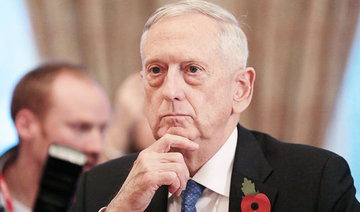
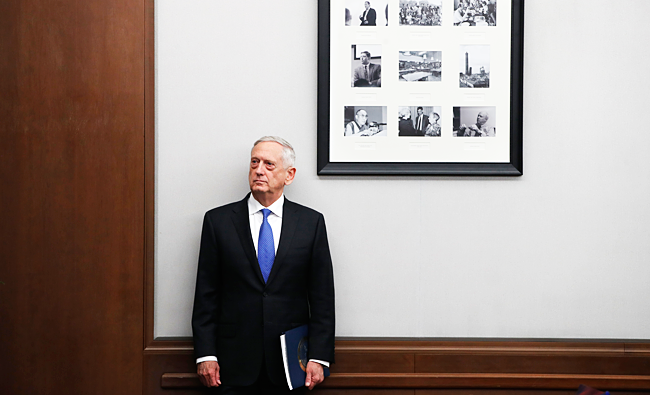
Speaking in Washington to launch the review, US Defense Secretary Jim Mattis accused Tehran and Pyongyang of destabilizing their respective regions by pursuing nuclear weapons or sponsoring terrorism.
“Rogue regimes like North Korea and Iran persist in taking outlaw actions that threaten regional and even global stability,” Mattis said.
“Oppressing their own people and shredding their dignity and human rights, they push their warped views outward.”
The unclassified summary of the strategy defines Iran as the “most significant challenge to Middle East stability” by using terrorism, proxy militias and arms to create an “arc of influence and instability while vying for regional hegemony.”
The document said: “The Department will sustain its efforts to deter and counter rogue regimes such as North Korea and Iran, defeat terrorist threats to the US, and consolidate our gains in Iraq and Afghanistan while moving to a more resource-sustainable approach.”
It added: “We will develop enduring coalitions to consolidate gains we have made in Afghanistan, Iraq, Syria, and elsewhere, to support the lasting defeat of terrorists as we sever their sources of strength and counterbalance Iran.”
His comments followed Rex Tillerson’s speech on Thursday, in which the secretary of state signalled an open-ended military presence in Syria as part of a broader strategy to prevent Daesh’s resurgence, challenge Syrian President Bashar Assad and curtail Iran’s influence.
Sigurd Neubauer, a Washington-based Middle East analyst, said US President Donald Trump had hired Mattis to run the Department of Defense because he wanted to challenge Tehran and bolster the region’s longstanding US allies.
“Mattis was selected in part for his expertise in the Middle East, where he witnessed Iran’s destructive role in Iraq after the 2003 invasion, and was alarmed by the Obama administration’s naive approach to negotiating the 2015 nuclear deal with Tehran,” Neubauer told Arab News.
“It’s therefore expected that the US National Defense Strategy, which cites Tehran as Washington’s premier regional adversary, would have Mattis’ fingerprints all over it. This outlook makes the Trump administration popular in Saudi Arabia, Israel and the UAE.”
Globally, the strategy review represents a toughening resolve by the Trump administration to address challenges from Russia and China, despite the president’s calls for improved ties with Moscow and Beijing.
Pentagon officials told reporters that, while cash-strapped, Russia is far more brazen than China in its use of military power, having annexed Ukraine’s Crimean peninsula in 2014 and intervened in Syria to support its ally Assad.
China was described as economically and militarily ascendant by the document, and has embarked on far-reaching military modernization that is in “deep contravention to our interests,” said Deputy Assistant Secretary of Defense Elbridge Colby.
The document describes international alliances as critical to the US military, by far the world’s best-funded.
But it also stresses a need for burden-sharing — a nod to Trump’s haranguing of allies who, he says, let Washington pick up the military bills.
In spending terms, America’s military outlay per year far outpaces China and Russia, the rivals cited by Mattis.
The US spends $587.8 billion per year on its military, China $161.7 billion and Russia $44.6 billion.